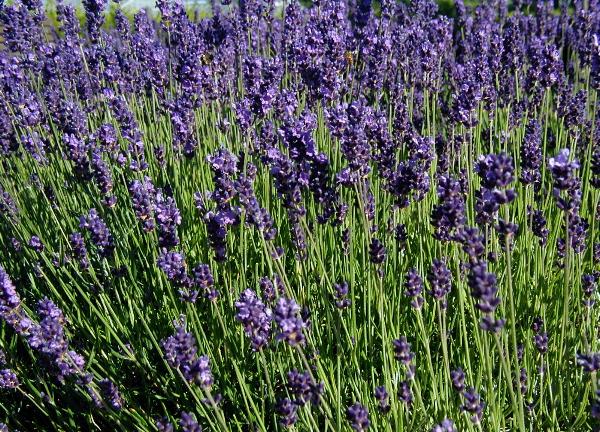
Photo: Sten Porse, CC BY-SA 3.0 · source

Dwarf shrub · Mint family (Lamiaceae)
English lavender
Lavandula angustifolia · also: Lavender, Common lavender
English lavender is a low, grey-green shrublet of 30–80 cm from the Mediterranean, with narrow, strongly aromatic leaves and, from June to August, bluish-purple flower spikes on long stalks. Bees and bumblebees adore it. It loves full sun and a dry, chalky, well-drained soil, and hates wet feet in winter. Pruned every year after flowering, it stays compact for years; it will not regrow from old, bare wood.
Light
Full sun
warm and bright
Moisture
Dry
tolerates drought
Legal basis
Any garden soil
neutral to chalky
Hardiness
Throughout Belgium
no protection needed
Size
0.3–0.8 m
tall
Flowering
June–August
| Pruning months | April and August–September |
|---|---|
| Height | 0.3–0.8 m |
| Native to Belgium | No, planted |
| Good for bees, butterflies and birds | Yes, for bees and butterflies |
| Poisonous to people and pets | Not known to be poisonous |
| Flowering | June–August |
Identify
English lavender: how do you recognise it?
- Habit
- Low, rounded shrublet 30–80 cm tall and wide, with a woody base.
- Leaf
- Opposite, narrow and linear, 2–5 cm, grey-hairy and strongly aromatic.
- Bark
- Woody base with peeling bark.
- Flower
- Bluish-purple spikes on long stalks, June–August; bees and bumblebees love them.
- Fruit
- Small nutlets.
- Difference from rosemary
- Rosemary has needle-like, dark green leaves.
Flowering: June–August · Harvest and fruit: June–August · Pruning: April and August–September
Identify by feature: Long, narrow leaves · Purple or blue flowers
Looks like it, but isn’t
- Rosemary: needle-like, dark green leaves.
In your garden
Why grow it?
- One of the best plants for bees and bumblebees.
- Fragrant leaves and fragrant flowers, fresh or dried.
- A low, evergreen hedge or edging along paths.
- Needs no fertiliser and little water: ideal for a dry, sunny spot.
English lavender: where does it grow best?
- Full sun: the warmer, the more scent and flowers.
- Dry, well-drained, preferably chalky soil; poor soil is no problem.
- No wet feet: on heavy clay, plant it in a raised bed or mix coarse sand or gravel into the soil.
- Lovely along a path, as a low hedge, in a gravel garden or in a large pot.
- Light
- Full sun
- Legal basis
- Any garden soil
- Moisture
- Dry
- Size
- 0.8 m tall, 0.8 m wide
- Hardiness
- Throughout Belgium, no protection needed
Goes well with
- Rosemary: Also Mediterranean, evergreen and fragrant, for the same sunny, dry spot.
- Garden thyme: A low, fragrant cushion for the edge, loved by bees.
- Lavender-cotton: Grey foliage and yellow button flowers: a lovely contrast with purple lavender.
- Common rock-rose: A low, yellow-flowered plant for the same dry, chalky soil.
Good and bad companions
Best kept away from
- Do not plant under the dense crown of these trees: norway spruce, european silver fir, nordmann fir, douglas fir, yew, horse chestnut, norway maple, sycamore
Maintenance
English lavender: when and how to plant it?
- Plant in April–May, so it is well rooted before the wet winter.
- For a hedge: plant every 30–40 cm.
- Varieties such as ‘Hidcote’ (dark purple) and ‘Munstead’ (lighter purple) stay low and compact.
- Don’t plant it deeper than it was growing, and if you like, cover the soil with gravel, not bark or compost.
- In a pot: use compost mixed with grit or sand, and make sure there is a drainage hole.
Care
- Watering
- Only in the first weeks after planting, and in pots; after that it looks after itself.
- Feeding
- Not needed: on rich soil it becomes floppy and less fragrant.
- Harvest
- Cut flower stalks for drying when the first flowers open, and dry them in bunches, upside down, in an airy, shady place.
- Renewing
- After 8–10 years a plant often becomes woody and bare: then replace it with a young plant.
Tip: Brush your hand over the plant as you walk past: the scent sits in tiny glands on the leaves and is released when touched.
English lavender: when to prune it?
Pruning months: April and August–September.
When: After flowering (August–early September) and lightly in April.
How:
- After flowering, cut off the flower stalks and a little of the foliage, so the plant stays compact.
- In April, lightly trim the plant into shape, only in the green foliage.
- Start young: a plant that is pruned every year stays full right down to the base.
Caution: Never cut back into bare, old wood: lavender won’t regrow from it.
Propagation
- Cuttings
- In summer, take 8–10 cm cuttings from non-flowering shoots, preferably with a heel; they root in a sandy mix.
- Sowing
- You can sow in spring, but seedlings differ from the parent plant in colour and shape.
English lavender: how does it get through the winter?
Hardy throughout Belgium: no protection needed.
- Hardy, but sensitive to wet soil: in winter it dies more often from wet than from frost.
- Don’t prune late in autumn: let the plant go into winter with its foliage.
Diseases and pests
- Root rot: The plant turns grey and dies back, often after a wet winter. Replant in a drier, better-drained spot.
- Bare and woody: Only flowers at the top and splays open. Prune every year; replace an old, bare plant.
- Rosemary beetle: Small, shiny beetles striped metallic green and purple, and their larvae, eat leaves and flowers. Shake them off over a bucket.
- Cuckoo spit: Blobs of white froth on the stems in May–June: harmless froghopper nymphs. Hose them off if they bother you.
Through the year
- April: Light shaping in the green foliage; planting.
- May: Planting and potting up.
- June: Flowering begins: bees and bumblebees.
- July: Full flower; cut stalks for drying.
- August: Pruning after flowering: flower stalks and a little foliage.
- September: Last pruning in early September; take cuttings.
- November: Move pots to a dry, sheltered spot.
Use
What can you use it for?
- Garden and landscape
- Low, fragrant hedge or edging along paths, in sunny, dry spots.
- For wildlife
- One of the best plants for bees and bumblebees.
- Also used for
- Dried flowers for scented sachets, tea and cooking.
Edible and useful
- Flowers (June–August)
- Cut the flower stems on a dry morning when about a third of the florets are open: that is when the scent is strongest. Use them in scented sachets, a bath bag or oil, and sparingly in the kitchen: in sugar, biscuits, honey, syrup or tea. A little goes a long way; too much tastes of soap.
- Storing
- Tie small bunches and hang them upside down in a dark, dry, airy place for 1 to 2 weeks. Then rub off the florets and keep them in a closed jar away from the light; they stay fragrant for a year.
Caution: For food and drink, only use true lavender (Lavandula angustifolia). Lavandin (Lavandula × intermedia) and French lavender (Lavandula stoechas) contain more camphor and taste bitter. Never swallow lavender essential oil and do not apply it undiluted to the skin. Test home-made oil on a small patch of skin first.
Eating and using is at your own risk: see the terms of use.
Recipes
- Lavender oil for skin and bath (Skin and body care · ± 250 ml · 15 min + 3–4 weeks infusing)
- Lavender sugar (Other · 1 jar of 250 g · 5 min + 1–2 weeks infusing)
- Lavender syrup (Syrup · ± 500 ml · 15 min + 30 min steeping)
- Lavender shortbread (Dish · ± 24 biscuits · 20 min + 30 min chilling + 20 min oven)
Good for wildlife
- Bees
- Nectar and pollen for honeybees and wild bees.
- Bumblebees
- Nectar and pollen for bumblebees, also from deep flowers and early in spring.
- Butterflies
- Nectar for butterflies.
You and this species
Did you know?
- Dried flowers in little bags keep moths out of the wardrobe.
- Many lavender fields in Provence are actually lavandin, a larger hybrid of English lavender and spike lavender.
- Despite the name English lavender, it grows wild in the mountains of the western Mediterranean, such as the Pyrenees.
- The famous purple fields of Provence are often planted with lavandin: a cross between English lavender and spike lavender that yields more oil.