Side by side
Lavender or rosemary? How to tell them apart
Lavandula angustifolia · Salvia rosmarinus
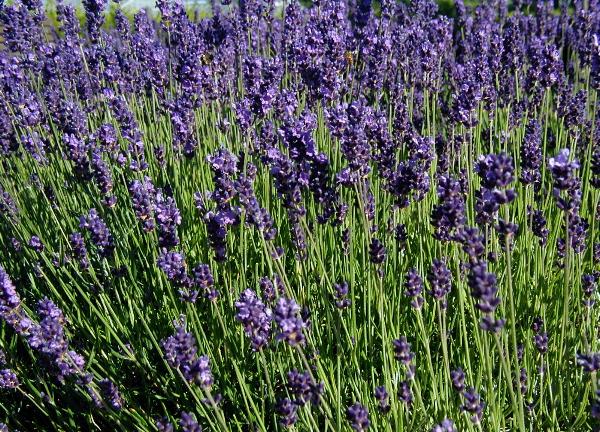
You can tell a lavender by its grey, soft, linear leaves and its purple flower spikes on long, bare stems in summer; a rosemary has needle-like, leathery leaves, dark green above and white-felted below, and pale blue flowers in the leaf axils in spring.
Rub a leaf: soft and grey on lavender, stiff, glossy dark green and needle-like on rosemary. The flowering gives them away too: lavender flowers in summer with spikes on long stems, rosemary as early as March–May with flowers among the leaves.


| Lavender | Rosemary | |
|---|---|---|
| Leaves | Opposite, narrow and linear, 2–5 cm, grey-hairy and strongly aromatic. | Opposite, 2–4 cm, narrow, needle-like and leathery; dark green above, white-felted below, with a rolled-under edge. |
| Flowering | Bluish-purple spikes on long stalks, June–August; bees and bumblebees love them (June–August). | Pale blue, two-lipped flowers in the leaf axils, March–May, and often again in autumn (March–May). |
| Fruit | Small nutlets. | Small nutlets. |
| Bark | Woody base with peeling bark. | Greyish-brown, woody and often twisted stems. |
| Shape and height | Dwarf shrub, 0.3–0.8 m | Dwarf shrub, 0.5–1.5 m |
| Site | Full sun, any garden soil, dry | Full sun, any garden soil, dry |
| Native to Belgium | No, planted | No, planted |
| Good for bees, butterflies and birds | Yes, for bees and butterflies | Yes, for bees |
| Poisonous to people and pets | Not known to be poisonous | Not known to be poisonous |
| Pruning months | April and August–September | May–June |
The best feature in each season
- Spring
- Rosemary flowers in March–May with pale blue, lipped flowers: an early source of food for bees. Lavender is only just starting into growth then, with fresh greyish-green leaves.
- Summer
- Lavender flowers in June–August with blue-purple spikes on long stems, alive with bees, bumblebees and butterflies. Rosemary has finished flowering by then and mainly grows on.
- Autumn
- Rosemary often flowers a second time in autumn. Lavender is pruned after flowering, in August–September, to just above the old wood.
- Winter
- Both stay green and dislike wet feet in winter. Turn a rosemary leaf over: the edge is rolled under and the underside white-felted.
Where do they grow?
Both come from the Mediterranean and grow here in gardens, herb gardens and pots. They love full sun and dry, well-drained soil.
Which one for your garden?
- Put them both in the sunniest, driest spot in the garden: together they feed bees from March to August. In heavy, wet soil the roots rot in winter: mix in sand or gravel, or choose a pot.
- Rosemary is used in the kitchen, lavender mostly for its scent. Prune lavender every year after flowering, but never into the bare old wood: it will not regrow from there.
Did you know? Botanists recently moved rosemary into the sage genus: it is now Salvia rosmarinus instead of Rosmarinus officinalis.
Read on
- Plant profile: Lavender
- Plant profile: Rosemary
- Lavender: when and how to prune
- Rosemary: when and how to prune
- Identification key: the question that separates them