Side by side
English lavender or common sage? How to tell them apart
Lavandula angustifolia · Salvia officinalis
You can tell English lavender by its narrow, linear leaves of 2–5 cm and its blue-purple flower spikes on long, bare stalks; common sage has oblong, felted, finely wrinkled leaves of 3–8 cm and lipped flowers in whorls along upright spikes.
The leaf says it all: narrow and grey-downy on lavender, broader, soft, felted and wrinkled like suede on sage. Rub it: lavender smells sweet and floral, sage spicy and sharp. Both are small grey-green shrubs from the Mediterranean, with opposite leaves and a woody base.
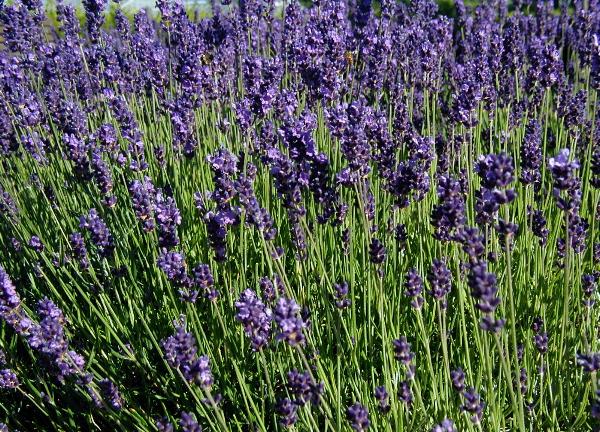
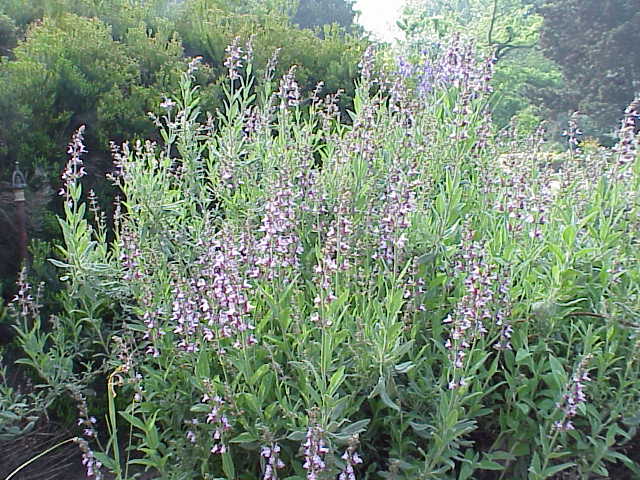


| English lavender | Common sage | |
|---|---|---|
| Leaves | Opposite, narrow and linear, 2–5 cm, grey-hairy and strongly aromatic. | Opposite, oblong, 3–8 cm, finely scalloped, greyish-green and felted, with a finely wrinkled surface; strongly aromatic. |
| Flowering | Bluish-purple spikes on long stalks, June–August; bees and bumblebees love them (June–August). | Bluish-purple two-lipped flowers (2–3 cm) in whorls on upright spikes, June–July (June–July). |
| Fruit | Small nutlets. | Small nutlets. |
| Bark | Woody base with peeling bark. | Square, felted stems that become woody at the base. |
| Shape and height | Dwarf shrub, 0.3–0.8 m | Dwarf shrub, 0.4–0.7 m |
| Site | Full sun, any garden soil, dry | Full sun, any garden soil, dry |
| Native to Belgium | No, planted | No, planted |
| Good for bees, butterflies and birds | Yes, for bees and butterflies | – |
| Poisonous to people and pets | Not known to be poisonous | Not known to be poisonous |
| Pruning months | April and August–September | April and July |
The best feature in each season
- Spring
- In April both start into growth. Sage produces broad, grey-green leaves on square, felted stems; lavender forms a mound of narrow, grey leaves.
- Summer
- Sage flowers in June–July, with blue-purple lipped flowers of 2–3 cm in whorls along the spike; lavender flowers from June to August, with dense spikes of small flowers on long, bare stalks above the foliage. Bees and bumblebees visit both.
- Autumn
- Lavender now carries its faded spikes, which you cut off; sage stays covered in leaves to pick for the kitchen until the frosts.
- Winter
- Both keep their grey-green leaves in winter, although sage’s become a little dull. In winter wet soil is their worst enemy, even more than frost.
Where do they grow?
Both come from the Mediterranean, where they grow wild on dry, sunny, often chalky slopes. Here they grow in gardens: lavender as a low hedge, along a path or in a gravel garden, sage in the herb garden or in a pot by the kitchen door.
Which one for your garden?
- Both want full sun and dry, free-draining soil; on heavy clay, plant them in a raised bed or mix coarse sand or grit into the soil. Lavender gives scent and flowers, sage mainly leaves for the kitchen.
- Lavender will not regrow from old, bare wood: prune it every year after flowering, but never back into bare wood. Sage becomes woody after 4–5 years and is then best replaced; do not drink sage every day in large amounts or during pregnancy, as it contains thujone.
Did you know? The name sage comes from the Latin salvus, ‘healthy’ or ‘safe’: in the Middle Ages sage was a medicinal herb found in every monastery garden.
Read on
- Plant profile: English lavender
- Plant profile: Common sage
- English lavender: when and how to prune
- Common sage: when and how to prune
- Identification key