Side by side
Dog rose or Japanese rose? How to tell them apart
Rosa canina · Rosa rugosa
You can tell a dog rose by its long, arching stems with hooked prickles, its hairless, unwrinkled leaflets and its elongated hips; a Japanese rose is a dense, low shrub covered in fine prickles, with deeply wrinkled leaves, large flowers and fat, flattened hips.
Feel the leaf: thick, glossy and deeply wrinkled on the Japanese rose, thin and smooth on the dog rose. The Japanese rose is densely covered in fine prickles and bristles, the dog rose has fewer, but strongly hooked prickles.
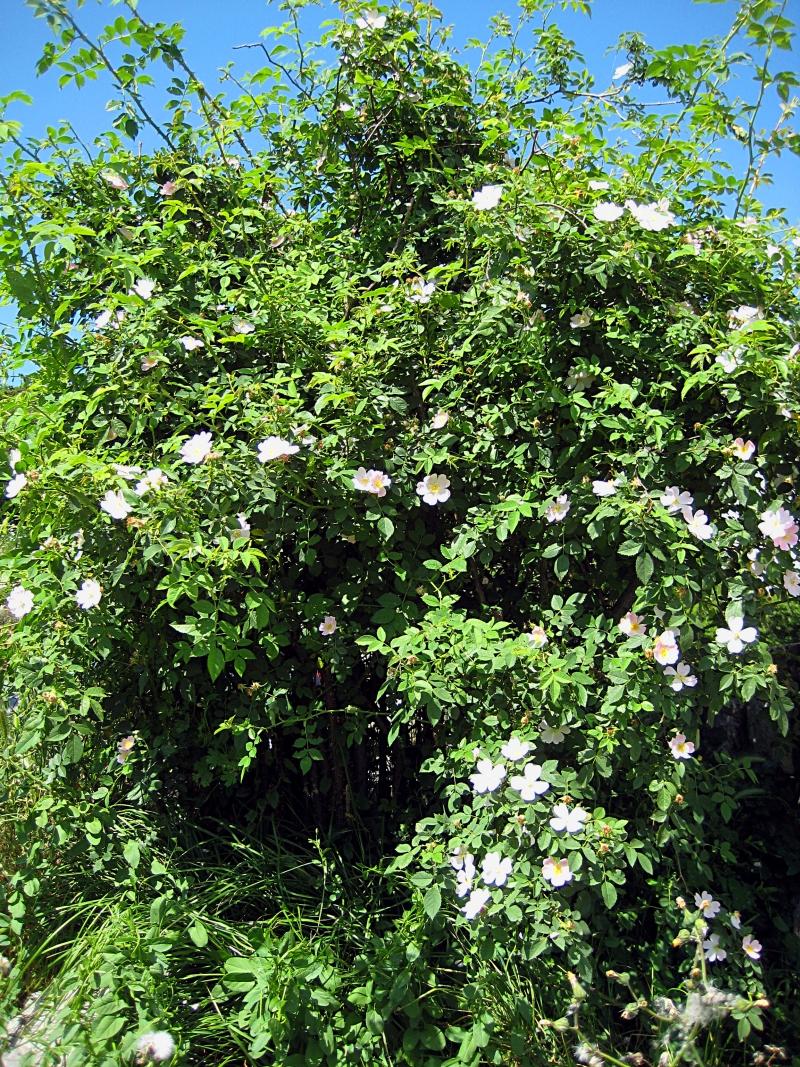


| Dog rose | Japanese rose | |
|---|---|---|
| Leaves | Alternate, pinnate with 5–7 toothed leaflets; stipules at the base. | Alternate, pinnate with 5–9 thick, deeply wrinkled, glossy leaflets; yellow autumn colour. |
| Flowering | Single, pale pink to white flowers with five petals, June (June). | Large (6–9 cm), fragrant, pink, purplish-red or white flowers from June to September (June–September). |
| Fruit | Red rose hips, rich in vitamin C (tea, jam); the hairs inside are itchy. | Large, flattened, tomato-red hips (2–3 cm), rich in vitamin C. |
| Bark | Green to red stems with hooked prickles. | Stems densely covered in fine prickles and bristles. |
| Shape and height | Shrub, 2–4 m | Shrub, 1–2 m |
| Site | Sun or partial shade, any garden soil, normal | Full sun, any garden soil, dry |
| Native to Belgium | Yes | No, naturalised |
| Good for bees, butterflies and birds | Yes, for bees, butterflies and birds | Yes, for bees |
| Poisonous to people and pets | Not known to be poisonous | Not known to be poisonous |
| Pruning months | February–March | February–March |
The best feature in each season
- Spring
- Both come into leaf in April. The dog rose sends out long shoots that scramble over other shrubs; the Japanese rose stays a dense, low shrub of 1–2 m.
- Summer
- The dog rose flowers in June, for a few weeks, with single pale pink to white flowers; the Japanese rose flowers from June to September with large, scented pink, purple-red or white flowers.
- Autumn
- The hips are very different: elongated and orange-red on the dog rose, large, flattened and tomato red (2–3 cm) on the Japanese rose. The leaves of the Japanese rose turn yellow.
- Winter
- Hips hang on for a long time, as food for blackbirds, thrushes and mice. The stems show the difference: densely covered in fine prickles and bristles on the Japanese rose, with scattered, strong hooks on the dog rose.
Where do they grow?
The dog rose is native and grows everywhere in hedges, copses, woodland edges and scrub. The Japanese rose comes from East Asia; it was planted as a hedge and in the dunes, but on the coast it now crowds out the native dune plants.
Which one for your garden?
- Choose the native dog rose for a natural hedge: flowers for bees, hips for birds and a food plant for many insects. It needs room, because its stems grow 2–4 m long.
- The Japanese rose makes a sturdy, easy hedge, but on the coast it is an invasive species: do not plant it near the dunes or nature reserves, and never dump clippings in the countryside.
Did you know? Children once made itching powder from the hairs around the seeds in rose hips.
Read on
- Plant profile: Dog rose
- Plant profile: Japanese rose
- Dog rose: when and how to prune
- Japanese rose: when and how to prune
- Identification key: the question that separates them
Also looks like
- Sweet-briar or dog rose
- Burnet rose or Japanese rose
- Field-rose or dog rose
- Bramble or dog rose
- Burnet rose or dog rose
- Raspberry or dog rose