Side by side
Sweet-briar or dog rose? How to tell them apart
Rosa rubiginosa · Rosa canina
You can tell a sweet-briar by its leaves, which smell of apples when you rub them thanks to the sticky glands on the underside, and by its bright pink flowers; a dog rose has leaves without scented glands, larger pale pink to white flowers and grows taller.
Rub a leaflet and sniff: on the sweet-briar it smells of fresh apples, especially after a shower or on a warm evening, while on the dog rose you smell almost nothing. Turn the leaf over: the underside of the sweet-briar is covered in tiny, sticky, reddish-brown glands, that of the dog rose is smooth. At 1.5–3 m the sweet-briar also stays a little smaller than the dog rose, whose arching stems reach 2–4 m.

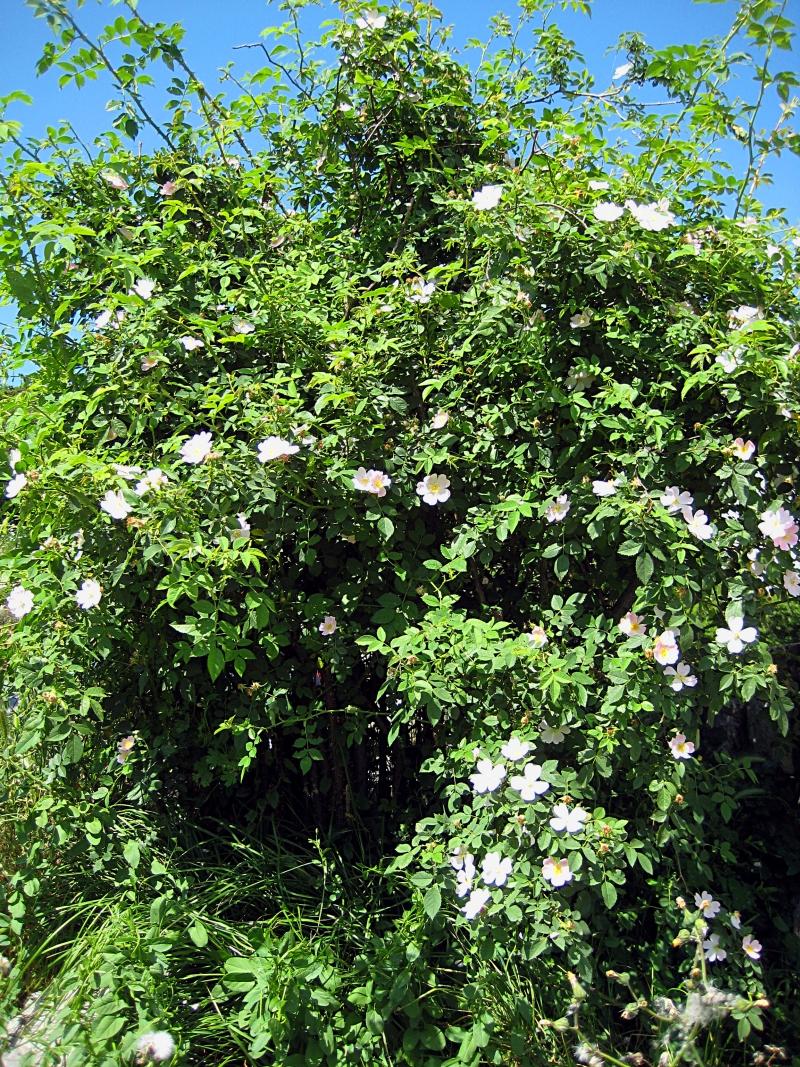


| Sweet-briar | Dog rose | |
|---|---|---|
| Leaves | Alternate, pinnate with 5–7 small (1–3 cm), roundish, double-toothed leaflets; underside densely covered with sticky, reddish-brown glands that smell of apple. | Alternate, pinnate with 5–7 toothed leaflets; stipules at the base. |
| Flowering | Bright pink flowers (2–3 cm) with five petals, in June–July (June–July). | Single, pale pink to white flowers with five petals, June (June). |
| Fruit | Oval, orange-red hips (1.5–2 cm), often with glandular hairs on the stalk, in September–October. | Red rose hips, rich in vitamin C (tea, jam); the hairs inside are itchy. |
| Bark | Stems with stout, hooked prickles, often mixed with finer prickles and glandular hairs. | Green to red stems with hooked prickles. |
| Shape and height | Shrub, 1.5–3 m | Shrub, 2–4 m |
| Site | Full sun, any garden soil, dry | Sun or partial shade, any garden soil, normal |
| Native to Belgium | Yes | Yes |
| Good for bees, butterflies and birds | – | Yes, for bees, butterflies and birds |
| Poisonous to people and pets | Not known to be poisonous | Not known to be poisonous |
| Pruning months | February–March | February–March |
The best feature in each season
- Spring
- The young leaves give the sweet-briar away as early as April and May: they smell of apples and feel slightly sticky. The dog rose comes into leaf at the same time, with smooth, scentless leaflets.
- Summer
- The dog rose flowers in June, in pale pink to white; the sweet-briar flowers in June–July, with smaller (2–3 cm), bright pink flowers. On warm evenings an apple scent hangs around the sweet-briar.
- Autumn
- Both bear red hips. Those of the sweet-briar are oval and orange-red, often with glandular hairs on the stalk; those of the dog rose are elongated, on a smooth stalk.
- Winter
- Without leaves, look at the prickles: the sweet-briar has strong, hooked prickles mixed with finer bristles and glandular hairs; the dog rose has only scattered, curved prickles on long, arching stems.
Where do they grow?
The dog rose is the most widespread wild rose in Belgium and the Netherlands, found in hedgerows, woodland edges, copses and scrub on almost any soil. The sweet-briar is native too, but has become rare in the wild; it grows in sunny, dry, chalky places such as limestone dunes and slopes.
Which one for your garden?
- Both are native roses for an informal hedge: flowers for bees and bumblebees, hips for the birds. The sweet-briar suits a smaller garden better and gives you its apple scent for free; plant it in a sunny spot you walk past after rain, but not right next to a narrow path, as its prickles are fierce.
- Choose the dog rose for a mixed hedge or shelterbelt on ordinary soil, even in partial shade; the sweet-briar wants full sun and dry, free-draining soil. Wear sturdy gloves for both, and remove the itchy hairs from the hips before making jam or tea.
Did you know? The name sweet-briar refers to the sweet scent of the leaves; Shakespeare calls it eglantine in A Midsummer Night’s Dream.
Read on
- Plant profile: Sweet-briar
- Plant profile: Dog rose
- Sweet-briar: when and how to prune
- Dog rose: when and how to prune
- Identification key
Also looks like
- Dog rose or Japanese rose
- Burnet rose or sweet-briar
- Field-rose or dog rose
- Bramble or dog rose
- Burnet rose or dog rose
- Raspberry or dog rose