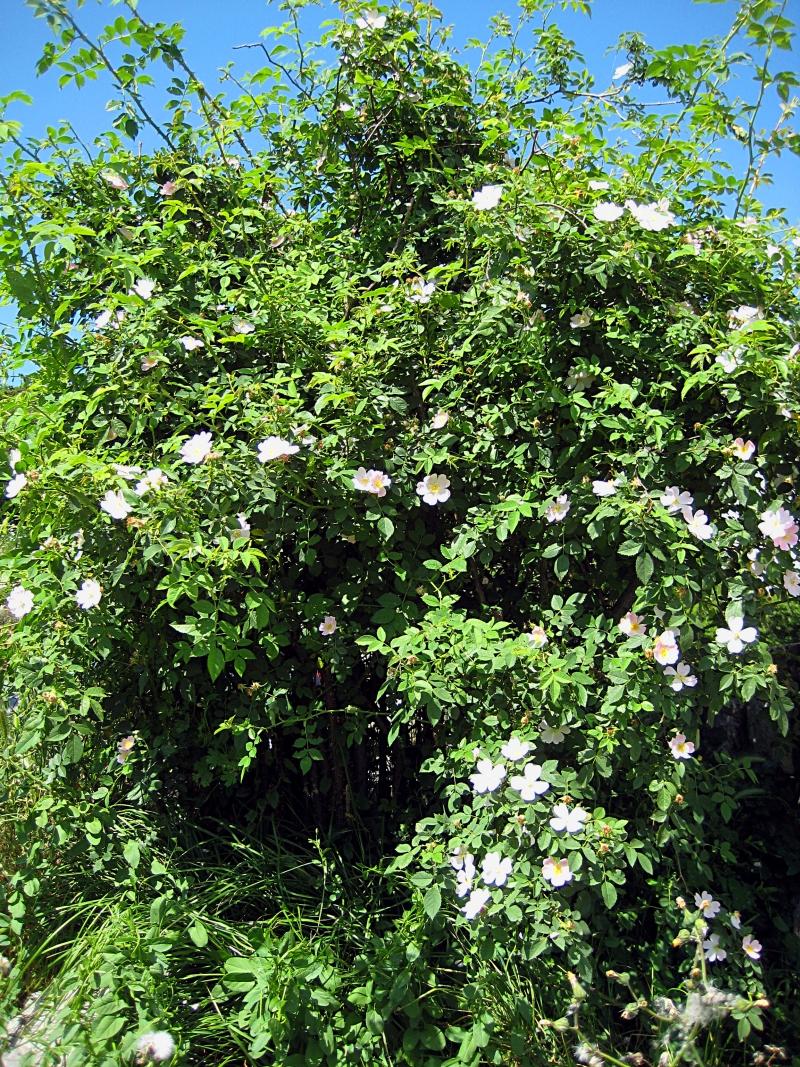
Photo: Roberta F., CC BY-SA 3.0 · source

Shrub · Rose family (Rosaceae)
Dog rose
Rosa canina · also: Wild rose
The dog rose is the most widespread wild rose in Belgium and the Netherlands: a shrub of 2–4 m with long, arching stems covered in hooked prickles. In June it bears simple, pale pink to white flowers that attract bees, bumblebees and hoverflies. In autumn come red rose hips, rich in vitamin C, for tea and jam, and for birds well into winter. It belongs in a mixed native hedge or hedgerow and needs little pruning.
Caution: The stems are covered in sharp, hooked prickles: wear sturdy gloves. The hairs around the seeds inside the hips itch on the skin and irritate the mouth and throat: remove them thoroughly before using the hips.
Light
Sun or partial shade
preferably some sun
Moisture
Normal
no wet feet
Legal basis
Any garden soil
any pH
Hardiness
Throughout Belgium
no protection needed
Size
2–4 m
tall
Flowering
June
| Pruning months | February–March |
|---|---|
| Height | 2–4 m |
| Native to Belgium | Yes |
| Good for bees, butterflies and birds | Yes, for bees, butterflies and birds |
| Poisonous to people and pets | Not known to be poisonous |
| Flowering | June |
Identify
Dog rose: how do you recognise it?
- Habit
- Shrub of 2–4 m with long, arching stems; sometimes scrambles through other shrubs.
- Leaf
- Alternate, pinnate with 5–7 toothed leaflets; stipules at the base.
- Bark
- Green to red stems with hooked prickles.
- Flower
- Single, pale pink to white flowers with five petals, June.
- Fruit
- Red rose hips, rich in vitamin C (tea, jam); the hairs inside are itchy.
- Difference from raspberry and bramble
- Raspberry has leaflets with white-felted undersides and straight canes; bramble has strong prickles and blackberries.
Flowering: June · Harvest and fruit: June and September–November · Pruning: February–March
Identify by feature: Pinnate leaves · Red berries · Thorns or prickles
Looks like it, but isn’t
- Raspberry Rubus idaeus: leaflets with white-felted undersides and straight canes. Difference from raspberry
- Bramble Rubus: strong prickles and blackberries. Difference from bramble
In your garden
Why grow it?
- Native and tough: fits into any mixed hedge or hedgerow.
- Flowers in June for bees, bumblebees and hoverflies.
- Red hips for tea and jam, and winter food for birds.
- The prickly stems give birds a safe nesting place.
Dog rose: where does it grow best?
- Sun to partial shade; in the sun it flowers best and sets the most hips.
- Any ordinary soil, including chalky or sandy; no waterlogging.
- Allow 3 m width: suitable for a mixed hedge, hedgerow or wild edge, less so for a small border.
- Light
- Sun or partial shade
- Legal basis
- Any garden soil
- Moisture
- Normal
- Size
- 3 m tall, 3 m wide
- Hardiness
- Throughout Belgium, no protection needed
Goes well with
- Hawthorn: Flowers in May, just before the rose: together a native hedge full of blossom, berries and hips.
- Blackthorn: White blossom in March and a thorny thicket where birds nest safely.
- Elder: Flowers and berries for the same wild edge.
- Common honeysuckle: Climbs through the rose and is fragrant in the evening.
Good and bad companions
Goes well with
- Together a mixed native hedge, good for birds and insects: hawthorn, blackthorn, hazel, common dogwood, guelder rose, wild privet, field maple, hornbeam
- Suits the woodland edge or the light shade of: ginkgo, box elder, ash, honey locust, field maple, silver maple
Maintenance
Dog rose: when and how to plant it?
- Plant from November to March, bare-root; that is how it establishes best.
- In a mixed hedge: put a dog rose here and there among hawthorn, blackthorn and hazel.
- After planting, cut the stems back to 20–30 cm: it will then shoot vigorously from the base.
- Water after planting and during dry spells in the first year.
Care
- Watering
- Only in dry spells during the first year.
- Feeding
- Not needed; on rich soil it mainly grows long stems.
- Prickles
- Wear sturdy gloves for any work on the shrub.
- Harvest
- Pick the hips when they are fully red and slightly soft, from September–October; after a first frost they become softer.
Tip: For jam: halve the hips and scrape out the seeds and hairs thoroughly, or cook them whole and strain the pulp through a fine cloth.
Dog rose: when to prune it?
Pruning months: February–March.
When: End of winter.
How:
- Thin out old, greying stems at the base; young stems flower and fruit best.
- Don’t cut back every stem, or there will be no hips.
- Overlong stems hanging over a path can be shortened to a side shoot.
Caution: Don’t prune during the nesting season, and leave the hips for the birds in autumn.
Propagation
- Sowing
- In autumn, take the seeds from ripe hips and sow them outdoors in a pot; they often only germinate after one or two winters.
- Cuttings
- In autumn, push 20–25 cm lengths of one-year-old wood into the ground; some of them will root.
Dog rose: how does it get through the winter?
Hardy throughout Belgium: no protection needed.
- Fully hardy.
- The hips hang on well into winter: winter food for blackbirds, thrushes and fieldfares.
Diseases and pests
- Robin’s pincushion: Red, hairy balls on the stems: the work of a tiny gall wasp. Harmless, and lovely to look at.
- Aphids: Green aphids on the young shoots in spring. Ladybirds and tits clear them up.
- Powdery mildew: White coating on the leaves, especially in late summer. A wild rose copes with it well; clear up affected leaves.
Through the year
- February: Thinning: remove old stems at the base.
- March: Last month for pruning and planting.
- May: First buds; watch for aphids on the young shoots.
- June: Flowering: bees and hoverflies on the flowers.
- September: Hips turn red.
- October: Pick hips for tea or jam.
- November: Planting; leave the hips for the birds.
Use
What can you use it for?
- Food and drink
- Rosehips for tea and jam, once the seeds and hairs have been removed.
- For wildlife
- Flowers for insects, hips for birds; ideal in a mixed hedge.
Edible and useful
- Flowers (June)
- In June, on a dry morning, pick some of the pale pink petals; leave plenty of flowers for hips and insects. They are edible and give a light rose scent to syrup, sugar or a salad.
- Fruit (September–November)
- Harvest rose hips from late September, when they are bright red and still firm, or after the first frost, when they are softer and sweeter. They are rich in vitamin C and make tea, syrup, purée and jam. The seeds and their itchy hairs must always be removed.
- Storing
- Dry halved, deseeded hips on a rack or in the oven at 40–50 °C until hard, and keep them in a closed jar. Whole hips can be frozen, which also softens them. Dry petals spread out on paper in the shade.
- Fermenting
- Rose hip wine is an old country recipe: the hips are fermented with sugar, water and yeast.
Caution: The seeds sit in a layer of fine hairs that irritate the mouth, throat and gut (children once used them as itching powder): remove them carefully and strain teas and syrups through a fine cloth or coffee filter. Only pick hips from wild or unsprayed roses, away from busy roads. Do not confuse the red hips with the poisonous berries of spindle, yew or honeysuckle, for example.
Eating and using is at your own risk: see the terms of use.
Recipes
- Rose hip tea (Tea · 1 teapot (± 4 cups) · 5 min + 10 min simmering)
- Rose hip syrup (Syrup · ± 750 ml · 1 hour + 2 rounds of draining)
- Rose petal sugar (Other · ± 250 ml · 20 min + 1–2 days drying)
- Rose hip soup (Dish · 4 servings · 1 hr)
Good for wildlife
- Birds
- Berries, seeds or insects as food, or a place to nest.
- Bees
- Nectar and pollen for honeybees and wild bees.
- Bumblebees
- Nectar and pollen for bumblebees, also from deep flowers and early in spring.
- Caterpillars
- Host plant: caterpillars of butterflies or moths eat the leaves.
- Ladybirds
- Aphids on the plant are food for ladybirds and their larvae.
You and this species
Did you know?
- Children used to make itching powder from the hairs inside the hips.
- Many garden roses are grafted onto a dog rose rootstock: wild shoots at the base of a garden rose are often dog rose.
- The name ‘canina’ (of the dog) is said to come from an old belief that the root cured rabies.
- The name dog rose may go back to the Roman writer Pliny, who claimed the root cured the bite of a rabid dog.
- The red, hairy balls sometimes seen on the stems are galls caused by a gall wasp. In Dutch they are called ‘sleep apples’: people once put them under their pillow to sleep well.