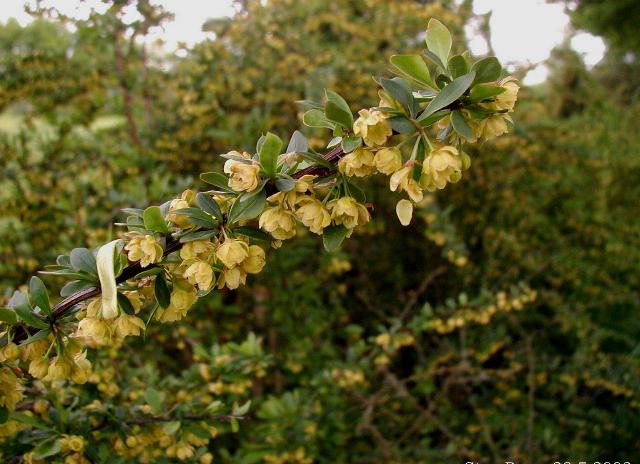
Photo: Sten Porse, CC BY-SA 3.0 · source

Pruning guide · Shrub
Japanese barberry: when and how to prune
Berberis thunbergii
Prune a Japanese barberry after flowering, in June–July, and if needed give a hedge another trim in late August–September: trim a hedge into shape, and on a free shrub saw off an old branch at the base now and then.
The Japanese barberry (Berberis thunbergii) is a dense, thorny shrub of 1–2 m, popular as a low hedge in green, red or yellow. It tolerates pruning well and needs little care. But it is a non-native with a downside: in North America it overruns woodland, and here too birds occasionally spread the berries. So pruning also has that aim: trim the hedge before the berries ripen, and never plant it next to woodland or nature areas.
| Pruning months | June–September |
|---|---|
| Nesting season (15 March–15 August) | Take care in June–August |
| Flowering | April–May |
| Good for bees, butterflies and birds | Yes, for bees and birds |
| Native to Belgium | No, planted |
Japanese barberry: when to prune it?
Trim a hedge after flowering, in June–July. That keeps it in shape, and at the same time removes a large part of the young berries.
If needed, trim again in late August–September, before the berries are ripe and red.
Prune a free-growing shrub after flowering, and only lightly.
What else to prune in those months? June · July · August · September
Japanese barberry: how to prune it?
- Wear thick gloves and long sleeves: the thorns are sharp.
- Trim a hedge into shape, slightly narrower at the top than at the bottom, so the base gets light.
- On a free shrub, saw an old branch off at the base now and then, so it stays young and dense.
- Lay a sheet under the hedge: otherwise the clippings keep pricking in the lawn for a long time.
- Pull up seedlings in the garden and nearby, and dig out unwanted shrubs, roots and all.
How much to cut, and how often?
- A hedge: one or two trims a year.
- A free shrub: an old branch every few years.
What does it mean for wildlife?
- June–July and August fall in the nesting season (15 March–15 August). Dunnocks and blackbirds like to nest in a dense, thorny hedge: look carefully first, and spare the stretch around an active nest.
- The small yellow flowers in April–May feed bees and bumblebees.
- The red berries are spread by birds, and seedlings then pop up in woodland edges. Trim the hedge before they ripen, and never plant it next to woodland or nature areas.
- For a new thorny hedge there are native alternatives that feed more wildlife: burnet rose, dog rose, hawthorn or gooseberry.
Common mistakes
- Letting the berries ripen in a hedge next to woodland or a nature reserve.
- Pruning among the thorns without thick gloves.
- Leaving the clippings in the grass, where they keep pricking for months.
- Leaving seedlings and unwanted shrubs in place.
Caution: Wear thick gloves; clipped twigs keep pricking in the lawn for a long time.
Nearby: related pruning guides
Similar to: Difference from barberry · Difference from gooseberry
Plant profile: Japanese barberry · Pruning calendar and basic rules