Side by side
Japanese barberry or barberry? How to tell them apart
Berberis thunbergii · Berberis vulgaris
You can tell a Japanese barberry by its single spines, small smooth-edged leaves and flowers borne singly or a few together; a barberry usually has three-pronged spines, leaves with finely spiny-toothed edges and hanging clusters of yellow flowers and berries.
Look under a tuft of leaves: the Japanese barberry has a single spine there, the barberry usually a three-pronged one. Then look at the leaf edge: smooth on the Japanese barberry, finely toothed with spiny teeth on the barberry. Both have leaves in tufts, grooved twigs and bright yellow wood under the bark.
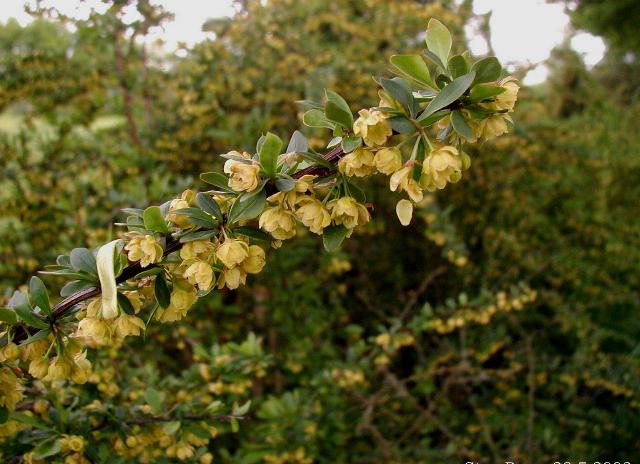


| Japanese barberry | Barberry | |
|---|---|---|
| Leaves | Alternate, in small clusters, small (1–3 cm), untoothed, green or red; fine autumn colour. | In tufts on short side shoots, 2–5 cm, obovate, with a finely bristle-toothed edge. |
| Flowering | Small yellow flowers in April–May (April–May). | Hanging clusters of small, scented yellow flowers in May; the stamens snap inwards when an insect touches them (May–June). |
| Fruit | Glossy red, elongated berries. | Elongated, scarlet berries (about 1 cm) in hanging clusters, in September–October; sour, but edible. |
| Bark | Grooved twigs with spines: single on Japanese barberry, three-pronged on common barberry. | Grooved, yellowish twigs with mostly three-pronged spines; wood and inner bark bright yellow. |
| Shape and height | Shrub, 1–2 m | Shrub, 1–3 m |
| Site | Sun or partial shade, any garden soil, dry | Sun or partial shade, any garden soil, dry |
| Native to Belgium | No, planted | Yes |
| Good for bees, butterflies and birds | Yes, for bees and birds | – |
| Poisonous to people and pets | Not known to be poisonous | Not known to be poisonous |
| Pruning months | June–September | June–July |
The best feature in each season
- Spring
- Both flower yellow: the Japanese barberry in April–May, with flowers singly or a few together; the barberry in May, in hanging, scented clusters. On the barberry the stamens snap inwards when you touch them with a blade of grass.
- Summer
- The leaf of the Japanese barberry is small (1–3 cm) and smooth-edged, often red or yellow in garden varieties; the barberry has larger leaves (2–5 cm) with spiny-toothed edges. At 1–3 m the barberry also grows a little taller.
- Autumn
- The Japanese barberry has single, glossy red, elongated berries and good autumn colour; the barberry has scarlet berries in hanging clusters in September–October, sour but edible.
- Winter
- The berries of the Japanese barberry stay on the shrub for a long time. Without leaves, look at the spines: one per node on the Japanese barberry, usually three on the barberry, which has yellowish twigs.
Where do they grow?
The barberry is native, but was once grubbed out around fields because it is the alternate host of black stem rust of cereals; it is now very rare in the wild in Belgium. The Japanese barberry comes from Japan and is used as a low hedge in many gardens; in North America it runs riot in woodland, and here too birds spread its berries.
Which one for your garden?
- The Japanese barberry is a non-native shrub that is invasive in North America and occasionally escapes here: do not plant it next to woodland or nature areas, trim the hedge before the berries ripen and pull up seedlings. Native alternatives for a thorny hedge are the barberry, the burnet rose, the dog rose and the common hawthorn.
- The barberry wants sun to partial shade and dry, chalky soil, and offers flowers for bees and berries for birds and for jam. Do not plant it next to a cereal field, and wear thick gloves for both because of the spines.
Did you know? The wood and roots of both barberries are bright yellow because of berberine; it was once used to dye wool and leather yellow.
Read on
- Plant profile: Japanese barberry
- Plant profile: Barberry
- Japanese barberry: when and how to prune
- Barberry: when and how to prune
- Identification key