Photo: Sten Porse, CC BY-SA 3.0 · source

Shrub · Barberry family (Berberidaceae)
Japanese barberry
Berberis thunbergii · also: Barberry, Berberis
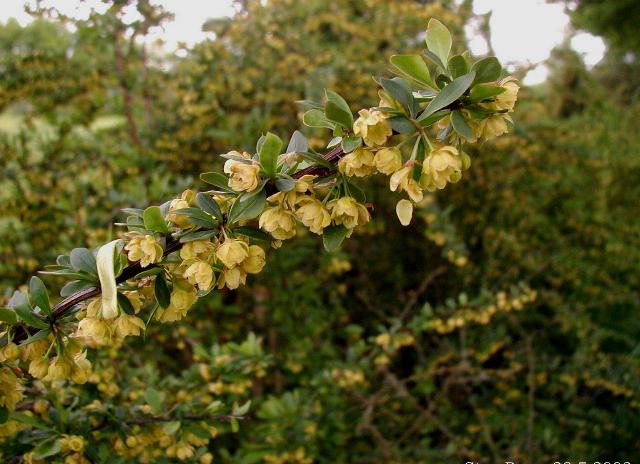
Japanese barberry is a dense, thorny shrub of 1–2 m from Japan, with small leaves in clusters, small yellow flowers in April–May and glossy red berries. It is popular as a low hedge in green, red or yellow, tolerates drought and needs little care. Yet it is an exotic with a downside: in North America it runs wild in forests on a massive scale, and here too birds spread the berries, although this remains rare (for now). Don’t plant it next to woodland or nature areas, and prefer a native thorny shrub.
Caution: An exotic that overruns forests in North America and occasionally runs wild here too. Don’t plant it next to woodland or nature areas, trim the hedge before the berries ripen and pull up seedlings. Native alternatives for a thorny hedge: burnet rose, dog rose, hawthorn or gooseberry.
Light
Sun or partial shade
preferably some sun
Moisture
Dry
tolerates drought
Legal basis
Any garden soil
any pH
Hardiness
Throughout Belgium
no protection needed
Size
1–2 m
tall
Flowering
April–May
| Pruning months | June–September |
|---|---|
| Height | 1–2 m |
| Native to Belgium | No, planted |
| Good for bees, butterflies and birds | Yes, for bees and birds |
| Poisonous to people and pets | Not known to be poisonous |
| Flowering | April–May |
Identify
Japanese barberry: how do you recognise it?
- Habit
- Dense, rounded shrub of 1–2 m with many thin, thorny twigs.
- Leaf
- Alternate, in small clusters, small (1–3 cm), untoothed, green or red; fine autumn colour.
- Bark
- Grooved twigs with spines: single on Japanese barberry, three-pronged on common barberry. The wood and roots are bright yellow.
- Flower
- Small yellow flowers in April–May.
- Fruit
- Glossy red, elongated berries that stay on the shrub for a long time.
- Difference from gooseberry
- Gooseberry has lobed leaves and hairy berries.
Flowering: April–May · Pruning: June–September
Identify by feature: Yellow flowers in spring · Red berries · Thorns or prickles
Looks like it, but isn’t
- Gooseberry Ribes uva-crispa: lobed leaves and hairy berries. Difference from gooseberry
In your garden
Why grow it?
- A low, thorny hedge that needs little maintenance and tolerates drought.
- Green-, red- or yellow-leaved varieties with vivid autumn colour.
- Flowers for insects in spring.
Japanese barberry: where does it grow best?
- Sun to partial shade; red-leaved varieties colour best in the sun.
- Any well-drained soil, even dry; it dislikes waterlogged soil.
- Allow 1–2 m height and 1.5 m width; there are also dwarf varieties.
- Don’t plant it near woodland, a hedgerow or a nature area: seedlings can run wild there.
- Light
- Sun or partial shade
- Legal basis
- Any garden soil
- Moisture
- Dry
- Size
- 2 m tall, 1.5 m wide
- Hardiness
- Throughout Belgium, no protection needed
Goes well with
- English lavender: Purple beside red leaves, in the same dry, sunny spot.
- Spiraea: An easy, low flowering shrub for the same border.
- Burnet rose: A native, low thorny shrub for the same dry spot, and a good alternative.
Good and bad companions
Goes well with
- Suits the woodland edge or the light shade of: ginkgo, box elder, ash, honey locust, field maple, silver maple
Maintenance
Japanese barberry: when and how to plant it?
- Plant from November to March, or from a pot outside periods of frost and drought.
- For a low hedge: 3–4 plants per metre.
- Plant at the same depth as before and firm the soil; wear thick gloves.
- Water after planting and during dry spells in the first year.
Care
- Watering
- Only in dry spells during the first year; after that it tolerates drought well.
- Feeding
- Not needed.
- Seedlings
- Pull out seedlings in the garden and the surrounding area straight away, roots and all.
- Tidying up
- Carefully clear up clipped twigs: they keep pricking in the lawn for a long time.
Tip: Spread a sheet under the hedge when trimming: you collect all the thorny twigs in one go, and they won’t prick hands and feet later.
Japanese barberry: when to prune it?
Pruning months: June–September.
When: After flowering and, if needed, again in late August.
How:
- Trim a hedge into shape after flowering, and again in late summer if needed.
- A freely growing shrub: now and then, saw an old stem off at the base; this keeps it young and dense.
- Trimming after flowering removes a large share of the young berries at the same time: birds then spread less seed.
Caution: Wear thick gloves; clipped twigs keep pricking in the lawn for a long time.
Propagation
- Cuttings
- In summer, take 10 cm cuttings of semi-ripe wood and put them under glass or plastic. Don’t propagate it for spots near woodland or nature areas.
Japanese barberry: how does it get through the winter?
Hardy throughout Belgium: no protection needed.
- Fully hardy.
- After the autumn colour, the leaves drop; the red berries often hang on well into winter.
Diseases and pests
- Running wild: Birds carry the berries to woodland edges, where dense, thorny thickets crowd out native plants. Pull up seedlings and dig out unwanted shrubs with their roots; just cutting them down doesn’t help, as they regrow.
- Berberis sawfly: Pale larvae with black spots and yellow patches strip the leaves in summer. Pick them off; the shrub usually leafs out again.
- Wilt: Branches or whole sections suddenly die (verticillium wilt). Cut them back well into healthy wood and don’t plant a new barberry in that spot.
Through the year
- April: Small yellow flowers for bees and bumblebees.
- June: Trim the hedge after flowering.
- July: Finish pruning; watch for sawflies.
- August: If needed, a second trim in late August.
- September: Last pruning; pull up seedlings in the surrounding area.
- October: Autumn colour and red berries.
- November: Dig out unwanted shrubs.
Use
What can you use it for?
- Garden and landscape
- Low, thorny hedge in green, red or yellow.
- For wildlife
- Flowers for insects, berries for birds.
Good for wildlife
- Bees
- Nectar and pollen for honeybees and wild bees.
- Birds
- Berries, seeds or insects as food, or a place to nest.
You and this species
Did you know?
- The wood and roots are bright yellow.
- In a few US states it may no longer be sold, because it overruns forests there.
- The species name honours the Swedish botanist Carl Peter Thunberg, who worked in Japan for the Dutch East India Company in the 18th century and described its flora.
- Common barberry spreads black stem rust to cereals and was therefore eradicated in many places. Japanese barberry hardly does, and was promoted in the US as a replacement.