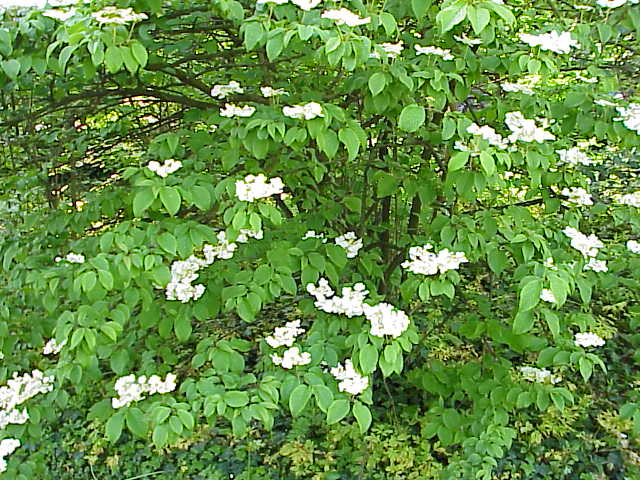
Photo: Kurt Stüber [1], CC BY-SA 3.0 · source

Pruning guide · Shrub
Japanese snowball: when and how to prune
Viburnum plicatum
Prune a Japanese snowball as little as possible, after flowering, in June–July: only remove branches that are in the way, dead or shooting straight up, back to a side branch, and don’t use hedge shears.
The Japanese snowball (Viburnum plicatum) is a broad shrub of 2–3 m with branches that grow in horizontal tiers, topped by two rows of white flower heads. That tiered shape is its greatest beauty, and it builds it on its own. Every cut in the wrong place disturbs it. So pruning is mainly about not doing it: only what is dead or in the way, and the upright shoots that break through the tiers.
| Pruning months | June–July |
|---|---|
| Nesting season (15 March–15 August) | Take care in June–July |
| Flowering | May–June |
| Native to Belgium | No, planted |
Japanese snowball: when to prune it?
If needed, prune after flowering, in June–July. The shrub then still has the whole summer to make new flower buds.
Don’t prune in winter or spring: you would cut off the flower buds.
Dead branches can be cut out all year round.
Japanese snowball: how to prune it?
- Only remove branches that are in the way, dead or shooting straight up, back to a side branch or at the base.
- Don’t simply shorten the horizontal branches to length: you would lose the tiered shape.
- If a tier has to be shorter, cut the branch back to a side branch growing in the same direction, so the shape is kept.
- Don’t use hedge shears: they turn the tiers into a ball.
- If it is too close to a path, rather move it in autumn than trim it every year.
How much to cut, and how often?
- As little as possible: often nothing for years.
- At most a few branches a year that are in the way or shooting up.
What does it mean for wildlife?
- June–July falls in the nesting season (15 March–15 August). Blackbirds and dunnocks like to nest in this broad, dense shrub: look carefully first, and spare an active nest.
- The flower heads have small, fertile flowers in the centre that attract bees, hoverflies and beetles. The large white outer flowers are only there to lure them.
- The berries turn red in summer and then black: food for blackbirds and thrushes.
- It is a non-native. If you also want a native viburnum, choose guelder rose or the wayfaring tree.
Common mistakes
- Trimming the shrub with hedge shears, so the tiered shape is lost.
- Shortening the horizontal branches to length.
- Pruning in winter or spring, so the flowering is lost.
- Pruning without first checking for nests.
Caution: Do not use a hedge trimmer: it destroys the tiered shape. June–July falls in the nesting season: check for nests first.
Nearby: related pruning guides
Similar to: Difference from guelder rose · Difference from wayfaring-tree
Plant profile: Japanese snowball · Pruning calendar and basic rules