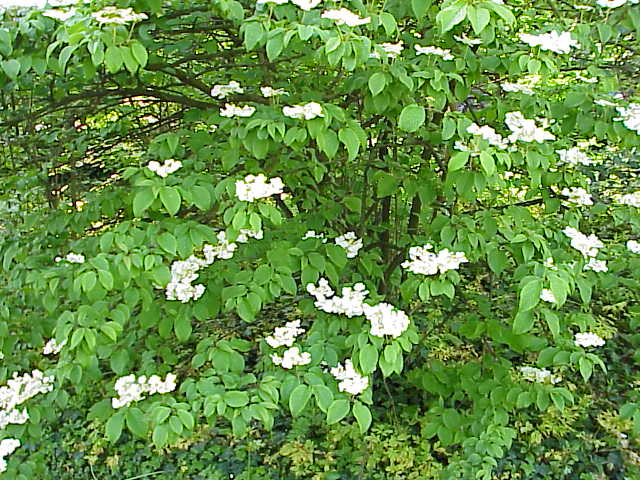
Photo: Kurt Stüber [1], CC BY-SA 3.0 · source

Shrub · Moschatel family (Adoxaceae)
Japanese snowball
Viburnum plicatum · also: Doublefile viburnum
Japanese snowball is a broad shrub of 2–3 m from Japan and China, with branches that grow in horizontal tiers. In May–June, two rows of white flower heads stand along the top of those branches, so that the whole shrub looks as if it is covered in snow. The leaves have deeply impressed veins and turn wine-red in autumn. It is ideal as a specimen shrub, in sun or partial shade, on moist, humus-rich soil that does not dry out.
Light
Sun or partial shade
preferably some sun
Moisture
Normal
no wet feet
Legal basis
Any garden soil
any pH
Hardiness
Throughout Belgium
no protection needed
Size
2–3 m
tall
Flowering
May–June
| Pruning months | June–July |
|---|---|
| Height | 2–3 m |
| Native to Belgium | No, planted |
| Poisonous to people and pets | Not known to be poisonous |
| Flowering | May–June |
Identify
Japanese snowball: how do you recognise it?
- Habit
- Broad shrub of 2–3 m with horizontal, tiered branches, often wider than tall.
- Leaf
- Opposite, 5–10 cm, oval, toothed, with deeply impressed, parallel side veins; wine-red autumn colour.
- Bark
- Greyish-brown, horizontally spreading branches.
- Flower
- In the most widely planted forms, flat heads ringed with large white sterile florets, in May–June, in two rows along the top of the branches; in the ‘snowball form’, rounded heads of sterile flowers only.
- Fruit
- Small berries that turn from red to black, in summer.
- Difference from guelder rose
- Guelder rose has lobed leaves and glossy red berries.
- Difference from wayfaring-tree
- Wayfaring-tree has felted leaves, no outer florets and an upright habit.
Flowering: May–June · Pruning: June–July
Identify by feature: Red autumn colour
Looks like it, but isn’t
- Guelder rose Viburnum opulus: lobed leaves and glossy red berries. Difference from guelder rose
- Wayfaring-tree Viburnum lantana: felted leaves, no outer florets and an upright habit. Difference from wayfaring-tree
In your garden
Why grow it?
- A spectacular display in May–June: white flower heads in rows along horizontal branches.
- An elegant, tiered habit that stands out even without flowers.
- Wine-red autumn colour.
- Bees and hoverflies on the small fertile flowers of the lacecap forms.
Japanese snowball: where does it grow best?
- Sun or partial shade; it flowers best in sun, as long as the soil does not dry out.
- Moist, humus-rich, well-drained soil; no dry sand and no waterlogging.
- Give it space: allow 3 m width so the tiers can show to full effect.
- Light
- Sun or partial shade
- Legal basis
- Any garden soil
- Moisture
- Normal
- Size
- 2.5 m tall, 3 m wide
- Hardiness
- Throughout Belgium, no protection needed
Goes well with
- Japanese maple: Fine leaves and fiery autumn colour beside the wine-red: together a Japanese corner.
- Hydrangea: Carries on flowering in summer once the snowball has finished, on the same moist, humus-rich soil.
- Lesser periwinkle: Evergreen ground cover under the horizontal branches, with small blue flowers in spring.
Good and bad companions
Goes well with
- Suits the woodland edge or the light shade of: ginkgo, box elder, ash, honey locust, field maple, silver maple
Maintenance
Japanese snowball: when and how to plant it?
- Plant from October to April, root-balled or from a pot, when the ground is not frozen.
- Give it a free-standing position, as a specimen in the lawn or at the front of a border, with space all round.
- Dig a generous planting hole and mix in compost or leaf mould.
- Plant at the same depth as before and water generously; keep the soil moist in the first year.
Care
- Watering
- Regularly in the first year, and in dry summers after that: it does not cope well with drought.
- Feeding
- A little compost or leaf mould in spring.
- Mulch
- A layer of leaf mould or wood chips keeps the roots cool and moist.
- Space
- Do not plant anything tall right next to it: the horizontal branches need room.
Tip: Plant it where you can see it from a little higher up, for example below an upstairs window or at the foot of a slope: that is the best way to see the rows of flower heads along the tiers.
Japanese snowball: when to prune it?
Pruning months: June–July.
When: After flowering (June–July).
How:
- Prune as little as possible to keep the characteristic tiers.
- Only remove awkward, dead or upright-shooting branches, back to a side branch.
- Do not simply shorten the horizontal branches: that destroys the tiered shape.
Caution: Do not use a hedge trimmer: it destroys the tiered shape. June–July falls in the nesting season: check for nests first.
Propagation
- Layering
- Lay a low, horizontal branch on the ground, wound it lightly and cover it with soil; after a year it will have roots.
- Softwood cuttings
- In June, take 10 cm cuttings of young, still soft shoots and root them under glass or plastic.
Japanese snowball: how does it get through the winter?
Hardy throughout Belgium: no protection needed.
- Fully hardy.
- A late frost can sometimes damage the young leaves; the shrub recovers on its own.
- In winter, the bare horizontal branches show off the tiered shape beautifully.
Diseases and pests
- Drought: In dry summers the leaves droop and turn brown at the edges. Water and mulch the soil.
- Waterlogging: On wet, heavy soil branches die back and the shrub struggles. Plant on well-drained soil.
- Few flowers: Too much shade, or pruned at the wrong time. Only prune after flowering.
Through the year
- March: Plant; give compost.
- May: Flowering: rows of white heads along the branches.
- June: After flowering, remove awkward branches, checking for nests first; take softwood cuttings.
- July: Last pruning month; the berries turn red.
- August: The berries turn black; water in dry spells.
- October: Wine-red autumn colour.
- November: Plant.
Use
What can you use it for?
- Garden and landscape
- Ornamental shrub with a tiered habit, flowers in May and fine autumn colour; ideal as a specimen.
- For wildlife
- Bees and hoverflies visit the small fertile flowers of the lacecap forms.
You and this species
Did you know?
- The scientific name plicatum means ‘pleated’, after the deeply impressed veins of the leaf.
- The well-known form ‘Mariesii’ is named after Charles Maries, who collected plants in Japan and China for an English nursery in the late 19th century.
- The snowball form of the Japanese snowball is not the same plant as the common snowball bush (‘Roseum’): the latter is a form of guelder rose, with lobed leaves.