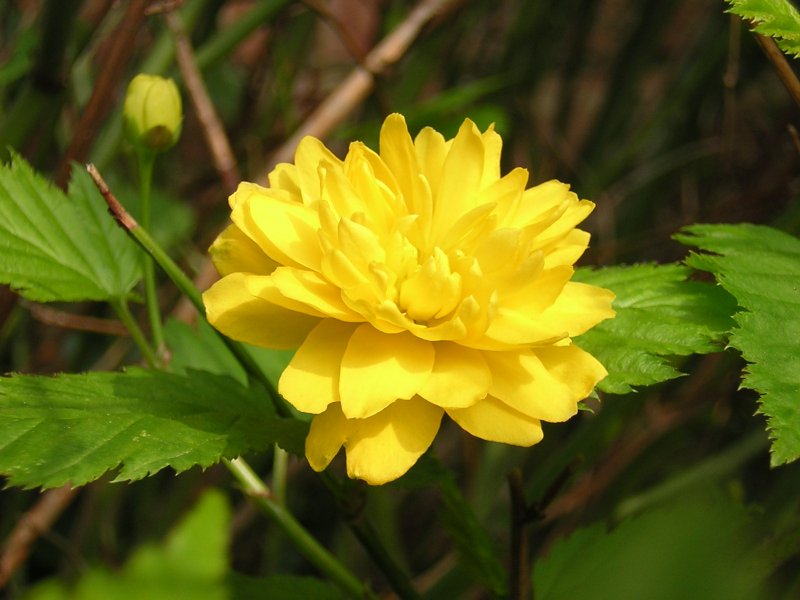
Photo: Wikimedia Commons, CC BY-SA 3.0 · source

Pruning guide · Shrub
Japanese kerria: when and how to prune
Kerria japonica
Prune a Japanese kerria after flowering, in May–June: cut the flowered shoots back to a young side shoot, and every year remove the oldest shoots at ground level.
Japanese kerria is one of the easiest shrubs for the garden: it flowers golden yellow in spring and keeps bright green shoots in winter. It flowers on last year’s shoots, so you prune it straight after flowering. With its suckers it forms a dense clump of its own accord, a little wider every year. Pruning is mostly renewal: old shoots out, young green ones in, and the suckers kept in check.
| Pruning months | May–June |
|---|---|
| Nesting season (15 March–15 August) | Take care in May–June |
| Flowering | April–May |
| Good for bees, butterflies and birds | Yes, for bees |
| Native to Belgium | No, planted |
Japanese kerria: when to prune it?
Prune straight after flowering, in May–June. The shrub then has the whole summer to make new shoots that flower the following spring.
Don’t prune in winter or early spring: you would cut off the flower buds.
Dig out suckers in autumn if they spread too far. With a piece of root attached, they make a new shrub for elsewhere.
Japanese kerria: how to prune it?
- Cut the flowered shoots back to a strong, young side shoot lower down.
- Every year, cut the oldest shoots off at ground level: they turn brown, branch heavily and flower less. That makes room for new green shoots.
- Shoots that turn brown and die are usually simply old. Cut them off at ground level.
- If it becomes too wide, dig out the suckers at the edge with a spade, or put in a root barrier.
- Cut a bare, overgrown shrub right back to just above the ground after flowering. It regrows quickly, but flowers less the following year.
How much to cut, and how often?
- Every year the flowered shoots and about a quarter of the oldest shoots at ground level.
- The suckers: as many as needed to keep it within its space.
What does it mean for wildlife?
- May–June falls in the nesting season (15 March–15 August). Blackbirds and dunnocks like to nest in a dense clump of shoots: look carefully first, and spare an active nest.
- The single-flowered kerria feeds bees and bumblebees in April–May. The well-known double form ‘Pleniflora’ has no pollen or nectar for insects.
- The green shoots give colour in winter, and the dense clump is a shelter for small birds and insects all year round.
- It is a non-native, but it hardly runs wild here: it only spreads by suckers. Combine it with native spring-flowering shrubs such as blackthorn or Cornelian cherry.
Common mistakes
- Pruning in winter, so the flower buds are gone.
- Shortening all the shoots to the same height, so you get a broom of thin shoots.
- Never removing old shoots, so the shrub turns brown and bare.
- Leaving the suckers for years, until it takes over the whole border.
Caution: Don’t prune in winter or early spring: you’d cut off the flower buds.
Nearby: related pruning guides
Similar to: Difference from forsythia
Plant profile: Japanese kerria · Pruning calendar and basic rules