Photo: Wikimedia Commons, CC BY-SA 3.0 · source

Shrub · Rose family (Rosaceae)
Japanese kerria
Kerria japonica · also: Kerria
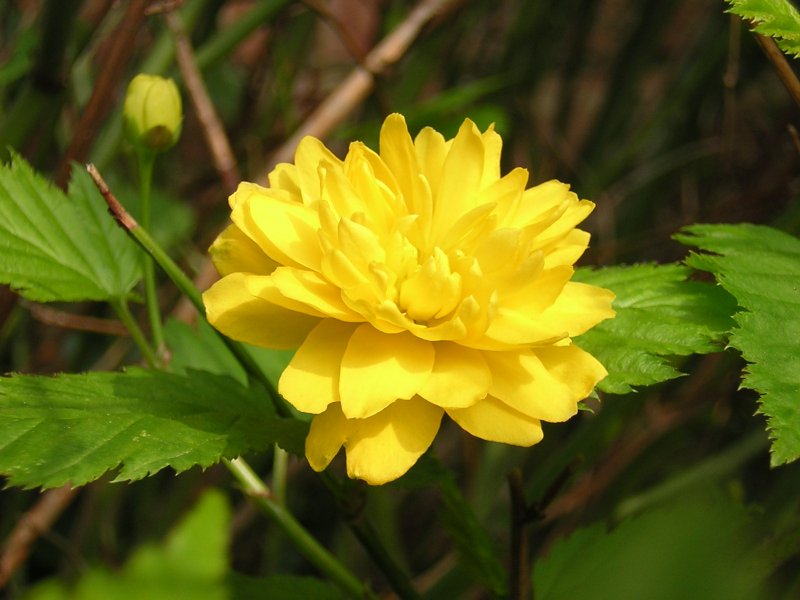
Japanese kerria comes from China and Japan and is one of the easiest shrubs for the garden. In April–May it is covered in golden-yellow flowers, fully double like little pompoms in the well-known form ‘Pleniflora’. It stands out in winter too, with its bright green, cane-like stems. It grows in sun and partial shade, on almost any soil, and by suckering it forms a dense clump 1.5–2 m tall all on its own.
Light
Sun or partial shade
preferably some sun
Moisture
Normal
no wet feet
Legal basis
Any garden soil
any pH
Hardiness
Throughout Belgium
no protection needed
Size
1.5–2 m
tall
Flowering
April–May
| Pruning months | May–June |
|---|---|
| Height | 1.5–2 m |
| Native to Belgium | No, planted |
| Good for bees, butterflies and birds | Yes, for bees |
| Poisonous to people and pets | Not known to be poisonous |
| Flowering | April–May |
Identify
Japanese kerria: how do you recognise it?
- Habit
- Shrub of 1.5–2 m with many thin, upright to arching stems; suckers.
- Leaf
- Alternate, 4–8 cm, oval with a long pointed tip, sharply double-toothed, with deeply impressed veins.
- Bark
- Bright green, thin, striped twigs, green even in winter.
- Flower
- Golden-yellow flowers in April–May; in ‘Pleniflora’ fully double, like little pompoms.
- Fruit
- Rarely: small, brownish-black nutlets.
- Difference from forsythia
- Forsythia flowers earlier (March) on bare branches and has opposite leaves.
Flowering: April–May · Pruning: May–June
Identify by feature: Yellow flowers in spring
Looks like it, but isn’t
- Forsythia Forsythia: flowers earlier (March) on bare branches and has opposite leaves. Difference from forsythia
In your garden
Why grow it?
- Golden-yellow flowers in April–May, even in partial shade.
- Bright green stems that give the shrub colour in winter too.
- Tough and easy: grows on almost any soil and needs little care.
- The single-flowered form is good for bees and other insects.
Japanese kerria: where does it grow best?
- Sun to partial shade; in partial shade the flowers fade less quickly.
- Almost any ordinary garden soil, not too dry and not too wet.
- Allow 2 m width, and a little more after a few years because of the suckers.
- Lovely in a border, at the edge of a group of shrubs or in front of a dark hedge.
- Light
- Sun or partial shade
- Legal basis
- Any garden soil
- Moisture
- Normal
- Size
- 2 m tall, 2 m wide
- Hardiness
- Throughout Belgium, no protection needed
Goes well with
- Common dogwood: Red stems in winter beside the green ones of the kerria.
- Lesser periwinkle: Small blue flowers in April under the yellow kerria, even in partial shade.
- Flowering quince: Red or orange flowers in spring, around the same time as the yellow ones.
Good and bad companions
Goes well with
- Suits the woodland edge or the light shade of: ginkgo, box elder, ash, honey locust, field maple, silver maple
Maintenance
Japanese kerria: when and how to plant it?
- Plant from October to March; a pot-grown shrub can go in all year round, except in frost or drought.
- Dig a generous planting hole and mix in some compost.
- Plant at the same depth as before and firm the soil.
- Water well after planting.
Care
- Watering
- In dry spells during the first year; after that only in long dry summers.
- Feeding
- A little compost in spring is enough.
- Suckers
- Spade off suckers if the shrub gets too wide; you can replant them elsewhere straight away.
- Dead stems
- After a few years, old stems turn brown and die: cut them off at ground level.
Tip: Plant it in front of a dark hedge or wall: that is where the green winter stems and the yellow spring flowers show up best.
Japanese kerria: when to prune it?
Pruning months: May–June.
When: After flowering, in May–June.
How:
- Cut faded stems back to a young side shoot.
- Every year, remove the oldest stems at ground level to make room for new green shoots.
- Spade off suckers if it gets too wide.
Caution: Don’t prune in winter or early spring: you’d cut off the flower buds.
Propagation
- Suckers
- In autumn or early spring, spade off a rooted sucker and replant it elsewhere; it couldn’t be easier.
- Hardwood cuttings
- In winter, push 15–20 cm lengths of one-year-old stems two thirds of the way into the ground.
Japanese kerria: how does it get through the winter?
Hardy throughout Belgium: no protection needed.
- Fully hardy.
- The green stems add colour in winter, especially against a dark background.
Diseases and pests
- Too wide: The suckers spread a little further every year. Spade them off or put in a root barrier.
- Pale flowers: In full sun the flowers soon fade. A spot in partial shade keeps them golden yellow.
- Dead stems: Stems that turn brown and die are usually just old. Cut them off at ground level; new shoots take over.
Through the year
- January: Green stems in winter.
- March: Last month for planting; a little compost around the base.
- April: Flowering starts.
- May: Flowering; afterwards cut back the faded stems.
- June: Finish pruning: oldest stems off at ground level.
- October: Planting and moving suckers.
- November: Spading off suckers and taking hardwood cuttings.
Use
What can you use it for?
- Garden and landscape
- Easy shrub with yellow spring flowers, even in partial shade; green stems in winter.
- For wildlife
- The single-flowered form is better for insects than the double one.
Good for wildlife
- Bees
- Nectar and pollen for honeybees and wild bees.
You and this species
Did you know?
- Spreads by suckers and so forms a dense clump on its own.
- The genus Kerria is named after William Kerr, a Scottish gardener who sent the double form from China to England in the early 19th century.
- Its Dutch name, ranonkelstruik (‘ranunculus shrub’), refers to the double flowers, which look like small yellow ranunculus blooms.
- Kerria is named after William Kerr, a Scottish gardener who sent the double form from China to Kew in the early 19th century. The single wild form only reached Europe later.
- Japanese kerria is the only species in its genus. In Japan it is called yamabuki, and the golden yellow of its flowers is a traditional colour name there: yamabuki-iro.