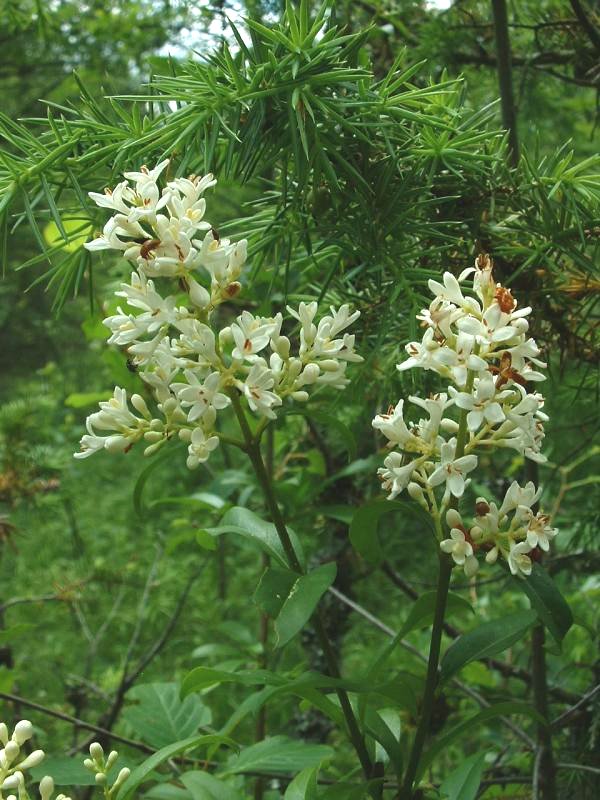
Photo: Wikimedia Commons, CC BY-SA 3.0 · source

Pruning guide · Shrub
Wild privet: when and how to prune
Ligustrum vulgare
Trim a wild privet hedge in May–June and late August–September; thin out a freely growing shrub in winter (November–March) by sawing a few of the oldest branches off at ground level.
Wild privet is our native privet: a shrub of 2–4 m that makes just as good a hedge as the common garden privet, but offers more to wildlife. It tolerates hard pruning, and a bare hedge simply regrows after being cut back. In June–July it flowers with fragrant white panicles on the young wood, followed by black, poisonous berries. How you prune it decides whether you get a crisp hedge, or a hedge with flowers and berries.
| Pruning months | May–June, August–September and November–March |
|---|---|
| As a hedge | May–June and August–September |
| As a free-standing shrub | November–March |
| Nesting season (15 March–15 August) | Take care in March, May–June and August |
| Flowering | June–July |
| Good for bees, butterflies and birds | Yes, for bees, butterflies and birds |
| Native to Belgium | Yes |
| Poisonous to people and pets | Yes, take care with children and pets |
Wild privet: when to prune it?
As a hedge
As a free-standing shrub
Trim a formal hedge twice: a first time in late May or June, a second time from late August into September. It then stays dense and tidy until spring.
Thin out a free shrub or an informal hedge in winter, November–March, ideally before mid-March: by then the shrub is almost bare and nothing is nesting yet.
Don’t trim after mid-September: the young shoots that still appear will be killed by frost in winter.
What else to prune in those months? January · February · March · May · June · August · September · November · December
Wild privet: how to prune it?
- For a hedge, stretch a line for a straight edge, and cut the sides at a slight angle: wider at the bottom than at the top. That way the base gets light and doesn’t go bare.
- If you want flowers and berries in the hedge, trim it only once a year, in late August–September, or trim one side one year and the other side the next. The flowers come on the new shoots that a June trim removes.
- On a free shrub, saw a few of the oldest branches off at ground level every few years, so young branches grow from the base.
- Cut an old, bare hedge back hard in winter, to 20–30 cm above the ground. It sprouts again in spring. If you like, spread it over two winters: first one side, then the other.
- After hard pruning, pinch out the new shoots a few times in the first summer, so the hedge branches well at the bottom.
- Never give the clippings to animals: the leaves and berries are poisonous to horses, livestock, dogs and cats. They are fine on the compost heap.
How much to cut, and how often?
- A formal hedge: two trims a year. A wildlife hedge: one, in late August–September.
- A free shrub: a few of the oldest branches every few years, nothing more.
- It copes well with hard pruning: a hedge that has become too wide or too tall can be cut back hard in a single winter.
What does it mean for wildlife?
- The May–June trim falls right in the nesting season (15 March–15 August). Blackbirds, dunnocks and chaffinches like to nest in a dense privet hedge: check carefully beforehand, and spare the stretch around an active nest until the young have fledged.
- The fragrant flowers in June–July are a feast for butterflies, bees and hoverflies. The less you trim in June, the more flowers there will be.
- Wild privet is the food plant of the privet hawk-moth: if you see a fat green caterpillar with purple and white stripes and a little horn in summer, leave it in peace.
- The black berries hang on into winter for blackbirds, thrushes and robins. For people they are poisonous.
Common mistakes
- Trimming a hedge wider at the top than at the bottom, so the base goes bare.
- Trimming the whole hedge in June without first checking for nests.
- Trimming after mid-September, so the young shoots get frosted.
- Feeding the clippings to horses, sheep or rabbits.
Caution: Before the May–June clip, check that no birds are nesting in the hedge; thin out free-growing shrubs before mid-March. Wild privet is poisonous: wear gloves and keep clippings away from children, pets and livestock.
Nearby: related pruning guides
Similar to: Difference from garden privet · Difference from snowberry
Plant profile: Wild privet · Pruning calendar and basic rules