Side by side
Garden privet or wild privet? How to tell them apart
Ligustrum ovalifolium · Ligustrum vulgare
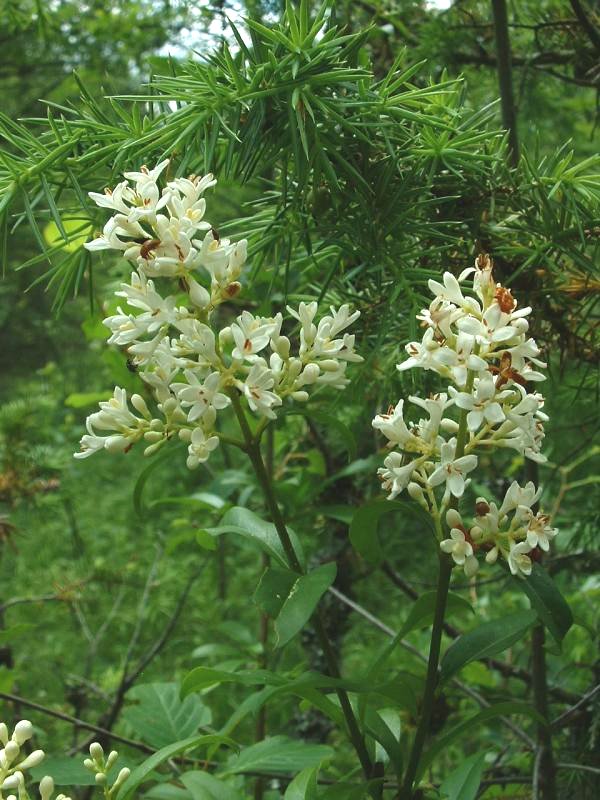
You can tell a garden privet by its broad, oval and glossy leaves that stay on the shrub in mild winters; a wild privet has narrower, lance-shaped leaves that drop in the course of the winter.
Both have opposite, smooth-edged leaves, white flower panicles and black berries. The leaf says it: broadly oval and glossy on the garden privet, narrow and lance-shaped on the wild privet. In winter a wild privet hedge is largely bare.

Photo: No machine-readable author provided. MPF assumed (based on copyright claims)., CC BY 2.5 · source
Garden privet Ligustrum ovalifolium


| Garden privet | Wild privet | |
|---|---|---|
| Leaves | Opposite, oval, 3–6 cm, untoothed and glossy; stays on the shrub in mild winters. | Opposite, lance-shaped, 3–6 cm, untoothed; drops during the course of the winter. |
| Flowering | White, heavily scented panicles in July (June–July). | White, strongly scented panicles in June–July (June–July). |
| Fruit | Glossy black berries, poisonous. | Glossy black berries that last all winter; poisonous. |
| Bark | Greyish-brown and smooth. | Grey and smooth. |
| Shape and height | Shrub, 2–4 m | Shrub, 2–4 m |
| Site | Sun to shade, any garden soil, normal | Sun or partial shade, any garden soil, normal |
| Native to Belgium | No, planted | Yes |
| Good for bees, butterflies and birds | Yes, for bees, butterflies and birds | Yes, for bees, butterflies and birds |
| Poisonous to people and pets | Yes, take care with children and pets | Yes, take care with children and pets |
| Pruning months | May–June and August–September | May–June, August–September and November–March |
The best feature in each season
- Spring
- The wild privet comes into leaf again with fresh, narrow leaves; the garden privet often still carries last year’s leaves.
- Summer
- Both flower with white, strongly scented panicles: the wild privet in June–July, the garden privet mainly in July. Bees and butterflies flock to them.
- Autumn
- Both carry glossy black, poisonous berries. Those of the wild privet stay all winter, as food for birds.
- Winter
- The best time to tell them apart: the garden privet stays green in mild winters, the wild privet loses most of its leaves and shows its black berries.
Where do they grow?
The wild privet is native and grows along woodland edges, in scrub and in the dunes, often on chalky soil. The garden privet comes from Japan and became one of the most planted hedges in our gardens, because it copes well with pruning and city air.
Which one for your garden?
- For wildlife the wild privet is the better choice: native, food plant of the privet hawk-moth and with berries that last all winter. If you want a hedge that stays green in winter, the garden privet is sturdier.
- The berries and leaves of both are poisonous to children, dogs, cats, horses and livestock: never give clippings to animals. Birds eat the berries without any problem.
Did you know? The privet hawk-moth, one of our largest moths, lays its eggs on privet: its green caterpillar with purple stripes grows up to 10 cm long.
Read on
- Plant profile: Garden privet
- Plant profile: Wild privet
- Garden privet: when and how to prune
- Wild privet: when and how to prune
- Identification key: the question that separates them