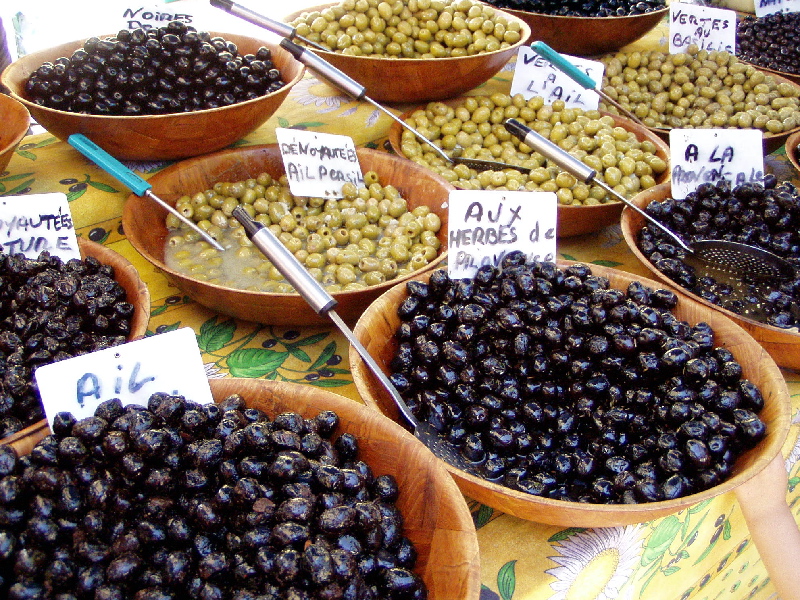
Photo: Amarant at Dutch Wikipedia, CC BY-SA 3.0 · source

Fruit tree · Olive family (Oleaceae)
Olive tree
Olea europaea · also: Olive
The olive tree comes from the Mediterranean and is an evergreen tree of 4–8 m with narrow, leathery leaves that are silvery grey underneath, and a gnarled trunk. In our gardens you often see old trees from Spain or Italy, in open ground or in a large pot. It tolerates a few degrees of frost, but not wet feet in winter, and a harsh winter can kill it. In our climate the olives rarely ripen properly: you plant it for its silvery-grey silhouette. Give it the sunniest, most sheltered spot you have.
Light
Full sun
warm and bright
Moisture
Dry
tolerates drought
Legal basis
Any garden soil
any pH
Hardiness
down to -10 °C
protect in harsh winters
Size
4–8 m
tall
Flowering
June
| Pruning months | April–May |
|---|---|
| Height | 4–8 m |
| Native to Belgium | No, planted |
| Good for bees, butterflies and birds | Little |
| Poisonous to people and pets | Not known to be poisonous |
| Flowering | June |
Identify
Olive tree: how do you recognise it?
- Habit
- Evergreen tree of 4–8 m with a broad, rounded crown; in a pot often as a standard or as an old, gnarled tree.
- Leaf
- Opposite, 4–8 cm, narrowly lance-shaped, untoothed and leathery; grey-green above, silvery below from tiny scales.
- Bark
- Grey; old trees develop a contorted, twisted and often hollow trunk.
- Flower
- Small, creamy-white, fragrant flowers in small clusters, in June.
- Fruit
- Olives: green at first, purple to black when ripe and inedibly bitter when fresh. In our climate they rarely ripen properly.
- Difference from oleaster
- Oleaster has alternate leaves with rust-brown scales underneath, and flowers in autumn.
Flowering: June · Harvest and fruit: January–December · Pruning: April–May
Identify by feature: Opposite leaves · Long, narrow leaves · White or silver underside · Evergreen leaves
Looks like it, but isn’t
- Oleaster Elaeagnus: alternate leaves with rust-brown scales underneath; flowers in autumn. Difference from oleaster
- Russian olive (Elaeagnus angustifolia): drops its leaves, which are alternate; often thorny.
In your garden
Why grow it?
- A silvery-grey evergreen silhouette that instantly gives a patio or garden a southern look.
- An old, gnarled trunk is an eye-catcher, even in a large pot.
- Tolerates drought and heat: ideal for a sunny patio.
- It regrows well, even from old wood: you can prune it into shape.
Olive tree: where does it grow best?
- Full sun, in the warmest and most sheltered spot: against a south-facing wall, in a courtyard or a town garden.
- Well-drained, rather dry soil; wet, heavy soil in winter is its worst enemy.
- In open ground it does best in the mildest places: in towns and on the coast. Elsewhere a large pot is safer.
- Allow about 4 m across; in a pot it stays smaller.
- Light
- Full sun
- Legal basis
- Any garden soil
- Moisture
- Dry
- Size
- 6 m tall, 4 m wide
- Hardiness
- down to -10 °C, protect in harsh winters
Goes well with
- English lavender: Silvery grey, drought-loving and fragrant: the classic partner at the foot of an olive.
- Rosemary: A Mediterranean herb for the same sunny, dry spot, also in a pot.
- Garden thyme: A low, fragrant ground cover between stones or gravel around the trunk.
Maintenance
Olive tree: when and how to plant it?
- Plant in spring (April–May), once frosts are over, so that it can root in before winter.
- Make sure drainage is good: on heavy soil, mix gravel into the planting hole, or plant on a low mound.
- In a pot: a large pot with drainage holes, filled with potting compost mixed with gravel or coarse sand.
- Buy a tree with a plant passport from a reliable nursery: in the EU, olive trees are checked for Xylella, a bacterial disease that has killed millions of olive trees in southern Italy.
- Water generously after planting, and during dry spells in the first summer.
Care
- Watering
- In open ground, only in the first summer and during long droughts. In a pot, regularly in summer, but let the compost dry out in between; very sparingly in winter.
- Feeding
- A little fertiliser now and then from April to August, especially in a pot.
- Repotting
- Repot a potted tree every few years in spring, or replace the top layer of compost.
- Winter chill
- It needs a cool winter to flower: don’t overwinter it in a heated room.
Tip: Not sure your olive will survive the winter outdoors? Put it in a large pot on castors: in hard frost you can wheel it indoors with no effort at all.
Olive tree: when to prune it?
Pruning months: April–May.
When: In spring, once frosts are over (April–May).
How:
- Keep the crown open so light can get through: remove inward-growing and crossing branches and water shoots.
- It regrows well, even from old wood: an overgrown or bare tree can be cut back hard.
- After a harsh winter, cut dead twigs back to healthy wood; wait until it starts growing again.
Caution: Tolerates a few degrees of frost, but not wet soil: make sure drainage is good, and protect it in hard frost.
Propagation
- Cuttings
- In summer, take semi-ripe cuttings of 10–15 cm, dip the base in rooting powder and root them under glass or plastic in a warm place. It takes patience.
Olive tree: how does it get through the winter?
Hardy to −10 °C: protect in harsh winters.
- An established olive tree in open ground tolerates brief frost down to about −10 °C. From about −7 °C, and in prolonged frost, the leaves and twigs are already cut back; a severe winter can kill it.
- Protect it in hard frost: put a thick layer of mulch over the base and drape horticultural fleece over the crown; remove it as soon as the weather turns milder.
- In a pot the roots freeze much sooner: from about −5 °C, move the pot to a cool, light, frost-free place such as a cold greenhouse or a garage with a window. In a heated living room it drops its leaves.
- Keep the soil on the dry side in winter: wet and cold is deadly.
Diseases and pests
- Wet feet: Yellow leaves, leaf drop and dying branches on wet, heavy soil or in a pot without drainage. Improve drainage and water sparingly in winter.
- Peacock spot: Round, dark spots with a yellow halo on the leaves, especially in wet years; affected leaves drop. Clear up fallen leaves and keep the crown open.
- Scale insects: Brown or black scales on twigs and leaf veins, with sticky honeydew and sooty mould. Brush them off or cut out affected twigs.
- Leaf drop indoors: An olive that overwinters too warm and too dark drops its leaves. Keep it cool and light; it usually grows back in spring.
Through the year
- January: In hard frost: fleece over the crown; keep potted trees frost-free and light.
- March: Remove protection after the last hard frost; put potted trees outside on mild days to acclimatise.
- April: Prune once frosts are over; plant and repot.
- May: Finish pruning; start feeding.
- June: Flowering: small, fragrant, creamy-white flowers.
- July: Water potted trees regularly; take semi-ripe cuttings.
- August: Last feed; cuttings.
- October: The olives colour up but rarely ripen properly; get winter protection ready.
- November: Move potted trees to a cool, light, frost-free place as soon as hard frost sets in.
- December: Keep the soil dry; fleece in hard frost.
Use
What can you use it for?
- Garden and landscape
- Silvery-grey evergreen tree for a sunny patio or a sheltered garden.
- Food and drink
- Olives (after curing in brine) and olive oil, in southern countries.
- Wood
- Hard wood with a wild grain for chopping boards and kitchen utensils.
Edible and useful
- Fruit (October–December)
- In Belgium olives only ripen after a long, warm summer, mostly on a tree in a pot on a sheltered patio. Pick them green in October, or purple to black in November and December. Raw, they are inedibly bitter: they must first be debittered in water and brine.
- Leaves (January–December)
- Leaves can be picked all year round, for instance when pruning, for a slightly bitter tea.
- Storing
- Debittered olives keep for months in brine in the fridge. Dried leaves keep for a year in a closed jar.
- Fermenting
- In brine, olives undergo a slow lactic fermentation that breaks down more of the bitterness and gives them their typical flavour.
Caution: Raw olives are not poisonous, but they are inedibly bitter. A thin white film on top of the brine (kahm yeast) can be skimmed off; if you see coloured mould, smell rot or find the olives mushy, throw everything away. Do not pick olives or leaves from a tree recently treated with a pesticide. Never eat anything you have not identified with certainty.
Eating and using is at your own risk: see the terms of use.
Recipes
- Brined olives (Fermentation · 1 one-litre jar · 30 min + 1–2 weeks in water + 4–8 weeks in brine)
- Olive-leaf tea (Tea · 1 cup · 10 min)
- Black olive tapenade (Dish · ± 1 jar of 200 ml · 20 min)
- Olive leaf soap (Skin and body care · ± 6 soaps of 50 g · 1 hr + 4 hrs drying and setting)
You and this species
Did you know?
- Our gardens often contain centuries-old trees from Spain or Italy. They tolerate a few degrees of frost, but not wet feet in winter.
- Fresh olives are bitter: they only become edible after curing, for example in brine.
- An olive tree can live for hundreds of years, and the olive branch has been a symbol of peace since ancient times.
- At the ancient Olympic Games, winners received no medal but a wreath of olive branches.
- The olive is related to our ash, privet and lilac: like them, it has opposite leaves.