Photo: No machine-readable author provided. JoJan assumed (based on copyright claims)., CC BY-SA 3.0 · source

Broadleaf tree · Olive family (Oleaceae)
Ash
Fraxinus excelsior · also: Common ash, European ash
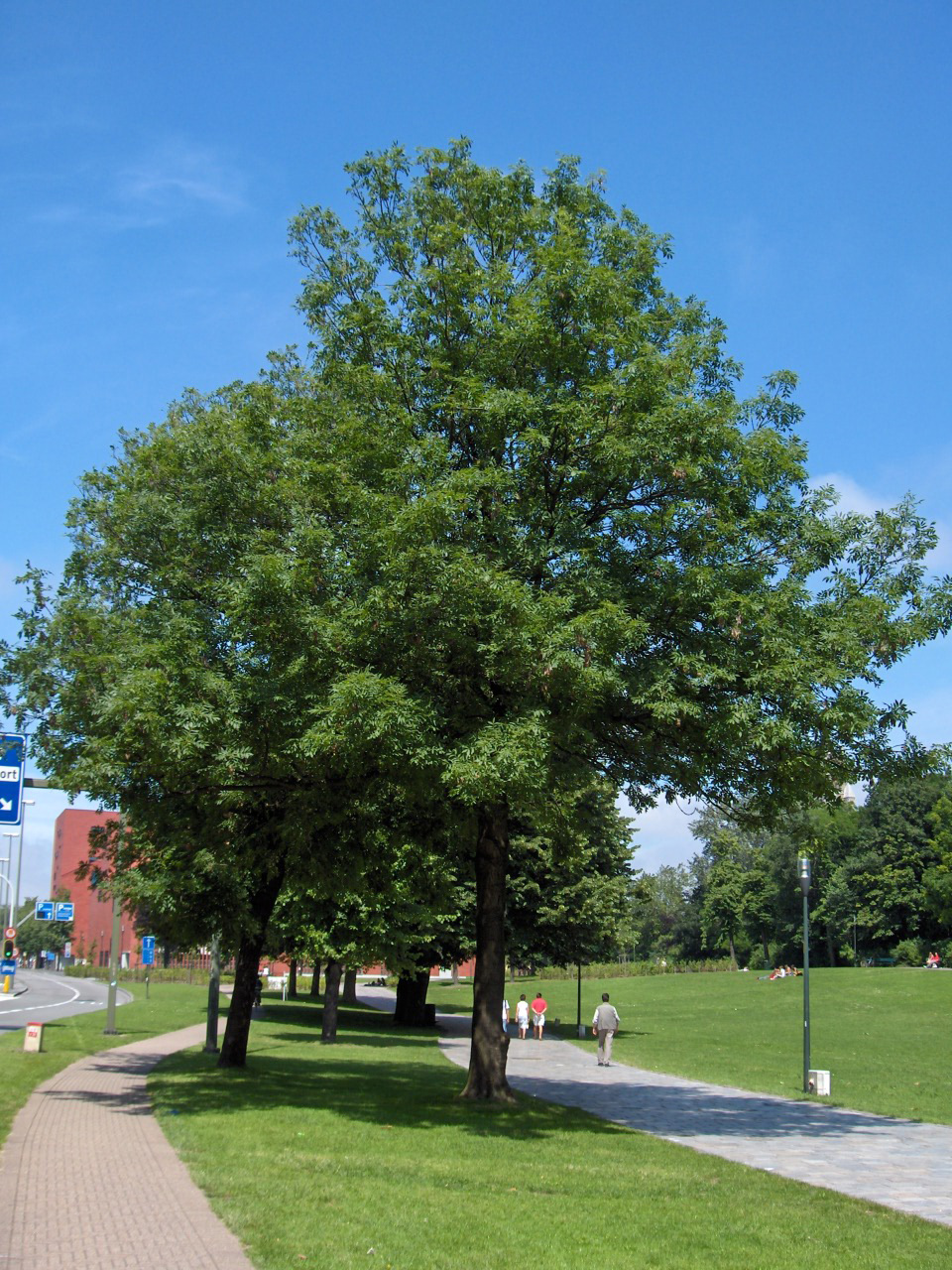
Ash is a large native tree of 20–35 m with a light, open crown, pinnate leaves of 9–13 leaflets and thick, matt black buds. It likes moist, chalky soil and grows along streams, in hedgerows and as a pollard. Since around 2010 ash has been severely hit here by ash dieback, a fungal disease from Asia: many trees die back or become unsafe. So for now it is better to plant a different native tree, and to spare healthy ash trees: they may be resistant. A free-standing ash is too big for an ordinary garden; as a pollard it does fit in a large garden.
Caution: Trees with ash dieback can suddenly drop dead branches or, if the base is rotting, fall over: have ash trees near paths, roads, buildings and play areas checked by an arborist.
Light
Sun or partial shade
preferably some sun
Moisture
Moist to wet
must not dry out
Legal basis
Any garden soil
neutral to chalky
Hardiness
Throughout Belgium
no protection needed
Size
20–35 m
tall
Flowering
April
| Pruning months | November–March |
|---|---|
| Height | 20–35 m |
| Native to Belgium | Yes |
| Good for bees, butterflies and birds | Yes, for butterflies and birds |
| Poisonous to people and pets | Not known to be poisonous |
| Flowering | April |
Identify
Ash: how do you recognise it?
- Habit
- Large tree of 20–35 m with a tall, light and open crown; as a pollard low and broad.
- Leaf
- Opposite, pinnate with 9–13 oblong, toothed leaflets. Comes into leaf late, often not until May, and the leaves often fall while still green in autumn.
- Bark and buds
- Smooth and greenish-grey when young, later pale grey with a fine network of ridges. Buds velvety and matt black.
- Flower
- Purplish-black clusters without petals in April, before the leaves open.
- Fruit
- Clusters of winged fruits (‘keys’) that hang on well into winter.
- Difference from rowan
- In rowan the leaves are alternate, not opposite.
- Difference from box elder
- Box elder has only 3–5 leaflets and green twigs.
Flowering: April · Harvest and fruit: June–July · Pruning: November–March
Identify by feature: Pinnate leaves · Opposite leaves · Winged seeds
Looks like it, but isn’t
- Rowan Sorbus aucuparia: leaves are alternate, not opposite. Difference from rowan
- Box elder Acer negundo: only 3–5 leaflets and green twigs. Difference from box elder
In your garden
Why grow it?
- A native tree that is important for mosses, lichens and insects.
- A light crown that comes into leaf late: plenty still grows under an ash.
- As a pollard it fits along a ditch or in a large garden, and provides firewood.
- Healthy old ash trees are valuable: they may be able to withstand ash dieback.
Ash: where does it grow best?
- Sun to partial shade; young ash trees tolerate some shade, old trees want light.
- Moist, fertile soil, preferably chalky: along streams, in valleys and on loam or clay.
- Allow for a crown 15 m wide or more: as a free-standing tree only for a field, a park or a very large garden. As a pollard it fits along a ditch or a field.
- Don’t plant it where a falling branch could do damage, such as by a play area or a driveway: because of ash dieback, dead branches can break off.
- Light
- Sun or partial shade
- Legal basis
- Any garden soil
- Moisture
- Moist to wet
- Size
- 30 m tall, 15 m wide
- Hardiness
- Throughout Belgium, no protection needed
Goes well with
Good and bad companions
Goes well with
- Tolerate the shade under this tree: oregon grape, rhododendron, oleaster, japanese skimmia, garden privet, camellia, laurustinus, box-leaved honeysuckle
Maintenance
Ash: when and how to plant it?
- Because of ash dieback, it is better for now to plant a different native tree, such as English oak, alder, small-leaved lime or hornbeam.
- If you still want an ash, for example as a pollard, plant a young bare-root tree between November and March.
- Put a stake on the windward side and protect the trunk from rabbits and deer.
- Water generously after planting and during dry spells in the first year.
- Spare seedlings and young ash trees that stay healthy: they may be resistant to the disease.
Care
- Inspection
- Every summer, look for dead shoot tips, wilted leaves and dark patches on the bark: signs of ash dieback.
- Safety
- Have trees along paths, roads and play areas checked regularly by an arborist, especially if there is rot at the base.
- Seedlings
- Ash self-seeds easily: weed out unwanted seedlings while young, roots and all.
- Watering
- In dry spells during the first year; on moist soil no longer needed after that.
Tip: Do you have a healthy old ash in a large garden or field? Keep it as long as it is safe: trees that withstand the disease are worth their weight in gold for the future of the ash.
Ash: when to prune it?
Pruning months: November–March.
When: Dead, diseased and broken branches can be removed at any time of year. Formative pruning and pollarding during winter dormancy.
How:
- Trees with ash dieback shed dead branches: check trees along roads and paths for safety.
- Pollard an ash every 5–10 years: saw off all the branches just above the head.
- Train a young tree on a single trunk and remove competing leaders in good time.
Caution: Don’t climb into a diseased ash yourself: dead ash wood quickly becomes brittle. Have large or diseased trees pruned or felled by an arborist.
Propagation
- Sowing
- In autumn, pick the keys from a healthy tree and sow them outdoors in a seedbed; they usually only germinate in the second spring.
- Moving a seedling
- A seedling from your garden can be moved in winter, preferably while still small.
Ash: how does it get through the winter?
Hardy throughout Belgium: no protection needed.
- Fully hardy.
- In winter you recognise it by its thick, matt black buds and the keys still hanging on the tree.
Diseases and pests
- Ash dieback: A fungus from Asia makes shoots and branches die back: wilted leaves in summer, dead tips, dark patches on the bark and lots of new shoots on the trunk. There is no cure. A small proportion of ash trees turns out to be hardly susceptible: spare healthy trees, and have diseased trees near paths and buildings felled in good time.
- Rot at the base: In diseased ash trees the base of the trunk often rots, sometimes with honey fungus. The tree can then suddenly fall over, even with a crown that is still green: have it checked.
- Seedlings: Ash self-seeds massively in borders and hedges. Pull the seedlings up while young, roots and all.
Through the year
- January: Pollarding and formative pruning during winter dormancy.
- February: Pollarding; plant in mild weather.
- March: Last month for pollarding and planting.
- April: Flowering: purplish-black clusters, before the leaves.
- May: The leaves come out late.
- July: Look for signs of ash dieback: wilted leaves and dead tips.
- August: Have diseased trees near paths and buildings checked.
- October: Pick keys for sowing; the leaves often fall while still green.
- November: Pollarding and pruning season begins; remove dead branches.
- December: Pollarding and pruning.
Use
What can you use it for?
- Wood
- Tough, springy wood for tool handles, sports equipment and furniture.
- Also used for
- Excellent firewood that burns well even when green; once also pollarded to provide wood for the farm.
- For wildlife
- Important for mosses, lichens and insects.
Edible and useful
- Leaves (June–July)
- In June and July, pick fully grown, healthy leaves for frênette, a lightly sparkling fermented drink from France. Dry them in the shade first.
- Seeds (June–July)
- The young green ‘keys’ in June and July, while they are soft and you can pinch through them with a fingernail. In England they have long been pickled in spiced vinegar, rather like capers. Older, tough or brown keys are too bitter and stringy.
- Storing
- Dried leaves keep for a year in a paper bag or jar. Let pickled keys mature for a month; unopened, they keep for a year.
- Fermenting
- Frênette: an infusion of ash leaves with sugar and citric acid, fermented with yeast into a lightly sparkling, low-alcohol drink. It used to be drunk in summer in the French countryside.
Caution: Do not confuse ash with elder, whose leaves are poisonous (fewer, broader leaflets and an unpleasant smell), or with other trees with pinnate leaves. Ash has opposite leaves with 7 to 13 toothed leaflets and fat black buds; rowan has alternate leaves. Only eat the keys cooked and pickled, and in small amounts. Pick well away from busy roads and sprayed fields, and never eat anything you have not identified with certainty.
Eating and using is at your own risk: see the terms of use.
Recipes
- Frênette (ash-leaf drink) (Fermentation · ± 5 litres · 1 hr + 3–4 weeks)
- Pickled ash keys (Vinegar · 1 jar of 350 ml · 45 min + 1 month maturing)
- Ash leaf tea (Tea · ± 25 cups · 15 min + 1 week drying)
- Ash keys in batter (Dish · 4 servings, as a nibble · 30 min)
Good for wildlife
- Caterpillars
- Host plant: caterpillars of butterflies or moths eat the leaves.
- Birds
- Berries, seeds or insects as food, or a place to nest.
You and this species
Did you know?
- Ash is severely affected by ash dieback, a disease caused by a fungus from Asia.
- In Norse mythology Yggdrasil, the world tree, is an ash.
- Ash wood burns well even when green, and the tough timber is used for tool handles and sports equipment.
- In Norse mythology Yggdrasil, the world tree linking the nine worlds, is an ash.
- An ash can bear male, female or hermaphrodite flowers, and some trees switch from one year to the next.