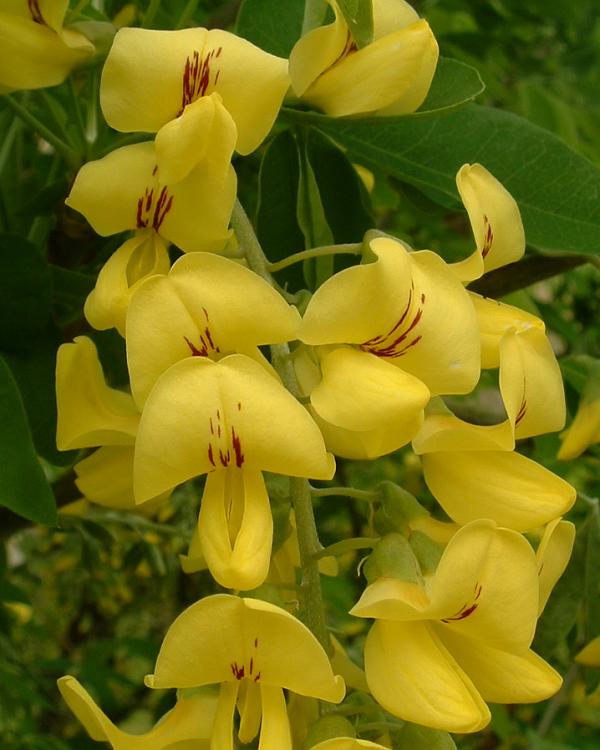
Photo: Wikimedia Commons, CC BY-SA 3.0 · source

Broadleaf tree · Pea family (Fabaceae)
Common laburnum
Laburnum anagyroides · also: Golden chain tree, Laburnum
Common laburnum is a small tree of 4–8 m from the mountains of southern and central Europe. In May–June it is hung with long clusters of golden-yellow pea flowers, one of the best-known sights of the late-spring garden. It fixes nitrogen from the air and grows on almost any soil. But it is also one of the most poisonous garden plants: all parts are highly poisonous, especially the seeds and pods. So don’t plant it where young children play or next to a pasture. Gardens often have the hybrid ‘Vossii’, with even longer clusters and few pods.
Caution: All parts are highly poisonous, especially the seeds and pods: just a few seeds can make a child ill. Dogs, horses and livestock are also susceptible. Don’t plant it where young children play or next to a field, cut off spent flower clusters and clear up pods and prunings.
Light
Sun or partial shade
preferably some sun
Moisture
Normal
no wet feet
Legal basis
Any garden soil
any pH
Hardiness
Throughout Belgium
no protection needed
Size
4–8 m
tall
Flowering
May–June
| Pruning months | July–September |
|---|---|
| Height | 4–8 m |
| Native to Belgium | No, planted |
| Poisonous to people and pets | Yes, take care with children and pets |
| Flowering | May–June |
Identify
Common laburnum: how do you recognise it?
- Habit
- Small tree or large shrub of 4–8 m, often multi-stemmed, with an open crown.
- Leaf
- Alternate, with three elliptic, untoothed leaflets 3–8 cm long on a long stalk; underside grey-green and silky-hairy.
- Bark
- Smooth, olive-green to brownish green; young twigs grey-green and hairy.
- Flower
- Hanging clusters 10–30 cm long of golden-yellow pea flowers, in May–June.
- Fruit
- Flat, hairy pods 4–6 cm long with black seeds, which stay on the tree for a long time.
- Difference from Voss’s laburnum
- Voss’s laburnum (Laburnum × watereri ‘Vossii’) has even longer clusters (up to 50 cm), less hairy leaves and few pods; it is the most widely planted garden form.
- Difference from Chinese wisteria
- Wisteria is a climber with pinnate leaves and bluish-purple flower clusters.
Flowering: May–June · Pruning: July–September
Identify by feature: Yellow flowers in spring · Hanging flower clusters · Pods
Looks like it, but isn’t
- Voss’s laburnum (Laburnum × watereri ‘Vossii’): even longer clusters (up to 50 cm), less hairy leaves and few pods; the most widely planted garden form.
- Chinese wisteria Wisteria sinensis: a climber with pinnate leaves and bluish-purple flower clusters. Difference from Chinese wisteria
In your garden
Why grow it?
- Long clusters of golden-yellow flowers in May–June.
- Small enough for an ordinary garden, and can be trained over an arch or pergola.
- Flowers for bumblebees and bees.
- Fixes nitrogen and grows on almost any soil.
Common laburnum: where does it grow best?
- Sun to partial shade; it flowers best in sun.
- Any well-drained soil, including chalky or poor soil; no wet feet.
- Allow 4 m width: suitable for an ordinary garden, but not where young children play, nor next to a field with horses or livestock.
- Light
- Sun or partial shade
- Legal basis
- Any garden soil
- Moisture
- Normal
- Size
- 6 m tall, 4 m wide
- Hardiness
- Throughout Belgium, no protection needed
Goes well with
- Chinese wisteria: Flowers at about the same time, in May: together over a pergola or arch, a picture in gold and bluish purple.
- Common lilac: Fragrant purple or white flowers in May, next to the yellow of the laburnum.
- Ornamental onion: Purple globes beneath a laburnum arch: a classic sight in May.
Maintenance
Common laburnum: when and how to plant it?
- Plant from November to March, root-balled or container-grown.
- For the garden, choose the hybrid ‘Vossii’: longer clusters and far fewer pods – though it is just as poisonous.
- Put a sturdy stake on the windward side and water well after planting.
- For a laburnum arch: plant young trees on both sides of a sturdy frame and tie the branches in along the arch.
Care
- Watering
- In dry spells during the first year; rarely needed after that.
- Feeding
- Not needed: it fixes its own nitrogen from the air.
- Spent flower clusters
- Cut them off as soon as they fade, before they set seed: this spares the tree and prevents poisonous pods.
- Laburnum arch
- Tie new shoots to the frame regularly and cut back anything that sticks out; wear gloves.
Tip: Want a laburnum arch without needless risk? Choose a spot well away from play areas and fields, plant ‘Vossii’ and cut off the spent flower clusters every year.
Common laburnum: when to prune it?
Pruning months: July–September.
When: After flowering, in summer (July–September).
How:
- Prune lightly; large wounds heal slowly.
- Cut off spent flower clusters before they set seed: this spares the tree and prevents poisonous pods.
- Remove dead, crossing and overlong branches, cutting back to a side branch.
Caution: Wear gloves and clear away all prunings: the branches, leaves and bark are poisonous too, and must never end up in a field or near animals.
Propagation
- Sowing
- Soak the hard seeds overnight in warm water and sow them in a pot in spring; wear gloves, as they are highly poisonous.
- Grafting
- The hybrid ‘Vossii’ is grafted by the nursery.
Common laburnum: how does it get through the winter?
Hardy throughout Belgium: no protection needed.
- Fully hardy.
- In winter pods often still hang on the tree: cut them off wherever children go.
Diseases and pests
- Poisonous pods: To children, the pods and seeds look like peas. Cut off spent flower clusters in good time and pick up fallen pods.
- Laburnum leaf miner: Brown blotches in the leaves, with tiny larvae between the leaf layers. Harmless to the tree; clear up fallen leaves.
- Honey fungus: Dying branches, white fungal sheets under the bark at the base of the trunk and toadstools in autumn. There is no cure: remove the tree with as many roots as possible.
Through the year
- March: Last month for planting.
- May: Flowering: long yellow clusters full of bumblebees.
- June: Flowering ends: cut off spent clusters before pods form.
- July: Prune after flowering; tie new shoots in along the arch.
- August: Pruning still possible; pick up fallen pods.
- September: Last month for pruning.
- November: Planting season begins; clear up pods.
Use
What can you use it for?
- Garden and landscape
- Small flowering tree, also trained over an arch or pergola (laburnum tunnel).
- Wood
- Hard, dark heartwood for inlay work and turning.
- For wildlife
- Flowers for bumblebees and bees.
Caution: All parts, especially the seeds and pods, are highly poisonous. Do not plant it where young children play or next to pastures.
You and this species
Did you know?
- Its dark, hard heartwood used to be called ‘false ebony’ and was used for inlay work and musical instruments.
- Like other members of the pea family, it fixes nitrogen from the air, with nodules on its roots.
- The hybrid ‘Vossii’ is a cross between common laburnum and Scotch laburnum.