Photo: Wikimedia Commons, CC BY-SA 3.0 · source

Shrub · Willowherb family (Onagraceae)
Hardy fuchsia
Fuchsia magellanica · also: Fuchsia, Magellan fuchsia
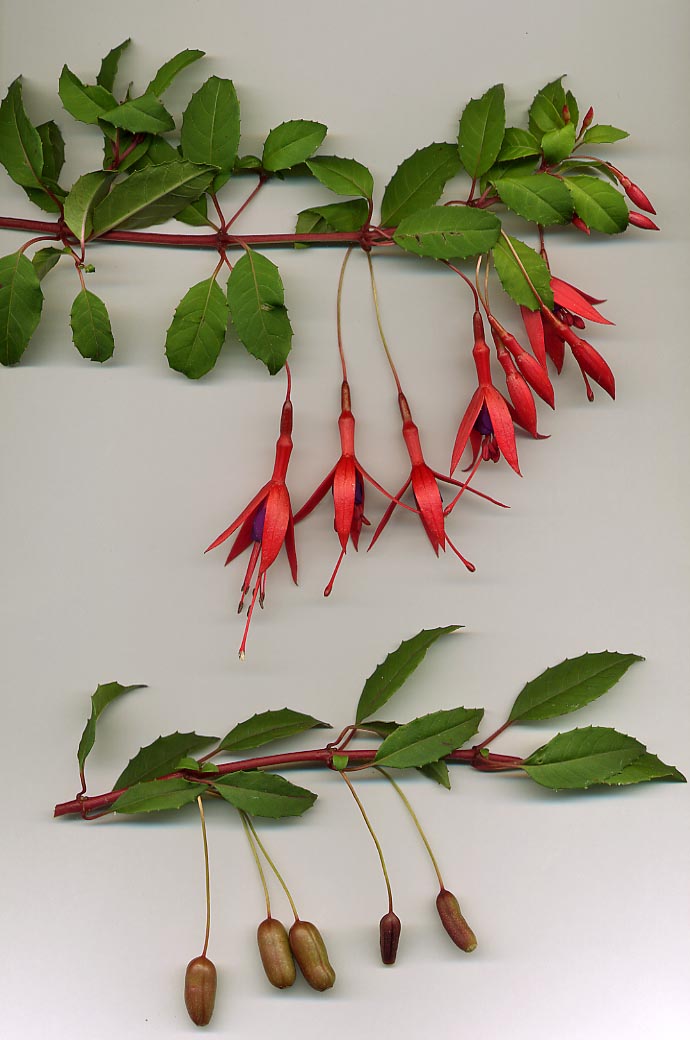
Hardy fuchsia comes from southern Chile and Argentina and is a shrub of 1–2 m with thin, reddish twigs. From July until the first frost it is hung with slender bells with a red calyx and purple petals. In a mild winter the branches survive; in severe frost they die back, but in spring it shoots again from the base and flowers normally on the new growth. On the coast you can even grow it as a hedge.
Light
Sun or partial shade
preferably some sun
Moisture
Normal
no wet feet
Legal basis
Any garden soil
any pH
Hardiness
Throughout Belgium
no protection needed
Size
1–2 m
tall
Flowering
July–October
| Pruning months | April |
|---|---|
| Height | 1–2 m |
| Native to Belgium | No, planted |
| Poisonous to people and pets | Not known to be poisonous |
| Flowering | July–October |
Identify
Hardy fuchsia: how do you recognise it?
- Habit
- Loose, upright shrub of 1–2 m with thin, slightly arching twigs; lower after a hard winter.
- Leaf
- Opposite or in whorls of three, 2–5 cm, oval to lanceolate, finely toothed, often with red veins and a red leaf stalk.
- Bark
- Thin, reddish-brown twigs; older stems with peeling bark.
- Flower
- Hanging flowers (3–5 cm) with a red tube and four red sepals around purple petals, from which the long stamens and style hang down; from July until the first frost.
- Fruit
- Elongated, purplish-black berries (1–2 cm); edible.
- Difference from indoor fuchsias
- The fuchsia hybrids for pots and tubs have larger, often double flowers in all sorts of colours and are not hardy.
Flowering: July–October · Pruning: April
Looks like it, but isn’t
- Indoor fuchsias (Fuchsia hybrids): larger, often double flowers in all sorts of colours; not hardy.
In your garden
Why grow it?
- Months of flowers, from July until the first frost.
- Also flowers in partial shade, when many other shrubs have finished.
- Bumblebees visit the flowers.
- If it dies back in winter, it shoots again in spring.
Hardy fuchsia: where does it grow best?
- Sun to partial shade, ideally with some shade during the hottest hours.
- Humus-rich, free-draining soil that does not dry out in summer or stay wet in winter.
- A sheltered spot, out of the cold east wind, helps the branches through the winter.
- Allow 1–1.5 m width; on the coast it can grow taller and wider.
- Light
- Sun or partial shade
- Legal basis
- Any garden soil
- Moisture
- Normal
- Size
- 1.5 m tall, 1.5 m wide
- Hardiness
- Throughout Belgium, no protection needed
Goes well with
- Hydrangea: Another late-summer flowerer for partial shade; the fuchsia fills in between the large flower heads.
- Escallonia: Also from South America and tolerant of sea wind: together a flowering hedge on the coast.
- Ferns: Fine green foliage at its foot in partial shade, on the same moist soil.
Good and bad companions
Goes well with
- Suits the woodland edge or the light shade of: ginkgo, box elder, ash, honey locust, field maple, silver maple
Maintenance
Hardy fuchsia: when and how to plant it?
- Plant in May, after the last night frost: it then has all summer to root in before its first winter.
- Plant it 5–10 cm deeper than it was in the pot: the base is then better protected against frost.
- Mix compost into the planting soil and firm it well.
- Water regularly during the first summer.
Care
- Watering
- In dry spells in summer, especially in the first year.
- Feeding
- Some compost or a fertiliser for flowering plants in spring.
- Winter blanket
- In November, spread a layer of leaves, straw or compost around the base.
- Hedge
- On the coast you can grow it as an informal flowering hedge; trim it lightly in April.
Tip: ‘Riccartonii’ is regarded as one of the toughest forms and is widely planted as a hedge. Fuchsia magellanica var. molinae has pale pink, almost white flowers.
Hardy fuchsia: when to prune it?
Pruning months: April.
When: In April, once the hard frosts are over.
How:
- Cut frost-damaged or dead shoots back to healthy wood or to just above the ground: it sprouts again from the base and flowers on new shoots.
- If the branches have stayed healthy after a mild winter, cut last year’s shoots back to a few healthy buds and saw the oldest stems off at the base.
- Not sure whether a branch is still alive? Scratch the bark lightly: green underneath means living wood.
Caution: Leave the old shoots on over winter to protect the base, and cover the base with a few leaves.
Propagation
- Cuttings
- In May–August, take tip cuttings of 5–10 cm from non-flowering shoots; they root within a few weeks in moist cutting compost. Keep young plants frost-free during their first winter.
- Layering
- In summer, bend a low shoot to the ground and cover it with soil; it roots quickly.
Hardy fuchsia: how does it get through the winter?
Hardy throughout Belgium: no protection needed.
- In light frost the branches survive. In severe frost, from about −10 °C, they die back to the ground, but the base survives, especially under a thick layer of leaves or straw.
- Leave the dead shoots on until April. In a pot it is much less hardy: keep it sheltered or frost-free.
Diseases and pests
- Frost-killed branches: Normal after a hard winter: cut them away in April. Be patient: sometimes the new shoots only appear in May or June.
- Aphids: Aphids on the shoot tips; hose them off or let natural predators do their work.
- Fuchsia rust: Orange spore pustules on the underside of the leaves, which then turn yellow. Pick off affected leaves and clear up fallen ones.
- Few flowers: Too much shade or too dry. Give it more light, and water in summer.
Through the year
- April: Prune: frost-damaged shoots back to healthy wood or to just above the ground.
- May: New shoots appear; plant after the last night frost; take cuttings.
- June: Water in dry spells.
- July: Flowering begins.
- August: Full flower; bumblebees on the flowers.
- September: Flowering continues; first ripe berries.
- October: Last flowers until the first frost.
- November: Leave the old shoots on; spread leaves or straw around the base.
Use
What can you use it for?
- Garden and landscape
- Flowers for months in late summer and autumn, even in partial shade; on the coast also as a hedge.
- For wildlife
- Bumblebees visit the flowers.
You and this species
Did you know?
- In Ireland and Scotland it has gone so wild on the coast that whole roads are lined with fuchsia hedges.
- The genus is named after Leonhart Fuchs, a 16th-century German botanist; the colour fuchsia was in turn named after the flower.
- In its homeland the flowers are pollinated by hummingbirds; here bumblebees do the job.