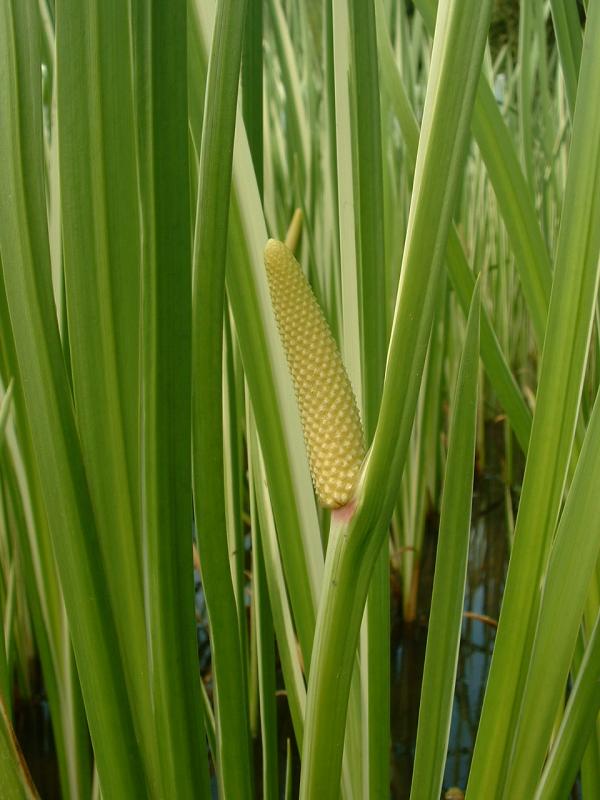
Photo: J.F. Gaffard, Autoreille, France, CC BY-SA 3.0 · source

Water or marginal plant · Acoraceae
Sweet flag
Acorus calamus
In other languages: Kalmoes (Nederlands) · Acore odorant (Français)
Sweet flag is a sturdy marginal plant with sword-shaped, fresh green leaves up to 1 m tall, which at first glance resemble those of yellow flag iris. Originally from Asia, it was introduced to western Europe in the 16th century and has since naturalised along ditches, canals and ponds in Belgium. Bruise a leaf and you smell a fresh, spicy scent of tangerine and cinnamon. It flowers rarely and inconspicuously, with a greenish spadix, and does not set seed here. Gardeners grow it for its fragrant foliage and crisp, upright shape in the marsh zone or shallow water; the variegated form ‘Variegatus’ has cream-striped leaves.
Caution: All parts, especially the rhizome, are poisonous if eaten. Do not plant it where young children, dogs, cats or grazing animals such as horses and sheep can reach it, never eat it and do not use it as a herb. It also spreads strongly: keep it in a basket and never put it into natural waters.
Light
Sun or partial shade
preferably some sun
Moisture
Moist to wet
must not dry out
Legal basis
Loam, clay or peat
any pH
Hardiness
Fully hardy
down to -30 °C
Size
1 m
tall, 0.6 m wide
| Pruning months | March and October |
|---|---|
| Height | 1 m |
| Native to Belgium | No, planted |
| Poisonous to people and pets | Yes, take care with children and pets |
Identify
Sweet flag: how do you recognise it?
- Habit
- Upright fans of sword-shaped leaves up to 1 m tall, rising from a creeping rhizome.
- Leaves
- Narrow and sword-shaped, up to 2 cm wide, fresh green with a clear midrib and a margin that is wavy in places.
- Scent
- When bruised, leaves and rhizome smell spicy, of tangerine and cinnamon.
- Flower
- Rare and inconspicuous: a greenish-yellow spadix jutting out sideways from a leaf-like stem. It does not set seed here.
- Roots
- A thick, fleshy, creeping rhizome that spreads through the mud.
Plants: April–June · Pruning: March and October
In your garden
Why grow it?
- Crisp, upright leaves give structure to the pond edge from spring to autumn.
- The bruised leaves smell fresh, of tangerine and cinnamon.
- Grows both in the marsh zone and in shallow water up to 20 cm deep.
- Tough and fully hardy, even in nutrient-rich water.
- The dense leaves shelter frogs, and dragonfly larvae climb up them to emerge as adults.
- The variegated form brightens a dark corner of the pond.
Sweet flag: where does it grow best?
- Sun or partial shade; it grows densest in full sun.
- Marsh zone or shallow water: 0–20 cm of water above the basket.
- Loam, clay or peat; acid, neutral or chalky: it is not fussy.
- Allow 40–60 cm per plant, and in a small pond one aquatic basket per plant.
- Light
- Sun and partial shade
- Soil type
- Loam, clay or peat
- Acidity
- Not fussy
- Moisture
- Wet
- Size
- 1 m tall, 0.6 m wide
- Hardiness
- Hardy (to -30 °C)
Goes well with
- Yellow flag: Yellow flowers in May–June with similarly shaped leaves.
- Flowering rush: Pink flower umbels in summer, in the same shallow water.
- Marsh marigold: Yellow spring flowers at its feet, in the marsh zone.
- Water forget-me-not: Pale blue flowers that weave between the stiff leaves.
- Water plantain: Airy white flower sprays beside the crisp foliage.
Maintenance
Sweet flag: when and how to plant it?
Plant in April–June.
- Plant from April to June, as the water warms up.
- Use an aquatic basket at least 20–30 cm wide, filled with heavy, low-nutrient aquatic soil or clayey garden soil without fertiliser or compost.
- Lay the rhizome horizontally just below the soil, with the fan of leaves above, and firm in well.
- Top with a layer of gravel so the soil does not wash out and fish do not dig in it.
- Lower the basket to 0–20 cm below the water surface; set young plants a little shallower at first.
- Keep 40–60 cm between plants.
Care
- Water
- Must never dry out. In dry summers, top up the pond with rainwater.
- Feeding
- Not needed: fertiliser in the pond encourages algae.
- Spread
- Check each spring whether the rhizome is growing over the rim of the basket and cut those pieces off.
- Repotting
- Every 3–4 years, lift it from the basket, divide it and replant in fresh aquatic soil.
- Dead leaves
- Remove yellowed leaves from the water in autumn, so they do not rot there.
Tip: Always plant it in a sturdy aquatic basket at a water depth of 0–20 cm: that keeps the thick rhizome in check and makes it easy to divide.
Sweet flag: when to prune it?
Pruning months: March and October.
When: In October, cut off the dead leaves above the water; in March, the rest of the old foliage, before the new shoots appear.
How:
- Cut yellow and brown leaves back to a few centimetres above the water surface.
- In autumn, leave some foliage as shelter for insects and clear it in March.
- Always remove the cut leaves from the pond.
Caution: Wear gloves if you handle the rhizome a lot and wash your hands afterwards: it is poisonous.
Propagation
- Division
- In April–May, cut the rhizome into pieces of 5–10 cm, each with a growing point and a few leaves, and plant each piece in its own aquatic basket.
- Seed
- Sweet flag does not produce viable seed here: it is propagated by division only.
Sweet flag: how does it get through the winter?
Hardy to −30 °C.
- Fully hardy, to about −30 °C: no protection needed.
- The rhizome overwinters in the mud; most of the foliage dies back.
- A basket in shallow water may freeze solid: the rhizome survives it.
Diseases and pests
- Spreading: The rhizome grows over the rim of the basket and roots into the pond floor. Cut off runners every spring.
- Aphids: In summer, aphids may settle on young leaves. Hose them off with a strong jet of pond water; frogs, fish and insects deal with the rest.
- Brown leaf tips: These appear naturally in late summer and after frost. Trim them off: it is not a disease.
- Reverting: The variegated form may produce plain green, more vigorous shoots. Cut them out to keep the variegation.
Through the year
- March: Cut old leaves back to above the water.
- April: Plant or divide. Cut off runners outside the basket.
- May: Plant. The new leaves grow quickly.
- June: Plant. Watch for aphids.
- July: Top up the water in dry spells.
- August: Top up the water in dry spells.
- October: Cut off dead leaves above the water and remove them from the pond.
- December: Rest.
Use
Edible and useful
Not edible. Sweet flag root was once candied and used to flavour bitters and liqueurs, but it contains beta-asarone, which has caused cancer in laboratory animals: do not use sweet flag as a herb, tea or liqueur. It often grows next to yellow flag, which is poisonous too and has almost the same leaves when not in flower; you can tell sweet flag by the spicy scent of a crushed leaf and its wavy edge. Keep children, dogs, cats and grazing animals away from the pond edge and wear gloves when dividing the rhizome. If any is swallowed, call a poison centre (in Belgium 070 245 245) or your doctor at once.
You and this species
Did you know?
- Sweet flag reached western Europe in the 16th century by way of Turkey. Because it does not set seed here, it has spread only through pieces of rhizome along rivers and canals.
- In the past, the fragrant leaves were strewn on the floors of churches and houses and the rhizome was used as a flavouring; because of its toxic compounds, this is no longer advised.
- Sweet flag belongs neither to the irises nor to the arums, but has a family of its own, one of the oldest branches of the monocots.