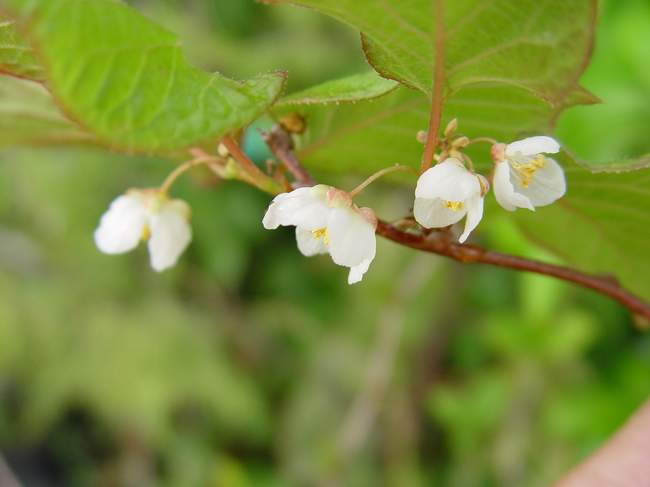
Photo: Wikimedia Commons, CC BY-SA 2.5 · source

Climber · Actinidiaceae
Variegated kiwi vine
Actinidia kolomikta
In other languages: Sierkiwi (Nederlands) · Actinidia (Français)
Actinidia kolomikta comes from the forests of north-east Asia: northern China, Korea, Japan and the Russian Far East. It is a twining climber of 3–5 m, grown mainly for its foliage: in May–June the heart-shaped leaves develop white and then pink tips, as if dipped in paint. At the same time small, sweetly scented white flowers hang beneath the leaves. It is a relative of the kiwi fruit but far hardier, coping with −30 °C. With a male and a female plant you also get small, smooth, sweet fruits.
Light
Sun or partial shade
preferably some sun
Moisture
Normal
no wet feet
Legal basis
Sand, loam or clay
acid to neutral
Hardiness
Fully hardy
down to -30 °C
Size
4 m
tall, 3 m wide
Flowering
May–June
| Pruning months | January and July |
|---|---|
| Height | 4 m |
| Native to Belgium | No, planted |
| Poisonous to people and pets | Not known to be poisonous |
| Flowering | May–June |
Identify
Variegated kiwi vine: how do you recognise it?
- Habit
- Twining climber, 3–5 m tall and 2–3 m wide; the stems wind around wires or battens.
- Leaf
- Oval to heart-shaped, 8–15 cm; bronze when young, then green with a white and pink tip, especially in sun and on older plants.
- Flower
- Small, white, cup-shaped and fragrant, in May–June beneath the leaves. Male and female flowers grow on separate plants.
- Fruit
- Smooth green berries about 2 cm long with a kiwi flavour, ripe at the end of summer, on female plants only.
- Roots
- Fairly shallow and fleshy; they dislike waterlogging.
Flowering: May–June · Harvest and fruit: August–September · Plants: March–May and September–October · Pruning: January and July
In your garden
Why grow it?
- Unique foliage splashed with white, pink and green, from May well into summer.
- One of the hardiest climbers with edible fruit: down to −30 °C.
- Small, sweetly scented white flowers in May–June.
- Female plants with a male nearby bear small, sweet, hairless fruits that you eat skin and all.
- Covers a wall, pergola or fence without rampaging like the common kiwi.
Variegated kiwi vine: where does it grow best?
- Sun or partial shade; the more light, the stronger the white and pink in the leaves.
- Ordinary, well-drained garden soil: sand, loam or clay, acid to neutral. On chalky soil the leaves can turn yellow.
- Moderately moist soil, with no standing water in winter.
- A sheltered wall or pergola: young shoots are sensitive to late frost.
- Plant 30 cm from the wall and allow 2–3 m of width per plant. For fruit, put a male within a few metres of the females.
- Light
- Sun and partial shade
- Soil type
- Sand, loam or clay
- Acidity
- Acid or neutral
- Moisture
- Normal
- Size
- 4 m tall, 3 m wide
- Hardiness
- Hardy (to -30 °C)
Goes well with
- Italian clematis: A late-flowering clematis adds summer colour among the variegated leaves.
- Climbing rose: Pink or white roses echo the colours of the foliage.
- Hardy geranium: Loose underplanting that keeps the base cool and shaded.
- Lady’s mantle: Fresh green leaves and small yellow flowers at the foot of the wall.
Maintenance
Variegated kiwi vine: when and how to plant it?
Plant in March–May and September–October.
- Plant in March–May or September–October, when the soil is neither frozen nor waterlogged.
- Fix wires or a trellis to the wall or pergola first: it twines but does not cling by itself.
- Dig a hole twice as wide as the root ball, 30 cm from the wall, and mix in compost.
- Set the plant at the same depth as in its pot, lean it towards the support and tie the shoots in loosely.
- Water in well and mulch around the base.
- While the plant is young, put a collar of wire netting around the base to keep cats off.
Care
- Water
- Weekly in dry spells during the first year. After that only in long dry periods.
- Feeding
- A little compost or organic fertiliser in April. Not too much nitrogen, or you mainly get long shoots.
- Tying in
- Guide young shoots along the wires in spring and summer; after that they twine on their own.
- Mulching
- A layer of compost or wood chips in spring keeps the roots cool and moist.
- Cats
- Cats lick and chew stems and leaves, especially on young plants. Protect the base with wire netting until the stem is woody.
Tip: Plant it against a sunny wall and be patient: the white and pink leaf tips only become really striking after two or three years.
Variegated kiwi vine: when to prune it?
Pruning months: January and July.
When: In January, when fully dormant, and again in July. Do not prune in March–April, when the plant bleeds sap.
How:
- In January, shorten last year’s side shoots to two or three buds and remove dead and weak stems.
- In July, shorten overlong shoots that grow away from the support.
- Keep a permanent framework of a few main stems along the wires.
- Renew an old, bare plant by removing a few of the oldest stems each winter.
Caution: Do not prune in late winter or spring: the sap is rising and the cuts bleed for a long time.
Propagation
- Semi-ripe cuttings
- In July–August, take 10–15 cm cuttings with a heel and root them in moist cutting compost under plastic, in shade.
- Layering
- In spring, peg a low stem into the soil; sever and replant it after a year. That way you know for sure whether it is male or female.
Variegated kiwi vine: how does it get through the winter?
Hardy to −30 °C.
- Very hardy, to about −30 °C: no protection needed in Belgium.
- Late frost in April–May can damage young shoots and flower buds; if you can, cover the plant with fleece on frosty nights.
- The leaves drop in autumn; the bare stems are inconspicuous in winter.
- It can also grow in a large pot, but wrap the pot in hessian or bubble wrap in winter.
Diseases and pests
- Cats: Chewed or flattened shoots at the base. Put wire netting around the plant until it is well grown.
- Little leaf colour: Young plants and plants in shade colour poorly. Be patient: after two or three years and with more light the white and pink appear.
- No fruit: You need a female plant with a male nearby. Plants sold in garden centres are often male.
- Frost damage: Black, limp young shoots after a late frost. Cut them off: the plant will reshoot.
- Yellow leaves: On chalky soil. Add leaf mould or compost and do not apply lime.
Through the year
- January: Winter pruning: shorten side shoots to two or three buds.
- March: Planting. Check wires or trellis.
- April: Add compost. Watch out for late frost.
- May: Leaves turn white and pink. Flowering begins. Tie in young shoots.
- June: Flowering. Water in dry spells.
- July: Summer pruning: shorten overlong shoots. Take cuttings.
- August: Fruits ripen on female plants.
- September: Pick the fruit. Planting.
- October: Planting. Leaf fall.
- December: Dormant.
Use
Edible and useful
- Fruit (August–September)
- In August–September, female plants bear small, smooth green berries 2 to 3 cm long, if a male plant grows nearby. Pick them when they are soft and smell sweet; they drop quickly then. They taste like a sweet kiwi fruit and are eaten skin and all: fresh, in fruit salad or in jam.
- Storing
- Ripe berries keep for a few days in the fridge. Picked hard, they ripen at room temperature next to an apple. Frozen or as jam they keep longer.
Caution: The berries are safe, but people allergic to kiwi fruit react to them too (an itchy mouth). Cats love the smell of the young shoots and leaves, as with catnip, and can claw young plants to pieces: protect them with wire mesh.
Eating and using is at your own risk: see the terms of use.
Recipes
- Mini kiwi jam (Jam · ± 3 jars · 30 min)
You and this species
Did you know?
- This climber is a relative of the shop-bought kiwi, but its fruits are smaller and smooth-skinned, and the plant is much hardier.
- Cats love it: the plant contains scent compounds similar to those in catmint.
- Male plants often show stronger white and pink leaf colour than female plants.