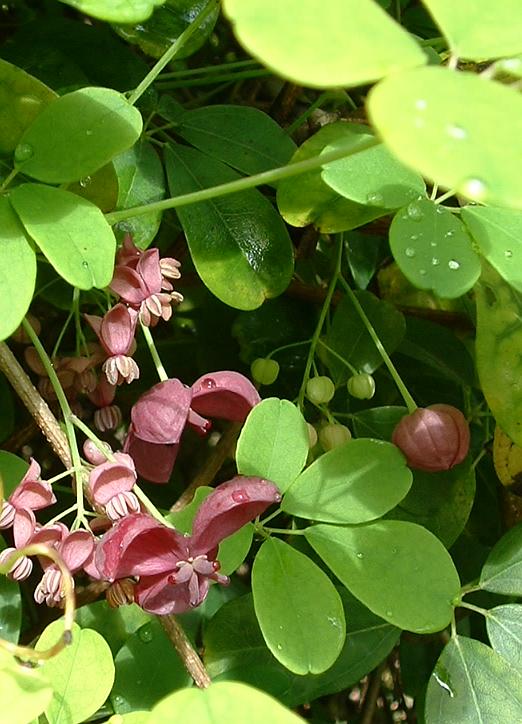
Photo: Wikimedia Commons, CC BY-SA 3.0 · source

Climber · Lardizabalaceae
Chocolate vine
Akebia quinata
In other languages: Akebia (Nederlands) · Akébie à cinq feuilles (Français)
Chocolate vine comes from China, Korea and Japan. It is a vigorous twining climber up to 10 m tall, with elegant leaves made of five oval leaflets that partly stay on the plant in mild winters. In April–May small clusters of purple-brown flowers hang among the leaves, scented of chocolate and vanilla, which explains the common name. Each cluster holds a few large female flowers and many smaller male ones. After a warm summer, and with two different plants, you get striking sausage-shaped purple fruits with edible white pulp. There is also a white-flowered form, ‘Alba’.
Light
Sun or partial shade
preferably some sun
Moisture
Normal
no wet feet
Legal basis
Sand, loam or clay
any pH
Hardiness
Fully hardy
down to -20 °C
Size
8 m
tall, 3 m wide
Flowering
April–May
| Pruning months | June |
|---|---|
| Height | 8 m |
| Native to Belgium | No, planted |
| Poisonous to people and pets | Not known to be poisonous |
| Flowering | April–May |
Identify
Chocolate vine: how do you recognise it?
- Habit
- Vigorous twining climber up to 10 m tall and 3–4 m wide; the thin stems wind around any support.
- Leaf
- Hand-shaped, made of five oval leaflets of 3–6 cm with a notched tip; blue-green beneath. Semi-evergreen.
- Flower
- Hanging clusters in April–May: a few large female flowers of about 3 cm at the base, many small male flowers towards the tip. Purple-brown and fragrant.
- Fruit
- Sausage-shaped purple fruit, 5–10 cm long, that splits open when ripe; sweet white pulp with black seeds.
- Roots
- Widely branching and undemanding.
Flowering: April–May · Harvest and fruit: September–October · Plants: March–May and September–October · Pruning: June
In your garden
Why grow it?
- Early, unusual flowers in April–May with a scent of chocolate and vanilla.
- Fine, hand-shaped foliage that partly persists in mild winters.
- Grows fast and covers a pergola, fence or arch within a few years.
- Edible, eye-catching purple fruits after a warm summer.
- Few diseases and undemanding about soil.
Chocolate vine: where does it grow best?
- Sun or partial shade; it flowers and fruits best in sun.
- Any well-drained garden soil: sand, loam or clay, acid to chalky.
- Moderately moist soil; do not let it dry out in the first year.
- A sheltered spot, as the early flowers are sensitive to late frost.
- Give it a sturdy support and room to spread: allow 3–4 m of width.
- Light
- Sun and partial shade
- Soil type
- Sand, loam or clay
- Acidity
- Not fussy
- Moisture
- Normal
- Size
- 8 m tall, 3 m wide
- Hardiness
- Hardy (to -20 °C)
Goes well with
- Italian clematis: Flowers from July to September through the chocolate vine once that has finished.
- Climbing rose: Summer flowers on a large pergola alongside the vine.
- Tulip: Dark purple tulips at the base flower at the same time, in April.
- Lenten rose: Shade-tolerant underplanting that flowers early in spring.
Maintenance
Chocolate vine: when and how to plant it?
Plant in March–May and September–October.
- Plant in March–May or September–October, when the soil is neither frozen nor waterlogged.
- Put up a sturdy support first: wires, a trellis, a pergola or an arch.
- Dig a hole twice as wide as the root ball and mix in compost.
- Set the plant at the same depth as in its pot, 30 cm from the wall, and guide the shoots to the support.
- Water in well and mulch around the base.
- For fruit, plant two different plants a few metres apart.
Care
- Water
- Regularly in dry spells during the first year; after that only in long dry periods.
- Feeding
- A little compost around the base in March. Nothing more is needed.
- Tying in
- Guide young stems in the right direction before they tangle.
- Pollinating
- Use a small brush to transfer pollen from the small male flowers to the large female flowers of the other plant: this improves your chances of fruit.
- Mulching
- A layer of compost or leaf mould in spring keeps the soil moist.
Tip: Plant two different plants side by side and pollinate with a small brush in April–May: that gives you the best chance of the striking purple fruits.
Chocolate vine: when to prune it?
Pruning months: June.
When: After flowering, in June. That leaves the whole summer to make new stems that flower the following spring.
How:
- Cut back overlong and tangled stems to keep it within its allotted space.
- Remove dead and weak stems.
- A neglected, tangled plant can be cut back hard after flowering; it regrows readily.
- Do not prune in autumn or winter, or you lose the next spring’s flowers.
Caution: If you want fruit, spare the stems where fruits are setting when you prune.
Propagation
- Semi-ripe cuttings
- In July–August, take 10–15 cm cuttings and root them in moist cutting compost under plastic, in good light but out of the sun.
- Layering
- In spring, peg a low stem into the soil; sever and replant it after a year.
- Seed
- Sow seed from ripe fruits straight away in autumn, in a pot outdoors or in a cold frame.
Chocolate vine: how does it get through the winter?
Hardy to −20 °C.
- Hardy to about −20 °C: no protection needed in Belgium.
- In mild winters some leaves stay on; in hard frost they drop and the plant reshoots in spring.
- The flower buds in April are sensitive to late frost: a sheltered spot helps.
- In a pot: wrap the pot in hessian and stand it against a wall.
Diseases and pests
- Frosted flowers: Brown, shrivelled flowers after a frosty night in April. Choose a sheltered spot and cover with fleece when frost is forecast.
- No fruit: A single plant, or two plants raised from the same cutting, rarely fruits. Add a second, different plant and hand-pollinate.
- Tangled growth: An impenetrable mass of stems. Prune every year after flowering and train young stems in good time.
- Few flowers: Too much shade or a plant that is still young. Give more light and a little patience.
Through the year
- March: Planting. Add compost.
- April: Flowering. Cover with fleece on frosty nights.
- May: Flowering. Hand-pollinate for fruit.
- June: Prune after flowering. Train young stems.
- July: Take cuttings. Water in dry spells.
- August: Water in dry spells. The fruits swell.
- September: Pick the fruits once they turn purple and split. Planting.
- October: Pick the fruits. Sow seed. Planting.
Use
Edible and useful
- Fruit (September–October)
- Here, you only get fruit after a warm summer, with two different plants and preferably hand pollination, and even then usually only a few. They are ripe in September and October: they turn purple and split open lengthways. Pick them straight away. Inside is a white, jelly-like pulp full of black seeds, with a soft, mildly sweet taste. Spoon it out and eat it fresh: suck the pulp off the seeds and spit them out or swallow them whole, but do not chew them, as they then taste bitter. The thick purple skin is bitter and is not eaten raw; in Japan it is eaten cooked, stir-fried with miso or stuffed with minced meat.
- Storing
- Once split open, the fruits keep for a day or two at most in the fridge: eat the pulp quickly. The skins keep for a day in the fridge until you cook them.
Caution: Only eat the pulp and, cooked, the skin. Do not chew or grind the seeds. Never eat the skin raw: boil it first in water that you pour away, as in Japan; even then it stays slightly bitter. The leaves, stems and roots are not for eating, not even as tea. Do not expect a big harvest: a single plant, or two plants from the same cutting, seldom bears fruit.
Eating and using is at your own risk: see the terms of use.
Recipes
- Stir-fried akebia skin with miso (Dish · 2 people as a side dish · 30 min)
You and this species
Did you know?
- The name quinata refers to the leaf, which is made up of five leaflets.
- In Japan the fruit is called akebi; the sweet pulp is eaten there and the stems are woven into baskets.
- Each flower cluster holds both male and female flowers; the female ones are much larger.