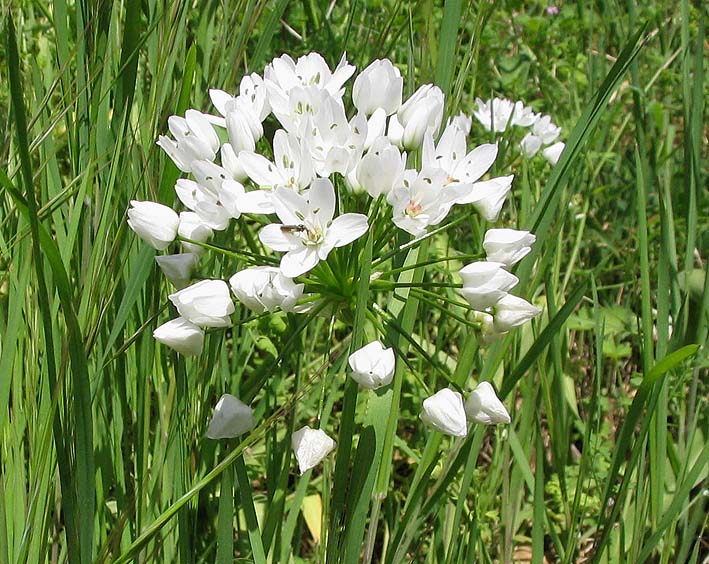
Photo: Jeantosti at French Wikipedia, CC BY-SA 3.0 · source

Bulb or tuber · Amaryllidaceae
Naples garlic
Allium neapolitanum
In other languages: Allium neapolitanum (Nederlands) · Ail de Naples (Français)
Naples garlic comes from the Mediterranean region, from Portugal and North Africa to the Middle East. Above a few narrow, flat leaves, loose, flat heads of pure white, star-shaped flowers with a light, sweet scent appear in May and June. It is one of the best ornamental onions for cutting: the stems are sturdy and the flowers last a long time in a vase. Because it comes from a warm climate, it is not fully hardy here: give it a warm, dry spot against a wall or grow it in a pot. The selection ‘Cowanii’ has slightly larger flowers.
Caution: All parts, and the bulbs in particular, are poisonous to dogs and cats, and also to horses and livestock. Keep loose bulbs out of reach of pets and children, and do not let dogs dig where you have planted them. In a warm spot it can self-seed heavily and spread by offsets; in regions with a mild climate it has become naturalised in many places.
Light
Full sun
warm and bright
Moisture
Dry to normal
no wet feet
Legal basis
Sand or loam
neutral to chalky
Hardiness
down to -8 °C
protect in harsh winters
Size
0.4 m
tall, 0.1 m wide
Flowering
May–June
| Pruning months | June–July |
|---|---|
| Height | 0.4 m |
| Native to Belgium | No, planted |
| Good for bees, butterflies and birds | Yes, for bees |
| Poisonous to people and pets | Yes, take care with children and pets |
| Flowering | May–June |
Identify
Naples garlic: how do you recognise it?
- Habit
- Slender stems 30–40 cm tall above a small tuft of leaves; about 10 cm wide.
- Leaves
- Narrow, flat and strap-like, fresh green. They appear early, sometimes as early as autumn or late winter.
- Flower
- Loose, flat heads of open, star- to cup-shaped flowers, in May and June.
- Colour and scent
- Pure white, with a light, sweet scent. Only bruised stems and leaves smell of onion.
- Bulb
- Small, round bulb that readily forms offsets.
Flowering: May–June · Plants: September–November · Pruning: June–July
In your garden
Why grow it?
- Pure white, lightly scented flowers in May and June, fresh among other spring flowers.
- An excellent cut flower that lasts a long time in a vase.
- Bees love to visit the open, star-shaped flowers.
- Small and slender: lovely in a pot on a sunny terrace or at the foot of a warm wall.
- In a suitable spot it slowly spreads into a white clump.
Naples garlic: where does it grow best?
- Full sun, in the warmest spot in the garden, ideally at the foot of a south-facing wall.
- Sandy or loamy, free-draining soil, neutral to chalky.
- Dry to moderately moist, but never wet in winter.
- Plant in groups 8–10 cm apart, or in a pot you can move in hard frost.
- Light
- Sun
- Soil type
- Sand or loam
- Acidity
- Neutral or chalky
- Moisture
- Dry or normal
- Size
- 0.4 m tall, 0.1 m wide
- Hardiness
- Half hardy (to -8 °C): protect it in harsh winters
Goes well with
- Lavender: Grey leaves and blue flowers for the same warm, dry spot.
- Rosemary: A Mediterranean shrub that, like it, loves a warm wall.
- Catmint: A blue edging that makes the white glow and attracts bees.
- Lamb’s ears: Silver-grey, felty leaves that go beautifully with the white heads.
Maintenance
Naples garlic: when and how to plant it?
Plant in September–November.
- Plant the bulbs in September, October or November.
- Choose a warm, sheltered spot and make sure drainage is good; mix grit into heavy soil.
- Plant the bulbs 8–10 cm deep, tip pointing up.
- Space them 8–10 cm apart and plant in groups of at least five.
- In a pot: a 20 cm pot holds 7–10 bulbs, in potting compost mixed with one third grit.
- Water once after planting, then let the soil dry out a little.
Care
- Watering
- In spring, while it is growing and flowering, water in dry spells. In summer, during its rest, keep it dry.
- Feeding
- Not needed in open ground. In a pot, a little bulb fertiliser in March.
- Cut flowers
- Cut the stems when the first flowers open; the rest will open in the vase.
- Deadheading
- Cut faded heads off in June before they set seed, unless you want it to self-sow.
- Foliage
- Let it die back naturally after flowering and remove it in July once it is dry.
Tip: Change the water in the vase every two days and trim the stems a little each time: the flowers last longer and you will not notice an oniony smell from the stems.
Naples garlic: when to prune it?
Pruning months: June–July.
When: No pruning is needed. Cut off the faded heads in June and clear the withered leaves in July.
How:
- After flowering, cut the flower stems off just above the ground.
- Leave the leaves until they are yellow and dry; the bulb draws reserves from them.
- For the vase, cut when the first flowers are open: that way you enjoy them longest.
Caution: In a warm, dry spot it can spread widely by seed and offsets: cut off the heads before the seed ripens.
Propagation
- Offsets
- In July–August, while the plant is dormant, lift the bulbs, separate the offsets and replant them in September.
- Seed
- Sow fresh seed in autumn in a pot of gritty seed compost, in a sheltered spot outdoors or in a cold frame. Seedlings flower after 2–3 years.
Naples garlic: how does it get through the winter?
Hardy to −8 °C: protect in harsh winters.
- Not fully hardy, to about −8 °C. In a warm, dry spot it survives a mild Belgian winter; a severe winter may kill it.
- The leaves appear early and can be frosted: in hard frost, cover the spot with straw or horticultural fleece.
- Wet soil in winter is as dangerous as cold: make sure drainage is good.
- In a pot: in hard frost, move it to a cold, light, frost-free place such as an unheated greenhouse.
Diseases and pests
- Frost damage: Brown, glassy leaf tips after hard frost. Cut them off; the bulb usually still grows. Protect it better next winter or grow it in a pot.
- Bulb rot: The bulbs go soft and fail to come up in soil that is too wet. Replant in a dry, warm spot.
- Slugs: They eat the young leaves in late winter and spring. Pick them off in the evening.
- Too many seedlings: In a spot it likes, it self-seeds freely. Cut off the heads before the seed ripens and pull out unwanted seedlings.
Through the year
- January: In hard frost, cover the leaves. Keep pots frost-free.
- March: Move pots back outside. Give bulb fertiliser in pots.
- April: Watch out for slugs. Water in dry spells.
- May: Flowering begins. Cut flowers for the vase.
- June: Last flowers. Cut off faded heads.
- July: Clear withered leaves. Keep pots dry. Collect offsets.
- September: Plant bulbs. Replant offsets.
- October: Plant bulbs. Sow fresh seed.
- November: Plant the last bulbs. Move pots under cover.
- December: In hard frost, cover the plants or bring the pot indoors.
Use
Edible and useful
Not edible. Ornamental onions are true alliums, related to onion, garlic, leek and chives, and like them they are poisonous to dogs and cats: all parts, especially the bulbs, contain sulphur compounds that damage the red blood cells and can cause anaemia. Cats are more sensitive than dogs, and the signs (lethargy, pale gums, red or brown urine) sometimes appear only after a few days. Horses, sheep and other livestock can fall ill from them too. Even though the leaves and bulbs smell of onion, they are not grown as vegetables: do not eat them, and never store the bulbs with the kitchen onions, as they are not meant for eating and may have been treated with pesticides. Do not plant them where your dog digs, keep loose bulbs out of reach of pets and children, and do not put a vase of alliums where your cat chews the stems. If your dog or cat has eaten a bulb or leaves, call your vet, even if it shows no signs yet. If any is swallowed, call a poison centre (in Belgium 070 245 245) or your doctor at once.
Good for wildlife
- Bees
- Nectar and pollen for honeybees and wild bees.
You and this species
Did you know?
- Neapolitanum means ‘from Naples’, but it grows wild throughout the Mediterranean region.
- Unlike many ornamental onions, the flowers smell sweet; only bruised stems and leaves smell of onion.
- Like many Mediterranean bulbs, it grows during the cool, wet season and rests through the hot, dry summer.