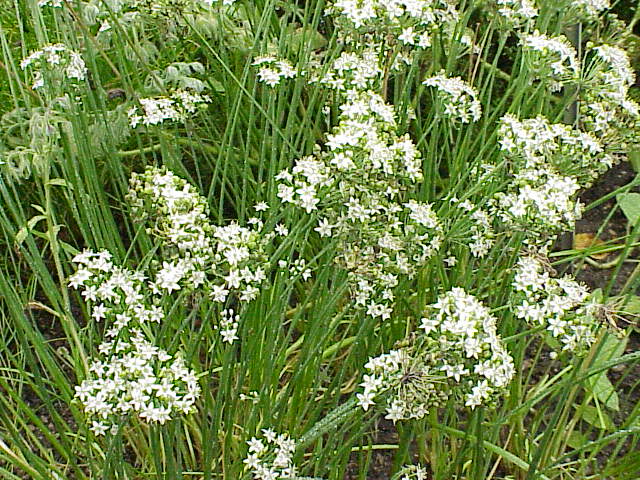
Photo: Kurt Stüber [1], CC BY-SA 3.0 · source

Herb · Amaryllidaceae
Garlic chives
Allium tuberosum
In other languages: Chinese bieslook (Nederlands) · Ciboulette chinoise (Français)
Garlic chives, also called Chinese chives, are a perennial from East Asia, where they have been grown as a vegetable for centuries. They form dense clumps of flat, grassy leaves with a mild garlic flavour. In August and September, umbels of small, white, star-shaped flowers appear on sturdy stems, and bees and butterflies love them. Unlike ordinary chives, they flower in late summer and have flat rather than hollow leaves. They are easy, hardy and will keep you in fresh leaves for years.
Caution: Like all onions and garlic, garlic chives are poisonous to dogs and cats. Do not plant them where pets nibble plants, and never give them leftovers containing garlic or onion. They also self-seed heavily: cut off the flowers before the seed ripens.
Light
Sun or partial shade
preferably some sun
Moisture
Normal
no wet feet
Legal basis
Sand, loam or clay
any pH
Hardiness
Fully hardy
down to -20 °C
Size
0.4 m
tall, 0.3 m wide
Flowering
August–September
| Pruning months | March and September |
|---|---|
| Height | 0.4 m |
| Native to Belgium | No, planted |
| Good for bees, butterflies and birds | Yes, for bees and butterflies |
| Poisonous to people and pets | Yes, take care with children and pets |
| Flowering | August–September |
Identify
Garlic chives: how do you recognise it?
- Habit
- Dense clump 30–40 cm tall and 30 cm wide, growing from short rhizomes with small, elongated bulbs.
- Leaves
- Flat, narrow and strap-like, 20–35 cm long; dark green with a mild garlic flavour.
- Flower
- Flat to domed umbels of small, white, star-shaped flowers on sturdy stems, in August–September.
- Seed
- Small black seeds in three-chambered capsules; the plant self-seeds readily.
- Flavour
- Milder than garlic, with a fresh oniony note; buds and flowers taste the same.
Flowering: August–September · Harvest and fruit: May–September · Sowing: March–May · Plants: April–May and September · Pruning: March and September
In your garden
Why grow it?
- Fresh leaves with a mild garlic flavour from spring to autumn, without any garlic to peel.
- White flower heads for bees and butterflies in late summer, when many other herbs have finished flowering.
- Delicious in stir-fries, omelettes, soups and dumplings; the buds and flowers are edible too.
- Hardy and perennial: one clump stays productive for years.
- Small enough for a pot, a herb planter or the edge of the vegetable patch.
Garlic chives: where does it grow best?
- Sun or partial shade; it flowers best in full sun.
- Any good garden soil: sand, loam or clay, slightly acid to chalky.
- Ordinary, not too dry soil; avoid spots where water lies.
- Plant 25–30 cm apart, or in a pot at least 20 cm across.
- Light
- Sun and partial shade
- Soil type
- Sand, loam or clay
- Acidity
- Not fussy
- Moisture
- Normal
- Size
- 0.4 m tall, 0.3 m wide
- Hardiness
- Hardy (to -20 °C)
Goes well with
- Chives: Flower in May–June; together they give you flowers and leaves for almost the whole summer.
- Oregano: Another late-summer bee plant for the same sunny spot.
- Ice plant: Flowers at the same time and attracts butterflies.
- Thyme: A low, fragrant edging in front of the clumps.
Maintenance
Garlic chives: when and how to plant it?
Plant in April–May and September.
- Sow indoors in March–April or outdoors in April–May; plant out young clumps in April–May or September.
- Sow 4–6 seeds together in a small pot and cover them thinly; at 15–20 °C they germinate in 2–3 weeks.
- Loosen the soil and work in some compost.
- Plant the clumps at the same depth as in the pot, 25–30 cm apart.
- Water straight away and keep the soil moist for the first few weeks.
- A thin mulch of compost keeps weeds down between the young clumps.
Care
- Watering
- Water in dry spells, especially in a pot: this keeps the leaves tender.
- Feeding
- A layer of compost in spring, and a little more after a few harvests.
- Harvesting
- Cut the leaves just above the ground when they are 15–20 cm long; they soon grow back. In the first year after sowing, harvest sparingly.
- Spent flowers
- Cut off the flower heads before the seed is ripe and black, or it will self-seed everywhere.
- Dividing
- Lifting and dividing the clump every 3–4 years keeps it young and productive.
Tip: Cut off the flower heads before the seed ripens, or you will find seedlings everywhere. Leave a few to eat the buds and flowers.
Garlic chives: when to prune it?
Pruning months: March and September.
When: Garlic chives are not really pruned. In March, cut away the dead leaves, and in September the spent flower heads.
How:
- In late winter or March, cut last year’s dead leaves back to just above the ground.
- Cut off the flower stems after flowering, before the seed ripens.
- If you want to save seed, leave a few heads and cut them once the capsules split open.
Propagation
- Division
- In spring or September: lift the clump and split it into pieces of a few bulbs each. Replant straight away and water.
- Seed
- Sow indoors in March–April or outdoors in April–May. Use fresh seed: it only stays reliably viable for a few years.
Garlic chives: how does it get through the winter?
Hardy to −20 °C.
- Hardy to about −20 °C; the leaves die back in winter and the clump regrows in spring.
- Leave cutting away the dead leaves until late winter.
- In a pot: stand it against a wall and make sure the compost does not stay sodden.
Diseases and pests
- Rust: Orange-brown pustules on the leaves, especially in wet summers. Cut affected leaves down to the ground: the new growth is usually healthy.
- Allium leaf miner and leek moth: Tunnels and white streaks in the leaves. Cover the clumps with fine insect mesh in spring and autumn.
- Seedlings everywhere: It self-seeds easily, even between paving. Cut off the flowers before the seed ripens.
- Slugs: They eat young seedlings. Protect them with a collar or pick the slugs off in the evening.
Through the year
- March: Cut away dead leaves. Add compost. Sow indoors.
- April: Sowing and planting. First leaves to harvest.
- May: Sow outdoors. Planting. Harvest regularly.
- June: Harvest. Water in dry weather.
- July: Harvest. Water in dry weather.
- August: Flowering. Pick buds and flowers.
- September: Flowering. Cut off spent heads. Plant or divide.
- October: Last harvest of leaves.
- November: The leaves die back.
Use
Edible and useful
- Leaves (May–September)
- Cut the flat leaves from May to September a few centimetres above the ground; they regrow quickly, so you can harvest three or four times a year. They taste like a mix of chives and garlic. Use them fresh: in scrambled eggs, dumplings, stir-fries, soup and herb butter.
- Flowers (August–September)
- The white star-shaped flowers and buds in August and September are edible too, with a mild garlic flavour: in a stir-fry or over a salad. Cut them off before they set seed, or the plant will sow itself everywhere.
- Storing
- Fresh, a few days in the fridge in a damp cloth or standing in a glass of water. Dried they have little flavour; finely chopped they freeze well. In winter the plant dies back above ground and reappears in spring.
Caution: Like all alliums, garlic chives are poisonous to dogs and cats: do not let them eat any. Remove the flower heads before the seeds ripen, as the plant self-seeds readily. People sensitive to onion or garlic sometimes tolerate garlic chives poorly too.
Eating and using is at your own risk: see the terms of use.
Recipes
- Garlic chive and egg dumplings (Dish · ± 30 pieces · 1 hr)
- Garlic chive and tofu stir-fry (Dish · 2 people · 20 min)
Good for wildlife
- Bees
- Nectar and pollen for honeybees and wild bees.
- Butterflies
- Nectar for butterflies.
You and this species
Did you know?
- Unlike ordinary chives, the leaves are flat, not hollow.
- In China they are also grown in the dark: the leaves stay yellow and tender and are prized as a delicacy.
- In Chinese cooking they are a classic filling for dumplings, often with pork or egg.