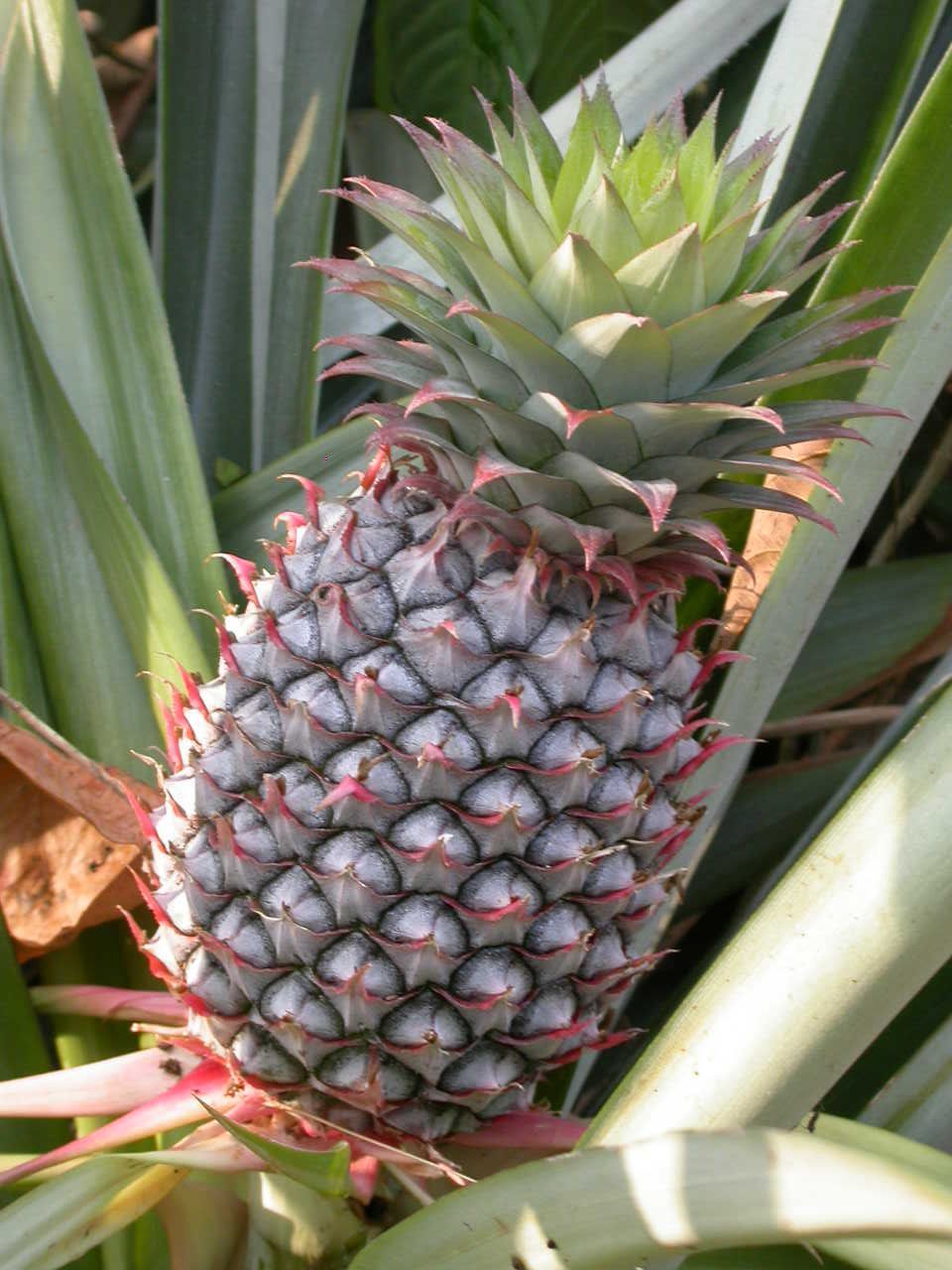
Photo: MANOJTV at English Wikipedia, CC BY-SA 3.0 · source

Houseplant · Bromeliaceae
Pineapple
Ananas comosus
In other languages: Ananas (Nederlands) · Ananas (Français)
Pineapple is a bromeliad from South America, probably originating in the region around Brazil and Paraguay. As a houseplant it forms a broad rosette of stiff, narrow, grey-green leaves, often with spiny edges, up to about 80 cm tall and wide. After a few years a sturdy flower stem may emerge from the centre, bearing small purple flowers that together develop into a small pineapple. Many people grow it from the leafy top of a shop-bought pineapple: a fun and cheap project, also with children. There are also ornamental forms with yellow- or cream-striped leaves.
Caution: The leaves have sharp edges and tips: do not place the plant where children or pets can brush against it.
Light
Full sun
warm and bright
Moisture
Dry to normal
no wet feet
Legal basis
Potting soil
Hardiness
Houseplant
min. 15 °C
Size
0.8 m
tall, 0.8 m wide
| Height | 0.8 m |
|---|---|
| Poisonous to people and pets | Not known to be poisonous |
Identify
Pineapple: how do you recognise it?
- Habit
- Broad, open rosette 60–80 cm tall and as wide.
- Leaves
- Stiff, narrow and channelled, grey-green; the edges often carry sharp spines and the tip is pointed.
- Flower
- After a few years, a dense, cone-shaped spike of small purple to violet flowers on a sturdy stem from the centre.
- Fruit
- A compound fruit topped with a new leafy crown; indoors it usually stays smaller than shop-bought fruit.
- Roots
- A fairly small, shallow root system: a modest pot is enough.
Harvest and fruit: January–December · Plants: April–May
In your garden
Why grow it?
- A free plant from the top of a shop-bought fruit.
- An exotic, sculptural rosette that looks good all year.
- May produce an edible fruit after a few years.
- Copes with dry indoor air and the odd forgotten watering.
- A fun growing project to follow with children.
Pineapple: where does it grow best?
- As bright as possible: a sunny windowsill, even facing south.
- Warm: preferably 20–25 °C and never below 15 °C.
- Airy, free-draining, slightly acid potting compost, for example mixed with a little orchid bark or sand.
- Dry to moderately moist: let the compost dry out between waterings.
- Plenty of space around it: the leaves spread wide and are sharp.
- Light
- Sunny
- Potting soil
- Multi-purpose compost or airy, humus-rich compost
- Acidity
- Acid or neutral
- Watering
- Sparingly or moderately
- Size
- 0.8 m tall, 0.8 m wide
- Temperature
- Minimum 15 °C
Goes well with
- Succulents: They share the same sunny windowsill and also like little water.
- Cacti: Same bright spot and dry regime.
- Aloe: Another sun-loving rosette plant with firm leaves.
- Air plant: Small relatives from the same family, lovely beside the pineapple.
- Yucca: A bold, architectural houseplant that also loves light.
Maintenance
Pineapple: when and how to plant it?
Plant in April–May.
- In April–May, twist the leafy top off a ripe, healthy pineapple and remove the lower leaves to expose 2–3 cm of stem.
- Let the top dry for a few days until the wound has sealed.
- Set it 2–3 cm deep in a 12–15 cm pot of airy, slightly acid potting compost.
- Water a little and keep it warm and bright. After a few weeks, roots and new leaves appear in the centre.
- After a year, pot it on into a pot of about 20 cm; larger is usually not needed.
- Choose a sturdy, heavy pot: otherwise the large rosette easily tips over.
Care
- Water
- Moderate: let the compost dry out between waterings. Use tepid water, ideally soft.
- Feeding
- From April to September, half-strength houseplant feed every three to four weeks.
- Humidity
- Tolerates dry air, but occasional misting does it good.
- Repotting
- Rarely needed; every two years in spring, only if the pot becomes too small.
- Harvesting
- The fruit is ripe when it turns yellow and smells sweet. Cut it off and eat it fresh, for example in a fruit salad.
Tip: If a plant a few years old will not flower, put it in a clear plastic bag with a ripe apple for a week: the gas given off by the apple can trigger flowering.
Pineapple: when to prune it?
When: A pineapple is not pruned. You only remove dry leaves and, after harvesting, the old mother plant.
How:
- Pull or cut off dried lower leaves.
- After harvesting, the mother plant slowly dies; let the offsets grow well first.
- Then cut away the old rosette or pot the offsets up separately.
- Wear gloves: the leaf edges are sharp.
Caution: The leaf edges and tips are sharp: wear gloves when repotting.
Propagation
- Leafy top
- In April–May, twist the top off a ripe pineapple, remove the lower leaves, let it dry for a few days and set it 2–3 cm deep in airy compost.
- Offsets
- After fruiting, offsets appear at the base. Let them reach 15–20 cm, cut them off and pot them up separately.
Pineapple: how does it get through the winter?
- Houseplant: never below 15 °C and no cold draughts.
- In winter, water less, only when the compost is completely dry, and do not feed.
- Place it in the brightest spot in the house, but not against cold window glass.
- It copes fairly well with dry air from the heating; occasional misting helps.
Diseases and pests
- Root rot: The leaves turn brown at the base and the rosette comes loose. Too much water: water less and use airy compost.
- Mealybug and scale: White tufts or small brown scales at the leaf bases. Wipe them off with a cotton bud dipped in alcohol.
- No flowers: The plant is still too young or too dark. Place a plant a few years old in a clear plastic bag with a ripe apple for a week.
- Pale, limp leaves: Too little light. Move it to a sunnier spot.
Through the year
- January: Little water. Brightest spot in the house.
- March: Water a little more as the days get lighter.
- April: Root a leafy top. Repot if needed.
- May: Plant the leafy top. Start feeding.
- June: Growth. Feed every three to four weeks.
- July: If needed, trigger older plants into flower with an apple.
- August: Growth. Water when the compost is dry.
- September: Last feed of the year.
- October: Water less.
- November: Rest: little water, no feed.
- December: Keep bright and warm, away from cold window glass.
Use
Edible and useful
- Fruit (January–December)
- A pineapple in a pot rarely fruits, and not until it is two to three years old or more: a flower stalk then appears from the heart of the rosette, and the fruit is ripe about six months later. So there is no fixed season: it depends on when the plant flowered. The fruit usually stays smaller than in the shops. It is ripe when it turns golden yellow from the bottom up, smells sweet at the base and gives very slightly when pressed. Let it ripen on the plant: once picked, a pineapple gets no sweeter. Cut off the fruit with a piece of stalk, cut off the crown and the skin, remove the brown eyes and eat the flesh fresh, in a fruit salad or a salsa. The crown can be rooted again.
- Storing
- A ripe pineapple keeps for two to three days at room temperature. Cut pieces keep for 3 to 4 days in a closed box in the fridge, or freeze them spread out for up to 3 months: great for smoothies and sorbet.
- Fermenting
- The skin and tough core make tepache, a lightly fermented, refreshing drink from Mexico: with sugar, water and a little cinnamon, it ferments in two to three days at room temperature.
Caution: Only eat ripe fruit: an unripe pineapple is very sour and stings the mouth and throat. Even ripe, fresh pineapple contains bromelain, an enzyme that breaks down proteins: after a lot of pieces, your lips and tongue may tingle or feel sore. Cooking deactivates the enzyme. That is why gelatine does not set with fresh pineapple, and fresh pineapple turns bitter after a while in yoghurt or cream: add it just before serving. The skin, eyes and leaves are not eaten; the leaf edges and tips are sharp. Tepache contains a little alcohol, more the longer it ferments. Do not eat fruit from an ornamental pineapple bought in flower or in fruit: ornamental plants are sometimes treated with products not approved for food.
Eating and using is at your own risk: see the terms of use.
Recipes
- Pineapple salsa with red chilli and coriander (Dish · 4 people · 15 min)
- Tepache (fermented pineapple drink) (Fermentation · ± 1 litre · 15 min + 2 to 3 days fermenting)
You and this species
Did you know?
- Christopher Columbus came across the pineapple on the island of Guadeloupe in 1493.
- In the 17th and 18th centuries wealthy Europeans grew pineapples in heated glasshouses: a pineapple on the table was a status symbol.
- Fresh pineapple contains an enzyme that breaks down proteins, which is why a jelly made with gelatine and fresh pineapple will not set. With tinned pineapple it works.