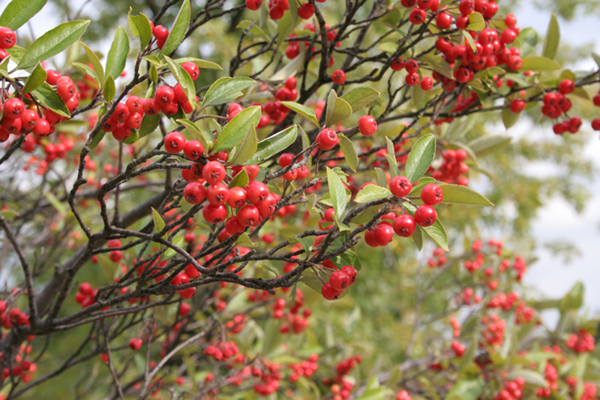
Photo: No machine-readable author provided. Abrahami assumed (based on copyright claims)., CC BY-SA 2.5 · source

Shrub · Rosaceae
Red chokeberry
Aronia arbutifolia
In other languages: Rode appelbes (Nederlands) · Aronie à feuilles d’arbousier (Français)
Red chokeberry comes from eastern North America, where it grows in wet woods, swamps and along watersides, but also on drier sandy soil. It is an upright, multi-stemmed shrub of 2–2.5 m with glossy dark green leaves that are grey and felted underneath. In May it bears small clusters of white flowers with pink anthers. In autumn the leaves turn a brilliant red, and the bright red berries hang on the branches well into winter. The best-known cultivar is ‘Brilliant’, with especially vivid autumn colour.
Light
Sun or partial shade
preferably some sun
Moisture
Normal to wet
must not dry out
Legal basis
Any garden soil
acid to neutral
Hardiness
Fully hardy
down to -30 °C
Size
2.5 m
tall, 1.5 m wide
Flowering
May
| Pruning months | February–March |
|---|---|
| Height | 2.5 m |
| Native to Belgium | No, planted |
| Good for bees, butterflies and birds | Yes, for bees and birds |
| Poisonous to people and pets | Not known to be poisonous |
| Flowering | May |
Identify
Red chokeberry: how do you recognise it?
- Habit
- Upright, multi-stemmed shrub 2–2.5 m tall and 1.5 m across; slowly forms a small thicket with suckers.
- Leaves
- Elliptic, finely toothed and glossy dark green; grey and felted underneath; bright red in autumn.
- Flower
- Small white flowers with five petals and pink anthers, in clusters in May.
- Fruit
- Small, round, bright red berries that last into winter.
- Roots
- Finely branched; in a good spot suckers appear around the shrub.
Flowering: May · Harvest and fruit: September–November · Plants: March–April and October–November · Pruning: February–March
In your garden
Why grow it?
- One of the finest red autumn colours of any shrub.
- Red berries that last into winter and feed birds late in the season.
- White flowers in May for bees.
- Tolerates wet soil, so it suits a damp garden or a bank by water.
- Rarely troubled by disease and needs little pruning.
Red chokeberry: where does it grow best?
- Sun gives the best autumn colour and the most berries; partial shade is fine too.
- Sandy, loamy, clay or peaty soil, acid to neutral; on very chalky soil the leaves may turn yellow.
- Normal to wet: also suitable for a bank by water or a spot that is wet in winter.
- Plant as a specimen, in a mixed informal hedge or in a group 1–1.5 m apart.
- Light
- Sun and partial shade
- Soil type
- Sand, loam, clay or peat
- Acidity
- Acid or neutral
- Moisture
- Normal or wet
- Size
- 2.5 m tall, 1.5 m wide
- Hardiness
- Hardy (to -30 °C)
Goes well with
- Michaelmas daisy: Blue and purple beside the red autumn leaves.
- Purple moor grass: Straw-yellow stems beside the red leaves, also on wet soil.
- Dogwood: Red or yellow stems in winter, for the same moist soil.
- Guelder rose: White flowers and red berries in a mixed, bird-friendly hedge.
- Elephant’s ears: Evergreen leaves at the foot of the shrub.
Maintenance
Red chokeberry: when and how to plant it?
Plant in March–April and October–November.
- Plant in March–April or October–November.
- Dig a hole twice as wide as the root ball and mix in compost.
- Set the shrub at the same depth as in the pot and firm the soil well.
- Space 1–1.5 m apart; in an informal hedge 80–100 cm.
- Water in with a full can.
- Mulch with leaf mould or wood chips.
Care
- Watering
- In dry spells in the first year; after that only in long dry periods, especially on sandy soil.
- Feeding
- Some compost in spring; nothing more is needed.
- Mulching
- A layer of leaf mould keeps the soil moist and slightly acid.
- Suckers
- In spring or autumn, cut off suckers that spread too far with a spade.
- Berries
- Leave the berries on for the birds and for winter interest.
Tip: Plant it where you can see it from the house: in October it turns fiery red, and the berries hang on into winter, when the shrub is otherwise bare.
Red chokeberry: when to prune it?
Pruning months: February–March.
When: Little needed. In February–March, remove an old stem at the base now and then.
How:
- Every one or two years, saw out one or two of the oldest stems at the base.
- Remove dead, weak and crossing branches.
- Do not cut back the tips: you would lose flowers and berries.
- If the shrub gets too wide, cut off suckers at the edge.
Propagation
- Suckers
- Between October and March, detach a rooted sucker with a spade and replant it.
- Softwood cuttings
- In June, root 10 cm cuttings of young shoots under plastic in moist cutting compost.
- Seed
- In autumn, clean the seed from the berries and sow it in a tray outdoors; winter cold breaks the dormancy.
Red chokeberry: how does it get through the winter?
Hardy to −30 °C.
- Very hardy, to −30 °C: no protection is needed in Belgium.
- The red berries decorate the bare shrub well into winter.
- In a pot: choose a large pot and keep the compost moist, even in winter.
Diseases and pests
- Yellow leaves: Chlorosis on chalky soil. Mulch with leaf mould or pine needles and water with rainwater.
- Bare base: Old stems become bare at the bottom. Saw them off at ground level; young shoots will fill the shrub again.
- Few berries: Too much shade or too much pruning. A sunnier spot and less pruning help.
- Aphids: On young shoots in spring. Natural predators usually deal with them; otherwise hose them off with water.
- Suckers: The shrub spreads. Cut suckers off every year.
Through the year
- February: Remove old stems at the base.
- March: Planting. Add compost.
- April: Planting. Apply mulch.
- May: Flowering; bees visit.
- June: Take softwood cuttings.
- July: Water in dry spells.
- August: The berries start to colour.
- September: Red berries. Autumn colour begins.
- October: Fiery red autumn colour. Planting. Sow seed.
- November: Planting. Leave the berries on.
- December: The berries brighten the bare shrub; birds eat them later in winter.
Use
Edible and useful
- Berries (September–November)
- The berries of red chokeberry turn bright red in September and are ripe in October and November, when they are deeply coloured and give slightly when pressed. They stay on the shrub well into winter, so there is no need to hurry. They are smaller, drier and more mealy than those of the purple-black chokeberry, and raw they are astringent and sweet-sour: use them cooked and mixed with apple, in jelly or apple sauce, to which they give a lovely pink colour. Never pick them all: leave a good share for the birds, which eat them late in the winter.
- Storing
- Fresh berries keep for one to two weeks in the fridge. You can also freeze them in a bag for up to a year and cook them from frozen. Jelly keeps for a year in sealed jars in a cool, dark place; apple sauce for a few days in the fridge or three months in the freezer.
Caution: Raw, the berries are astringent: only taste a few and cook the rest. Cook them whole, rub them through a sieve or let the juice drip, and do not grind or blend the pips: as with many fruits of the rose family, they contain small amounts of substances that can release hydrogen cyanide. The juice stains clothes. Do not confuse them with other red berries in the garden, such as those of cotoneaster, guelder rose or yew: only pick from your own shrub, which you recognise with certainty.
Eating and using is at your own risk: see the terms of use.
Recipes
- Red chokeberry and apple jelly (Jelly · ± 3 jars of 250 ml · 1 hr + overnight draining)
- Pink apple sauce with red chokeberry (Compote · ± 1 litre · 45 min)
Good for wildlife
- Bees
- Nectar and pollen for honeybees and wild bees.
- Birds
- Berries, seeds or insects as food, or a place to nest.
You and this species
Did you know?
- The name chokeberry refers to the sharp, astringent taste of the berries.
- Botanically the berries are tiny apples, and the shrub is related to apple, pear and rowan.
- Purple chokeberry is a natural hybrid between red and black chokeberry.