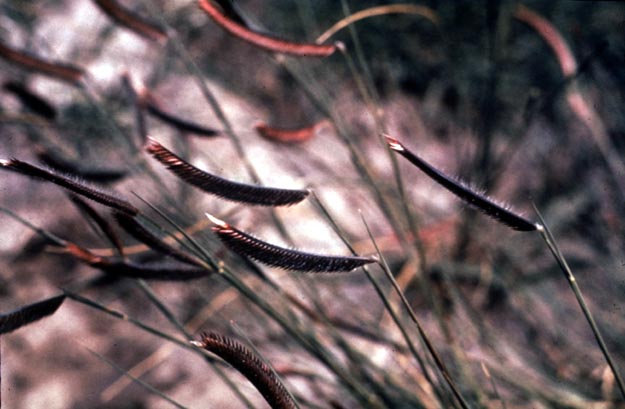
Photo: Wikimedia Commons, Public domain · source

Ornamental grass · Poaceae
Blue grama
Bouteloua gracilis
In other languages: Bouteloua gracilis (Nederlands) · Bouteloua gracilis (Français)
Blue grama (Bouteloua gracilis), also called mosquito grass, is a low grass from the dry prairies of North America, from Canada to Mexico. It forms fine tufts of narrow, grey-green leaves, about 40 cm tall with the flower stems. From July to September the flower spikes stand out horizontally at the tips of the stems, like tiny eyelashes or mosquitoes: purplish red at first, later straw-coloured. It is a true drought survivor and a perfect plant for a gravel garden or a sunny rock garden. The best-known cultivar is ‘Blonde Ambition’, which grows taller and has more, paler spikes.
Light
Full sun
warm and bright
Moisture
Dry
tolerates drought
Legal basis
Sand or loam
neutral to chalky
Hardiness
Fully hardy
down to -30 °C
Size
0.4 m
tall, 0.3 m wide
Flowering
July–September
| Pruning months | March–April |
|---|---|
| Height | 0.4 m |
| Native to Belgium | No, planted |
| Poisonous to people and pets | Not known to be poisonous |
| Flowering | July–September |
Identify
Blue grama: how do you recognise it?
- Habit
- Fine, loose tuft 20–30 cm tall, about 40 cm with the flower stems, and 30 cm wide.
- Leaves
- Narrow, grey-green to blue-green, sometimes slightly curled; straw-coloured in autumn.
- Flowers
- One-sided, comb-like spikes held horizontally on the stem from July to September; purplish red, later beige.
- Seed
- The spikes stay on the stems into winter.
- Roots
- Fine, fibrous roots in a dense tuft, sometimes with short runners; it is not invasive.
Flowering: July–September · Plants: April–May · Pruning: March–April
In your garden
Why grow it?
- The horizontal spikes are very unusual: a plant visitors ask about.
- Very drought tolerant: once established, it rarely needs watering.
- Perfect for a gravel garden, a rock garden or a sunny edge on sandy soil.
- Low and compact: also suitable for a small garden or a pot.
- The spikes last a long time and still look good in autumn and winter.
- Little work: cut back once a year.
Blue grama: where does it grow best?
- Full sun: the sunnier and warmer, the better it flowers.
- Poor, well-drained soil: sand or light loam, neutral to chalky.
- Dry: it dislikes wet soil, especially in winter.
- Ideal in a gravel garden, a rock garden or on a sunny bank.
- Plant 25–30 cm apart, in groups or as a low edging.
- Light
- Sun
- Soil type
- Sand or loam
- Acidity
- Neutral or chalky
- Moisture
- Dry
- Size
- 0.4 m tall, 0.3 m wide
- Hardiness
- Hardy (to -30 °C)
Goes well with
- Catmint: Blue flowers and grey leaves in the same dry, sunny spot.
- Thyme: A low, fragrant mat at its feet, also in a gravel garden.
- Purple coneflower: A prairie plant from the same region, with pink summer flowers.
- Lavender: Silver-grey foliage and purple flowers in full sun.
- Ice plant: Fleshy leaves and pink late-summer flowers, also drought tolerant.
Maintenance
Blue grama: when and how to plant it?
Plant in April–May.
- Plant in April or May: as a warm-season grass it establishes best in warm soil.
- Loosen the soil and, in heavy soil, mix in plenty of gravel or coarse sand.
- Do not add compost or fertiliser to the hole: poor soil keeps it compact.
- Set the plant at the same depth as it was in the pot, slightly higher on heavy soil, and leave 25–30 cm between plants.
- Water straight away and during dry spells for the first few weeks; after that only in exceptional drought.
- Spread a layer of gravel around the base if you like: it keeps the tuft dry and the weeds down.
Care
- Watering
- Hardly ever needed after the first summer. In a pot, water when the compost is completely dry.
- Feeding
- Do not feed: fertiliser makes the stems floppy.
- Cutting back
- At the end of March or in April, cut the old tuft back to about 5 cm above the ground.
- Weeds
- Keep the tuft free of vigorous neighbours and weeds, as it is small and easily smothered.
- Spent spikes
- Leave them until spring: they look lovely with frost and in the low winter sun.
Tip: Give it no fertiliser and, once established, no water: on dry, poor soil the stems stay firm and the spikes plentiful.
Blue grama: when to prune it?
Pruning months: March–April.
When: Cut back at the end of March or in April, before new growth starts; leave the spikes standing all winter.
How:
- Cut the whole tuft down to about 5 cm above the ground with shears or a hedge trimmer.
- Rake away the old leaves so that light and warmth reach the centre.
- Do not cut back in autumn: the old tuft protects the centre in winter.
Caution: It starts into growth late, often in May when the soil is warm: be patient.
Propagation
- Division
- In May–June, when it is growing well, lift a tuft and split it into pieces with roots; replant straight away and water.
- Seed
- Sow in May in pots in a warm, sunny spot, barely covering the seed. In a gravel garden it sometimes self-seeds lightly.
Blue grama: how does it get through the winter?
Hardy to −30 °C.
- Very hardy, to about −30 °C: frost is not a problem.
- Wet soil in winter is dangerous, though: make sure the soil drains freely and plant on a slight mound if necessary.
- Leave the tuft and the spikes standing; they protect the centre of the plant.
- In a pot it can stay outside, ideally under cover so that the compost does not get too wet.
Diseases and pests
- Root rot: The tuft rots on wet, heavy soil. Plant in gravel or sand and do not water in winter.
- Floppy stems: On over-rich soil or with fertiliser the stems flop. Choose poor soil and do not feed.
- Late start: In April the tuft still looks dead. Wait until May–June before throwing it away.
- Smothering: Vigorous neighbours or weeds crowd out the small tuft. Weed around the plant and give it space.
Through the year
- January: Leave the spikes standing. Do not water.
- March: At the end of March, cut back to about 5 cm.
- April: Cut back if not yet done. Plant.
- May: Plant. New growth begins.
- June: Divide when it is growing well. Weed.
- July: First horizontal spikes.
- August: Flowering. Water only plants in pots.
- September: Flowering. The spikes turn straw-coloured.
- November: Leave the spikes for winter.
- December: Dormant. Avoid wet soil.
You and this species
Did you know?
- Blue grama is the official state grass of the American states of Colorado and New Mexico.
- In dry regions of the United States it is sown as a lawn that needs little water.
- The genus Bouteloua is named after the Spanish brothers Claudio and Esteban Boutelou, botanists and gardeners.