Photo: Henryhartley at English Wikipedia, CC BY-SA 3.0 · source

Tree · Cornaceae
Kousa dogwood
Cornus kousa
In other languages: Japanse kornoelje (Nederlands) · Cornouiller du Japon (Français)
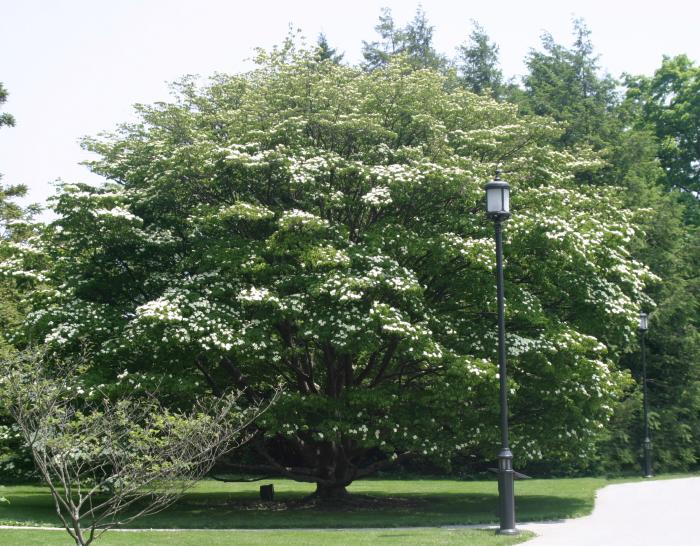
Kousa dogwood is a small tree or large shrub from Japan, Korea and China, with tiered branches that spread horizontally. In late May and June it is covered in large white bracts, each surrounding a small knob of true flowers. In late summer come round red fruits that look like raspberries and are edible, and in autumn the leaves turn red to purple. On older trees the bark flakes away in a patchwork of grey and brown. Well-known varieties include ‘China Girl’ and ‘Milky Way’, which flower freely, and ‘Satomi’, with pink bracts.
Light
Sun or partial shade
preferably some sun
Moisture
Normal
no wet feet
Legal basis
Sand or loam
acid to neutral
Hardiness
Fully hardy
down to -25 °C
Size
7 m
tall, 6 m wide
Flowering
May–June
| Height | 7 m |
|---|---|
| Native to Belgium | No, planted |
| Good for bees, butterflies and birds | Yes, for bees and birds |
| Poisonous to people and pets | Not known to be poisonous |
| Flowering | May–June |
Identify
Kousa dogwood: how do you recognise it?
- Habit
- Small tree or multi-stemmed shrub 6–7 m tall and 5–6 m wide, with tiered, horizontal branches.
- Leaves
- Oval with a wavy edge and curved veins, opposite; red to purple in autumn.
- Flowers
- Four pointed white, sometimes pink, bracts around a green knob of tiny true flowers, late May–June.
- Fruit
- Round, pink to red fruits of 2–3 cm on long stalks, ripe in September–October.
- Bark
- On older trees it flakes away in patches of grey, brown and beige.
Flowering: May–June · Harvest and fruit: September–October · Plants: March–April and October–December
In your garden
Why grow it?
- Attractive in every season: flowers in early summer, fruit in late summer, autumn colour and decorative bark in winter.
- Flowers only once the leaves are out, so it is rarely damaged by late frost.
- The sweet fruits are edible and are also popular with birds.
- Bees visit the small true flowers in the centre.
- An ornamental tree full of character for a medium-sized garden, as a focal point on a lawn or in a border.
Kousa dogwood: where does it grow best?
- Sun or partial shade; in sun it flowers more freely and colours better in autumn, but the soil must not dry out.
- Humus-rich, lime-poor sandy or loamy soil, acid to neutral. On chalky soil the leaves turn yellow.
- Soil that stays evenly moist, without waterlogging.
- A spot sheltered from hot, drying winds.
- Give it room: allow a spread of 5–6 m, well away from the house and paths.
- Light
- Sun and partial shade
- Soil type
- Sand or loam
- Acidity
- Acid or neutral
- Moisture
- Normal
- Size
- 7 m tall, 6 m wide
- Hardiness
- Hardy (to -25 °C)
Goes well with
- Hydrangea: Flowers after it in the partial shade under or beside the tree.
- Rhododendron: Likes the same lime-poor, humus-rich soil.
- Ferns: Green underplanting that keeps the base cool.
- Spring bulbs: Snowdrops and daffodils flower under the tree before the leaves come out.
Maintenance
Kousa dogwood: when and how to plant it?
Plant in March–April and October–December.
- Plant from October to December or in March–April, when the soil is not frozen.
- Dig a generous hole, two to three times as wide as the root ball, and mix leaf mould or compost into the soil.
- Set the tree at the same depth as it was in the pot or nursery; the root collar must not end up below ground.
- For a larger tree, drive in an angled stake on the windward side and tie the trunk loosely.
- Water in well and mulch the planting area with leaf mould or wood chips, keeping it off the trunk.
Care
- Water
- Weekly in dry spells for the first two or three years. Later too in dry summers, or the leaves will scorch.
- Feeding
- Usually not needed. A layer of leaf mould in spring is enough.
- Mulching
- Each spring, a layer of leaf mould or compost around the base keeps the shallow roots cool.
- Soil
- Do not dig or hoe around the trunk: the roots are shallow.
Tip: Plant it in humus-rich, lime-poor soil that does not dry out, and give it room to spread: it flowers in June, then carries edible fruits and turns red in autumn.
Kousa dogwood: when to prune it?
When: Pruning is hardly ever needed. If a branch has to go, do it in summer, after flowering.
How:
- Keep the natural tiered shape intact: that is where its beauty lies.
- Remove only dead, diseased and crossing branches, just outside the branch collar.
- On a young tree you can remove a competing second leader if you want a single trunk.
Caution: Don’t shorten the branches: it will lose its tiered shape and produce clusters of water shoots.
Propagation
- Seed
- Clean the seeds from ripe fruits and sow them outdoors in a pot in autumn, so they get the winter cold. Germination is slow and it takes years to flower; varieties do not come true from seed.
- Cuttings
- Summer cuttings in June–July root with difficulty; nurseries usually graft named varieties.
Kousa dogwood: how does it get through the winter?
Hardy to −25 °C.
- Hardy to about −25 °C: no protection needed in Belgium.
- A mulch around the base protects young trees from drying out and frost.
- The flaking bark and tiered branches give the tree structure in winter too.
Diseases and pests
- Leaf scorch: Brown leaf edges in a hot, dry summer. Water and mulch, and avoid a hot, poor spot.
- Yellow leaves: On chalky soil the leaves turn yellow between the veins. Work in leaf mould and mulch with leaf compost.
- Anthracnose: Leaf spots and dying twigs. Kousa dogwood is far less susceptible than the American flowering dogwood; cut out affected twigs.
- Few flowers: Young seedlings only flower after several years; too much shade also holds back flowering. Patience and enough light help.
Through the year
- March: Plant. Mulch with leaf mould.
- April: Plant. The leaves emerge.
- May: The bracts appear, greenish at first, then white.
- June: Full bloom. Water in dry spells.
- July: Water in dry spells, especially young trees.
- August: The fruits colour up.
- September: Harvest the fruits as soon as they are soft.
- October: Red autumn colour. Plant.
- November: Plant.
- December: Plant in mild weather.
Use
Edible and useful
- Fruit (September–October)
- The round, pinkish-red fruits, the size of a cherry with a knobbly skin, ripen in September and October. They are ripe when they feel soft and come away easily. Cut them open or suck out the soft orange flesh: it tastes sweet, of mango and peach. The skin is bitter and the small seeds are not eaten.
- Storing
- Ripe fruits keep for only a day or two: use them quickly. The sieved pulp can be frozen.
Caution: The flesh is edible and safe; the skin is tough and bitter, and the hard seeds should not be swallowed. Do not confuse the fruits with those of other shrubs with red berries: kousa dogwood is recognised by its large white bracts in June and its fruits on long stalks, like small raspberries.
Eating and using is at your own risk: see the terms of use.
Recipes
- Kousa dogwood purée (Compote · ± 2 portions · 20 min)
Good for wildlife
- Bees
- Nectar and pollen for honeybees and wild bees.
- Birds
- Berries, seeds or insects as food, or a place to nest.
You and this species
Did you know?
- What look like large petals are in fact bracts. The true flowers are small and greenish and sit together in the central knob.
- The fruit is a compound fruit: a group of small fruits fused into a single ball. The sweet pulp is eaten; the tough skin and the seeds are usually left.
- Unlike the American flowering dogwood, it flowers only once the leaves are out, and its bracts are pointed rather than notched.