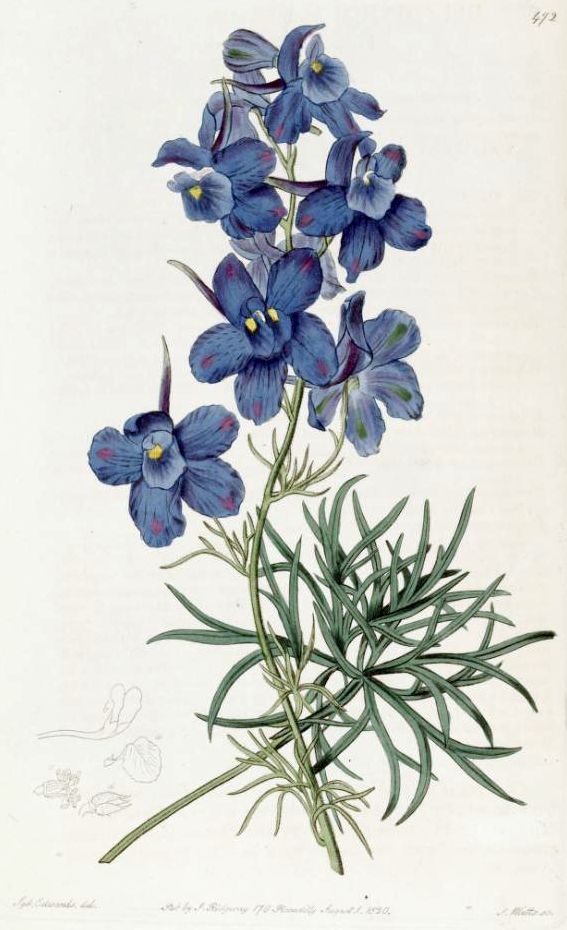
Photo: Sydenham Edwards, Public domain · source

Perennial · Ranunculaceae
Chinese delphinium
Delphinium grandiflorum
In other languages: Chinese ridderspoor (Nederlands) · Dauphinelle à grandes fleurs (Français)
Chinese delphinium comes from Siberia, Mongolia and northern China, where it grows on dry grassland and rocky slopes. It is much smaller and finer than the familiar tall delphiniums: a loose, branching plant 30–60 cm tall with finely divided leaves. From June to September it carries loose sprays of brilliant blue, spurred flowers, a colour found in few other plants. It is short-lived and usually lasts only two or three years, but it flowers in its first year if you sow early. The best-known cultivar is ‘Blue Butterfly’, with deep gentian-blue flowers.
Caution: All parts are toxic if eaten, especially the seeds. Take care with young children, pets and grazing animals, and wear gloves when pruning.
Light
Full sun
warm and bright
Moisture
Normal
no wet feet
Legal basis
Sand or loam
any pH
Hardiness
Fully hardy
down to -30 °C
Size
0.5 m
tall, 0.3 m wide
Flowering
June–September
| Pruning months | July and October |
|---|---|
| Height | 0.5 m |
| Native to Belgium | No, planted |
| Good for bees, butterflies and birds | Yes, for bees |
| Poisonous to people and pets | Yes, take care with children and pets |
| Flowering | June–September |
Identify
Chinese delphinium: how do you recognise it?
- Habit
- Loose, branching clump 30–60 cm tall and about 30 cm wide.
- Leaves
- Finely divided into narrow, almost thread-like segments; fresh green.
- Flower
- Flowers of 3–4 cm with a spur at the back, in loose sprays at the tips of the stems.
- Colour
- Usually bright gentian blue; there are also white and pale blue forms.
- Lifespan
- Short-lived: the plant often disappears after two or three years.
Flowering: June–September · Sowing: February–March · Plants: April–May · Pruning: July and October
In your garden
Why grow it?
- One of the purest blues in the border, from June to September.
- Flowers in its first year from seed, so it is easy to raise yourself.
- Bumblebees and bees love the flowers.
- A graceful cut flower for small, airy bouquets.
- Compact enough for the front of the border and for pots.
Chinese delphinium: where does it grow best?
- Full sun; in shade the stems flop and it flowers poorly.
- Well-drained soil that is not too heavy: sand or loam, acid to chalky.
- Evenly moist, but never waterlogged in winter.
- Plant 25–30 cm apart, at the front of the border or in a pot.
- Light
- Sun
- Soil type
- Sand or loam
- Acidity
- Not fussy
- Moisture
- Normal
- Size
- 0.5 m tall, 0.3 m wide
- Hardiness
- Hardy (to -30 °C)
Goes well with
- Shasta daisy: White next to blue: a fresh, classic combination.
- Catmint: Low, lavender-blue flowers at its feet.
- Yarrow: Flat heads in yellow or pink next to the blue sprays.
- Roses: Blue accents among pink and white shrub roses.
Maintenance
Chinese delphinium: when and how to plant it?
Plant in April–May.
- Sow indoors in February–March and plant the young plants out in April–May.
- Dig a hole a little larger than the root ball and mix in some compost; in heavier soil add some grit too.
- Set the plant at the same depth as it was in the pot, no deeper: a crown planted too deep rots easily.
- Space plants 25–30 cm apart.
- Water well and protect the young plants from slugs for the first few weeks.
Care
- Watering
- Water regularly in dry weather, at the base and not over the leaves.
- Feeding
- Some compost in spring; after the first flush, a little organic fertiliser for a second flush.
- Support
- In a windy spot, add a few twiggy sticks or a low plant support.
- Deadheading
- Remove faded sprays; after the first flush, cut the whole plant back for a second flush.
- Resowing
- Sow new plants every other year to replace the oldest ones.
Tip: Sow a new batch in February every other year: that way you always have plants in flower, even when the oldest ones disappear.
Chinese delphinium: when to prune it?
Pruning months: July and October.
When: In July, after the first flush, cut back for a second flush; in October, remove the dead stems.
How:
- After the first flush, cut all flowering stems back to just above the leaves at the base.
- Then water and feed a little: a second flush follows in August–September.
- In October, when the plant dies down, cut the stems back to a few centimetres above the ground.
- Wear gloves when pruning, as the plant is toxic.
Caution: After the first flush, do not cut into the rosette of leaves at the base: that is where the new flowering stems come from.
Propagation
- Seed
- In February–March indoors at 15–20 °C; cover the seed lightly. Fresh seed germinates best: store seed cool and dry, for example in the fridge.
- Cuttings
- In April, take basal cuttings of young shoots with a sliver of the rootstock and root them in sandy cutting compost.
Chinese delphinium: how does it get through the winter?
Hardy to −30 °C.
- Hardy to about −30 °C: frost is no problem.
- Wet soil in winter is dangerous, though: the crown rots. Choose a well-drained spot.
- In a pot: keep it sheltered from rain and water very little until spring.
Diseases and pests
- Slugs: They strip the young shoots in spring. Pick them off in the evening and only plant out sturdy young plants.
- Powdery mildew: White powder on the leaves in late summer. Water at the base, space the plants and remove affected leaves.
- Dying out: The plant disappears after two or three years. This is normal: sow new plants regularly.
- Root rot: Yellow, limp plants in wet soil. Move to a drier spot or a raised bed.
Through the year
- February: Sow indoors.
- March: Sow indoors. Prick out seedlings.
- April: Plant out. Protect from slugs. Take basal cuttings.
- May: Plant out. Add support in a windy spot.
- June: Flowering begins. Cut flowers for a vase.
- July: Cut back after the first flush and feed.
- August: Second flush. Water in dry weather.
- September: Last flowers. Collect seed if you like.
- October: Cut back the dead stems.
Use
Edible and useful
Not edible. All parts of delphinium are poisonous, especially the seeds and young plants: they contain alkaloids related to those of monkshood, which act on nerves and muscles. Swallowing any causes a tingling or burning feeling in the mouth, vomiting and stomach ache, and in larger amounts muscle weakness and a slow or irregular heartbeat. In cattle, larkspur is a well-known cause of poisoning, and other grazing animals are at risk too: do not plant it in or next to a field, and never throw trimmings or faded stems into a field or pen. Keep young children, dogs and cats away, from the seeds and from a vase of cut flowers too, and wear gloves when cutting back. If any is swallowed, call a poison centre (in Belgium 070 245 245) or your doctor at once.
Good for wildlife
- Bees
- Nectar and pollen for honeybees and wild bees.
You and this species
Did you know?
- The name Delphinium comes from the Greek word for dolphin: the flower bud looks like a little dolphin.
- The English name larkspur and the Dutch name ridderspoor (‘knight’s spur’) both refer to the long spur at the back of the flower.
- Despite its name, it is not only native to China but also to Siberia and Mongolia.