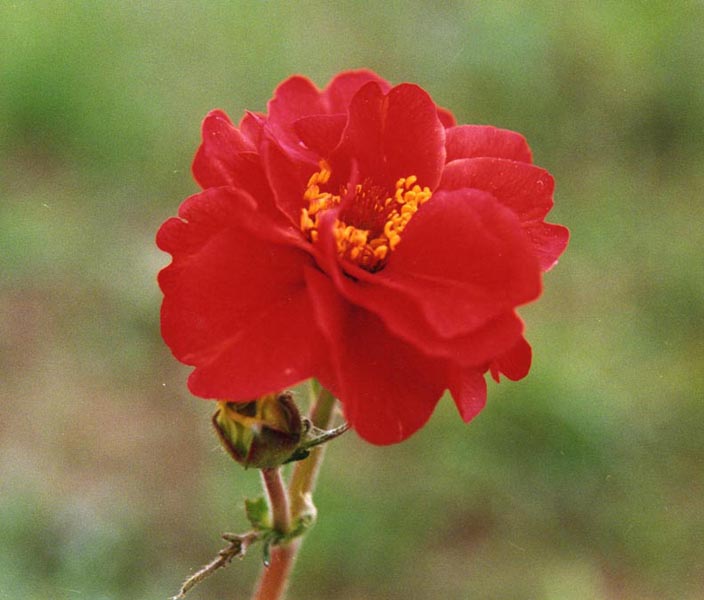
Photo: Ghislain118 (AD) http://www.fleurs-des-montagnes.net, CC BY-SA 3.0 · source

Perennial · Rosaceae
Chilean avens
Geum quellyon
In other languages: Nagelkruid (Nederlands) · Benoîte du Chili (Français)
Geum quellyon, also known as Geum chiloense, is an avens from Chile. It forms a low, evergreen rosette of pinnate, slightly hairy leaves, from which branched stems up to 60 cm tall rise from May into August. These carry saucer-shaped flowers in fiery colours: scarlet, orange or yellow, often semi-double. Gardeners love it for those warm colours, its long flowering season and because it takes up little space. The classic cultivars ‘Mrs. J. Bradshaw’ (scarlet) and ‘Lady Stratheden’ (golden yellow) have been grown for a very long time and come fairly true from seed.
Light
Sun or partial shade
preferably some sun
Moisture
Normal
no wet feet
Legal basis
Sand, loam or clay
any pH
Hardiness
Fully hardy
down to -25 °C
Size
0.6 m
tall, 0.45 m wide
Flowering
May–August
| Pruning months | March and August |
|---|---|
| Height | 0.6 m |
| Native to Belgium | No, planted |
| Good for bees, butterflies and birds | Yes, for bees |
| Poisonous to people and pets | Not known to be poisonous |
| Flowering | May–August |
Identify
Chilean avens: how do you recognise it?
- Habit
- Low leafy rosette topped by branched, airy flower stems of 40–60 cm; about 45 cm wide.
- Foliage
- Pinnate, with a large, rounded end leaflet and smaller side leaflets; slightly hairy and green in mild winters.
- Flower
- Saucer-shaped, 3–4 cm, single or semi-double, with a ring of stamens in the centre; from May to August.
- Colour
- Scarlet, orange or yellow, depending on the cultivar.
- Fruit
- A round head of small, dry seeds, each with a little tail.
Flowering: May–August · Sowing: February–April · Plants: March–April and September–October · Pruning: March and August
In your garden
Why grow it?
- Bright reds, oranges and yellows that warm up a border.
- A long flowering season from May into August, especially if you remove faded stems.
- Bees visit the open flowers with their ring of stamens.
- The evergreen rosette keeps the border from looking bare in winter.
- Easy to raise yourself from seed and useful as a cut flower for a small posy.
Chilean avens: where does it grow best?
- Sun to partial shade; it flowers best in full sun, as long as the soil does not dry out.
- Fertile, free-draining soil: sand, loam or clay, acid to chalky.
- Normally moist: it dislikes summer drought as much as wet feet in winter.
- Allow 40–45 cm between plants, ideally in groups of three or more.
- Light
- Sun and partial shade
- Soil type
- Sand, loam or clay
- Acidity
- Not fussy
- Moisture
- Normal
- Size
- 0.6 m tall, 0.45 m wide
- Hardiness
- Hardy (to -25 °C)
Goes well with
- Woodland sage: Blue or purple spikes next to the fiery reds and oranges.
- Catmint: A haze of lavender blue that calms the bright colours.
- Spurge: Lime-green bracts with orange and yellow avens.
- Siberian iris: Narrow, sword-shaped leaves and flowers in May–June.
- Blue cranesbill: A fresh contrasting colour at the same time of year.
Maintenance
Chilean avens: when and how to plant it?
Plant in March–April and September–October.
- Plant in March–April or September–October, when the soil is neither frozen nor waterlogged.
- Dig a hole twice as wide as the root ball and mix in some compost.
- Set the plant at the same depth as it was in the pot: the centre of the rosette must stay just above soil level.
- Space plants 40–45 cm apart.
- Water in well straight away, then during dry spells for the first few weeks.
- Mulch with compost, but keep the centre of the rosette clear.
Care
- Watering
- During dry summer spells, especially in a sunny spot; this keeps it flowering for longer.
- Feeding
- In March–April, a layer of compost or a little organic fertiliser.
- Deadheading
- Regularly cut faded flower stems back to the foliage: new flowers will follow.
- Dividing
- Every three years, in spring or early autumn: this keeps it young and free-flowering.
- Support
- In a windy spot the thin stems can flop; a few twiggy sticks pushed in between them help.
Tip: Plant it where you pass every week: if you faithfully cut off the faded stems, you will have flowers until August.
Chilean avens: when to prune it?
Pruning months: March and August.
When: It is not really pruned: remove old leaves in March, and cut off faded stems during and after flowering.
How:
- In March, cut away damaged and brown leaves at the base; leave the healthy evergreen leaves.
- From May to August, cut faded flower stems back to the foliage.
- In August, after the last flowers, remove all flower stems; a small second flush sometimes follows.
Propagation
- Seed
- Sow indoors in February–April at 15–20 °C, barely covering the seed. Prick the seedlings out into small pots and plant out after mid-May. They usually flower fully from the second year.
- Division
- Every three years in March–April or September: lift the clump, pull it apart into pieces that each have a rosette and roots, and replant them in refreshed soil.
Chilean avens: how does it get through the winter?
Hardy to −25 °C.
- Hardy to about −25 °C; the rosette stays green in mild winters.
- Wet soil in winter is the biggest danger: do not plant in a hollow, and open up heavy clay with coarse sand.
- In a pot: stand it against a wall and raise the pot on pot feet so that excess water can drain away.
Diseases and pests
- Dwindling: After a few years it flowers less and the centre dies. Dividing every three years keeps it young.
- Root rot: In wet, heavy soil the crown rots in winter. Improve drainage or plant it slightly higher.
- Slugs: They eat young leaves and flower buds. Pick them off in the evening.
- Aphids: On young flower stems in spring. Hose them off with water; ladybirds will do the rest.
Through the year
- February: Sow indoors at 15–20 °C.
- March: Remove old leaves. Apply compost. Plant or divide. Sow indoors.
- April: Plant. Prick out seedlings.
- May: Flowering begins. Plant out seedlings after mid-May.
- June: In flower. Cut off faded stems. Water in dry spells.
- July: In flower. Keep deadheading.
- August: Last flowers. Cut off all flower stems.
- September: Plant or divide.
- October: Plant.
- December: Rest; the rosette often stays green.
Use
Good for wildlife
- Bees
- Nectar and pollen for honeybees and wild bees.
You and this species
Did you know?
- The name Geum chiloense refers to Chiloé, an island off the coast of Chile.
- Its native European cousin, wood avens, has a root that smells of cloves: hence the Dutch name nagelkruid, ‘clove herb’.
- Avens belong to the rose family, like strawberries and brambles.