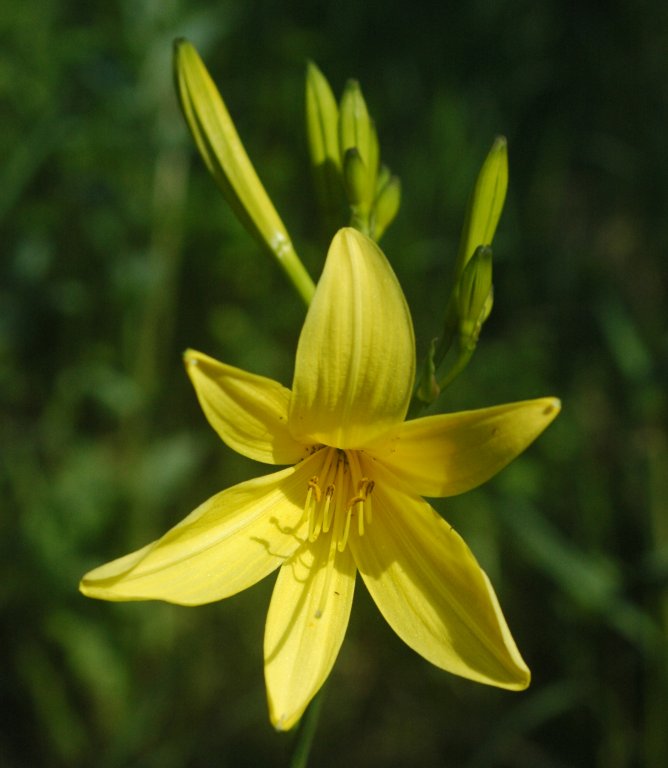
Photo: Doronenko, CC BY 2.5 · source

Perennial · Asphodelaceae
Lemon lily
Hemerocallis lilioasphodelus
In other languages: Gele daglelie (Nederlands) · Hémérocalle jaune (Français)
The lemon lily is native to East Asia and has been a cherished garden plant in Europe for centuries. It is one of the earliest daylilies: as early as May and June it carries lemon-yellow, trumpet-shaped flowers on sturdy stems above a clump of narrow, arching leaves about 80 cm tall. The flowers smell wonderful and each lasts just one day, but new buds keep opening for days. The plant is long-lived, tough and asks for almost nothing, which makes it a reliable backbone for any border.
Caution: All parts of the lemon lily are very poisonous to cats, including the flowers and pollen. Keep cats away and do not leave cut flowers within their reach. Eat the flowers only if you are sure of the species and they are unsprayed; do not confuse them with true lilies.
Light
Sun or partial shade
preferably some sun
Moisture
Normal
no wet feet
Legal basis
Sand, loam or clay
any pH
Hardiness
Fully hardy
down to -35 °C
Size
0.8 m
tall, 0.6 m wide
Flowering
May–June
| Pruning months | March and July |
|---|---|
| Height | 0.8 m |
| Native to Belgium | No, planted |
| Poisonous to people and pets | Yes, take care with children and pets |
| Flowering | May–June |
Identify
Lemon lily: how do you recognise it?
- Habit
- Dense, loose clump 70–90 cm tall and 50–60 cm wide, which slowly widens.
- Foliage
- Narrow, strap-like and arching, 40–60 cm long, fresh green; dies back in winter.
- Flower
- Trumpet-shaped blooms 8–10 cm across, lemon-yellow, fragrant, in clusters on sturdy stems.
- Flowering
- May and June; each flower lasts a day, but more buds follow.
- Roots
- Fleshy, swollen roots in which the plant stores reserves; this makes it resistant to drought.
Flowering: May–June · Harvest and fruit: June–August · Plants: March–May and August–September · Pruning: March and July
In your garden
Why grow it?
- Flowers as early as May and June, before most other daylilies, with soft yellow, fragrant blooms.
- Very tough and long-lived: it may stay in the same spot for decades with no care.
- Extremely low maintenance: it is little troubled by disease and rarely needs more than a little water.
- The handsome arching foliage stays decorative even when flowering is over.
- The flowers are edible and used in the kitchen for salads and dishes.
Lemon lily: where does it grow best?
- Sun to part shade: it flowers most freely in sun, a little less in light shade.
- Almost any garden soil: sand, loam or clay, acid to chalky. Best moisture-retentive and fertile.
- Average moisture; it tolerates drought but flowers better with the odd drink.
- Not demanding about shelter, but in a warm, sheltered spot the flowers smell their best.
- Space plants 50–60 cm apart and expect a clump that widens slowly.
- Light
- Sun and partial shade
- Soil type
- Sand, loam or clay
- Acidity
- Not fussy
- Moisture
- Normal
- Size
- 0.8 m tall, 0.6 m wide
- Hardiness
- Hardy (to -35 °C)
Goes well with
- Sage: Blue-purple spikes next to the yellow flowers.
- Lavender: Scent and colour that go well together in a sunny border.
- Ornamental grasses: Loose plumes as a soft backdrop.
- Hardy geranium: Blue flowers and foliage that complement the clump nicely.
- Lady’s mantle: A light, yellow-green edge at the front of the border.
Maintenance
Lemon lily: when and how to plant it?
Plant in March–May and August–September.
- Plant in March, April or May, or in August–September. In autumn the soil is still warm and it establishes well.
- Dig a hole twice as wide as the root ball and mix in some compost.
- Set the plant so that the crown, where the leaves emerge, sits about 2–3 cm below the soil surface.
- Leave 50–60 cm between plants.
- Water thoroughly straight away and repeat in dry weather during the first year.
- Spread a thin layer of compost or fine bark around the plant to suppress weeds and retain moisture.
Care
- Water
- Regularly in dry weather during the first year. After that, water in long dry spells is enough.
- Feeding
- In spring a spadeful of compost or an organic feed. No more is needed.
- Mulching
- A thin layer of compost in spring suppresses weeds and keeps the soil moist.
- Deadheading
- Trim faded flowers, and later the bare flower stalks, down to the foliage.
- Dividing
- Divide only after four to six years, when the clump gets too dense or flowers less.
Tip: Plant it so the crown sits just below the soil surface and cut tatty foliage back in July: you will have fresh green leaves again for the rest of the season.
Lemon lily: when to prune it?
Pruning months: March and July.
When: In March remove last year’s dead foliage; after flowering cut off the flower stalks and, if you like, the foliage in July.
How:
- In March, cut the dead foliage down to just above the ground.
- Cut the bare flower stalks off at the base after flowering.
- If the foliage looks tatty or yellow in July, cut it back to about 10 cm: fresh green growth follows.
- Remove faded flowers regularly to keep the clump tidy.
Caution: Daylilies are very poisonous to cats. Do not leave trimmings where a cat can get at them.
Propagation
- Division
- In September or early spring, lift the clump and split it with a sharp spade or knife into pieces with at least a fan of leaves and roots. Replant at once and water well.
- Seed
- Sow seed in autumn or spring; it germinates slowly and unevenly. Plants flower after 2–3 years. The flowers may not come true to the parent.
Lemon lily: how does it get through the winter?
Hardy to −35 °C.
- Fully hardy to about −35 °C: no protection is needed, even in the hardest Belgian winters.
- The foliage dies back in autumn and returns in spring from the crown.
- Choose a spot where water does not stand: wet feet in winter are more harmful than frost.
Diseases and pests
- Daylily gall midge: Flower buds are swollen, distorted and drop without opening. Remove and destroy affected buds; do not put them on the compost heap.
- Slugs: They eat young shoots in spring. Pick off slugs or lay a barrier of crushed shells.
- Aphids: On buds and young leaves. Rinse off with water; ladybirds help.
- Yellow leaf tips: Spots or yellow streaks on the leaves, often due to drought or a fungus. Water, cut off affected leaves and trim the foliage after flowering.
- Poor flowering: Usually too much shade, planted too deep or a clump that has become too dense. Move or divide it.
Through the year
- March: Cut back dead foliage. Apply compost. Plant or divide.
- April: Plant. Watch for slugs on the new shoots.
- May: Flowering begins. Water in dry weather.
- June: Full bloom. Cut off faded flowers and bare stalks.
- July: Optionally trim tatty foliage. Water in dry weather.
- August: Plant or divide.
- September: Plant or divide. Water.
- October: The foliage turns yellow and dies back.
Use
Edible and useful
- Flowers (June–August)
- From June to August, pick the plump, still-closed buds the day before they open, or the open flowers (each flower lasts only one day). The buds taste like green beans with a sweet note and are lovely stir-fried or briefly steamed; the flowers can be stuffed or shredded into a salad. In China the wilted flowers are dried as ‘golden needles’ for soup.
- Storing
- Buds and flowers keep for a day or two in a box in the fridge. Wilted flowers can be dried on a rack somewhere airy and kept in a closed jar; soak them in warm water for half an hour before use.
Caution: Daylilies (Hemerocallis) are edible for people but highly poisonous to cats: even a little pollen or a scrap of leaf can destroy a cat’s kidneys. Keep cats away. The first time, eat only a little: some people get stomach ache or diarrhoea. Only eat daylilies, never true lilies (Lilium) or other bulbs. Preferably cook the buds briefly; do not eat large amounts raw.
Eating and using is at your own risk: see the terms of use.
Recipes
- Stir-fried daylily buds with garlic (Dish · 2 people · 15 min)
- Daylilies stuffed with goat’s cheese (Dish · 4 people (as a nibble) · 20 min)
You and this species
Did you know?
- The name Hemerocallis comes from Greek and means ‘beauty for a day’: each flower is open for just one day.
- A daylily is not a true lily: it belongs to a different plant family, the Asphodelaceae, and has fleshy, swollen roots.
- In Asian cooking the flowers and flower buds of daylilies have been eaten for centuries.