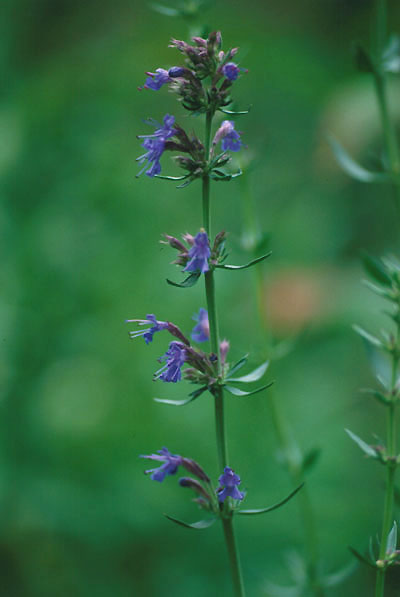
Photo: Wikimedia Commons, CC BY-SA 3.0 · source

Herb · Lamiaceae
Hyssop
Hyssopus officinalis
In other languages: Hysop (Nederlands) · Hysope (Français)
Hyssop is an aromatic sub-shrub from southern Europe and the Mediterranean, where it grows on dry, stony, chalky slopes. It forms a compact bush of 40–60 cm with narrow, dark green, strongly scented leaves. From July to September the upright stems are crowded with dense spikes of small, deep blue flowers that draw bees and butterflies from afar. Gardeners use hyssop as a low hedge, in the herb garden and in dry borders. Besides the blue form, there are forms with pink and white flowers.
Light
Full sun
warm and bright
Moisture
Dry
tolerates drought
Legal basis
Sand, loam or clay
neutral to chalky
Hardiness
Fully hardy
down to -20 °C
Size
0.6 m
tall, 0.5 m wide
Flowering
July–September
| Pruning months | April and September |
|---|---|
| Height | 0.6 m |
| Native to Belgium | No, planted |
| Good for bees, butterflies and birds | Yes, for bees and butterflies |
| Poisonous to people and pets | Not known to be poisonous |
| Flowering | July–September |
Identify
Hyssop: how do you recognise it?
- Habit
- Sub-shrub, 40–60 cm tall and 50–60 cm wide, with upright stems that become woody at the base.
- Leaves
- Narrow and lance-shaped, 2–4 cm long, dark green; some stay on the plant in mild winters.
- Flowers
- Small lipped flowers in dense, one-sided spikes at the stem tips, from July to September.
- Colour
- Usually deep blue to violet-blue; there are also pink and white forms.
- Scent
- The leaves smell herby, with a hint of mint and camphor, especially when crushed.
Flowering: July–September · Harvest and fruit: May–September · Sowing: March–May · Plants: April–May · Pruning: April and September
In your garden
Why grow it?
- Flowers in late summer, from July to September, when many other herbs have finished.
- A favourite of bees, bumblebees and butterflies.
- Copes well with drought and poor, chalky soil.
- Suitable as a low, fragrant hedge around a herb or vegetable garden.
- The leaves and flowers are edible and, used sparingly, add a herby, slightly bitter flavour.
Hyssop: where does it grow best?
- Full sun: in shade it becomes floppy and flowers poorly.
- Free-draining soil: sand, loam or clay with added gravel, neutral to chalky.
- Dry: once established it rarely needs extra water.
- Plant 30–40 cm apart; as a low hedge, 25–30 cm.
- Light
- Sun
- Soil type
- Sand, loam or clay
- Acidity
- Neutral or chalky
- Moisture
- Dry
- Size
- 0.6 m tall, 0.5 m wide
- Hardiness
- Hardy (to -20 °C)
Goes well with
- Lavender: The same sunny, dry spot; together they flower from June to September.
- Common sage: Grey-green leaves next to the dark leaves of hyssop, in the herb garden.
- Catmint: A loose blue haze for bees in the same dry border.
- Thyme: A low, fragrant edge at the front, on the same poor soil.
Maintenance
Hyssop: when and how to plant it?
Plant in April–May.
- Plant in April–May, when the soil is warming up and hard frosts are over.
- Dig a hole slightly larger than the root ball and mix heavy soil with coarse sand or fine gravel.
- Set the plant at the same depth as in the pot and firm in well.
- Keep 30–40 cm between plants, or 25–30 cm for a hedge.
- Water in straight away and in dry weather for the first weeks, until the plant is growing well.
- If you mulch, use gravel rather than compost: it keeps the base of the plant dry.
Care
- Watering
- Only in the first year during long dry spells. After that, rain is enough.
- Feeding
- Not needed. On rich soil it becomes floppy and less fragrant.
- Harvesting
- Pick young shoot tips and leaves just before or during flowering, on a dry morning.
- Spent spikes
- Cut them off in September for a tidy plant, or leave a few for the seed.
- Renewing
- After 4–5 years it often becomes woody and bare; replace it then with a cutting or seedling.
Tip: Cut back every spring to just above the old wood: hyssop then stays compact and full of flowers for years. Use the bitter leaves sparingly in the kitchen.
Hyssop: when to prune it?
Pruning months: April and September.
When: Do the main prune in April, when the new buds become visible. In September, cut off the spent flower spikes.
How:
- In April, cut last year’s shoots back to a few centimetres above the old wood, just above a few new buds.
- This keeps the bush compact and well branched.
- Remove dead and frost-damaged shoots completely.
- Prune a hedge the same way, and trim it lightly into shape in September, after flowering.
Caution: Do not cut into bare old wood: hyssop is slow to regrow from it. Do not prune late in autumn either, as young shoots would be frosted.
Propagation
- Seed
- Indoors in March–April at 15–20 °C, barely covering the seed; it germinates in 2–3 weeks. In May you can also sow outdoors.
- Cuttings
- In June, take softwood cuttings of 5–8 cm from non-flowering shoots, in sandy cutting compost kept lightly moist.
Hyssop: how does it get through the winter?
Hardy to −20 °C.
- Hardy to about −20 °C: it survives most Belgian winters without protection.
- Cold, wet soil is its worst enemy: a free-draining, slightly raised spot helps.
- Leave the spent stems until April: they protect the base.
- In a pot: keep it against a sheltered wall, out of the rain, and give hardly any water in winter.
Diseases and pests
- Root rot: The plant wilts and dies on wet, heavy soil. Replant in a dry, free-draining spot.
- Bare and woody: Happens without yearly pruning or on older plants. Prune every spring and replace old plants.
- Few flowers: Too much shade or soil that is too rich. Move it to full sun and stop feeding.
- Aphids: Sometimes on young shoot tips in spring. Hose them off; natural predators usually deal with them.
Through the year
- March: Sow indoors.
- April: Main prune to just above the old wood. Plant and sow indoors.
- May: Plant and sow outdoors.
- June: Take softwood cuttings.
- July: Flowering starts. Harvest leaves and flowers.
- August: Full flower: bees and butterflies. Rarely needs water.
- September: Last flowers. Cut off the spent spikes.
- October: Rest. No more pruning or feeding.
Use
Edible and useful
- Flowers (July–September)
- Pick the deep blue (or pink and white) flowers from July to September. They taste milder than the leaves, spicy and slightly sweet. Strip them from the spike and scatter them over a salad, a fruit salad or a dessert, or add them to a tea.
- Leaves (May–September)
- Pick young shoot tips and leaves from May to September, on a dry morning; they are most fragrant just before and during flowering. Hyssop tastes spicy, somewhere between mint and sage, and slightly bitter: use it sparingly. A few chopped leaves go well with lamb, game, beans and lentils, in soup, or with summer fruit such as apricots and peaches.
- Storing
- Hyssop dries well. Cut flowering stems, tie them in small bunches and hang them upside down somewhere airy and dark. Strip off the leaves and flowers once they are crisp and keep them in a closed jar for up to a year. Fresh sprigs keep for a few days in a glass of water.
Caution: Use hyssop as a kitchen herb, in small amounts: drink no more than one cup of hyssop tea a day, and not for weeks on end. Not during pregnancy or breastfeeding, nor with epilepsy. Never swallow the essential oil: it can cause fits, especially in children.
Eating and using is at your own risk: see the terms of use.
Recipes
- Hyssop tea (Tea · 1 cup · 10 min)
- Apricots with hyssop and honey (Compote · 4 people · 20 min)
Good for wildlife
- Bees
- Nectar and pollen for honeybees and wild bees.
- Butterflies
- Nectar for butterflies.
You and this species
Did you know?
- According to many botanists, the ‘hyssop’ of the Bible was probably a different plant, most likely a kind of wild marjoram.
- Hyssop is one of the herbs traditionally used to make absinthe.
- In the 16th and 17th centuries hyssop was planted as a low edging in knot gardens, the ornamental beds with geometric patterns.