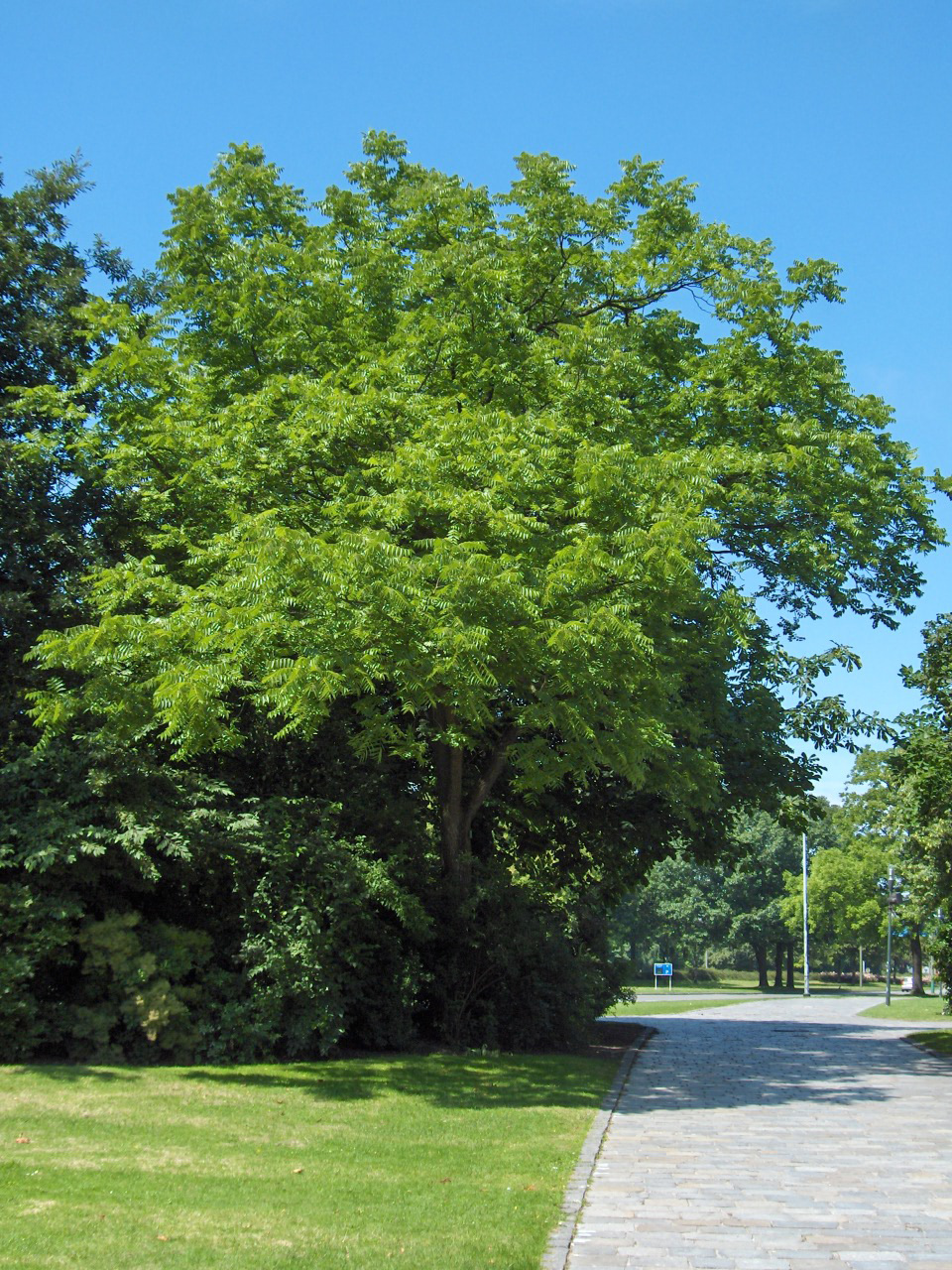
Photo: No machine-readable author provided. JoJan assumed (based on copyright claims)., CC BY-SA 3.0 · source

Tree · Juglandaceae
Black walnut
Juglans nigra
In other languages: Zwarte walnoot (Nederlands) · Noyer noir (Français)
The black walnut comes from the east of North America and is a large, stately tree of 20–30 m with a broad, round crown and dark, deeply furrowed bark. The compound leaves, 30–60 cm long, have 15–23 leaflets, smell aromatic when crushed and come out late in spring. It flowers in May with hanging catkins. In October the round, green husks holding the nut fall. The flavour is richer and stronger than that of the common walnut, but the shell is very hard. The tree gives off juglone, a substance that holds back many plants beneath it.
Caution: This is a large tree that gives off juglone, a substance that holds back or kills tomato, potato, apple, birch, rhododendron and many other plants beneath it. The husks stain hands and clothes brown. Sawdust and shavings of the wood are harmful to horses; dogs can become ill from mouldy nuts. Plant it only if you have plenty of space.
Light
Full sun
warm and bright
Moisture
Normal
no wet feet
Legal basis
Sand, loam or clay
any pH
Hardiness
Fully hardy
down to -35 °C
Size
25 m
tall, 20 m wide
Flowering
May
| Pruning months | July–August |
|---|---|
| Height | 25 m |
| Native to Belgium | No, planted |
| Poisonous to people and pets | Not known to be poisonous |
| Flowering | May |
Identify
Black walnut: how do you recognise it?
- Habit
- Large tree 20–30 m tall and 15–20 m wide with a broad, round crown and a straight trunk.
- Leaves
- Odd-pinnate, 30–60 cm long, with 15–23 toothed leaflets; aromatic when crushed, yellow in autumn, falls early.
- Flower
- In May, hanging male catkins up to 10 cm and small female flowers on the same tree; wind-pollinated.
- Fruit
- Round, green husk 4–6 cm across holding a very hard, deeply ridged nut, ripe in October.
- Bark and roots
- Dark brown to black, deeply furrowed bark; deep taproot; roots and leaves contain juglone.
Flowering: May · Harvest and fruit: September–October · Plants: March–April and October–December · Pruning: July–August
In your garden
Why grow it?
- An impressive shade and landscape tree for a large garden or park.
- The nuts are edible and have a rich, earthy flavour, stronger than that of the common walnut.
- The dark timber is a sought-after wood for furniture and other special objects.
- Handsome compound leaves that smell aromatic and turn yellow in autumn.
- Squirrels, birds and other animals benefit from the nuts.
Black walnut: where does it grow best?
- Full sun; in shade it grows poorly and sets no nuts.
- Deep, fertile, free-draining soil: loam or clay, also sand if it is moist enough; acid to chalky.
- Evenly moist; it copes better with drought, but young trees need water then.
- Allow 15–20 m of space around the trunk, especially from buildings, the vegetable garden, fruit trees and perennials that are sensitive to juglone.
- Light
- Sun
- Soil type
- Sand, loam or clay
- Acidity
- Not fussy
- Moisture
- Normal
- Size
- 25 m tall, 20 m wide
- Hardiness
- Hardy (to -35 °C)
Goes well with
- Hosta: Often cited as tolerant of juglone and grows well in the half shade beneath the tree.
- Cranesbill: A tough ground cover that often grows well under walnuts.
- Ferns: A fresh underplanting that usually does not complain under walnuts.
- Daffodil: Spring bulbs flower before the tree comes into leaf.
- Snowdrop: An early flowerer that forms a carpet beneath the still-bare tree.
Maintenance
Black walnut: when and how to plant it?
Plant in March–April and October–December.
- Plant in March–April or from October to December, when the soil is neither frozen nor waterlogged.
- Choose a young tree: because of the deep taproot, an older tree transplants badly.
- Dig a deep hole, two to three times as wide as the root ball, and loosen the bottom.
- Set the tree at the same depth as in its pot or nursery, with the root collar at soil level. Put in a stake and tie the tree loosely.
- Water in with 20–30 litres straight away and spread mulch around the base, keeping it off the trunk.
Care
- Water
- For the first years, a good soaking every week in dry weather. After that the tree usually copes by itself.
- Feeding
- Usually not needed. On poor soil a spade of compost in spring can help.
- Mulching
- A layer of leaf mould or bark around the young tree keeps the soil moist; keep the trunk clear.
- Harvest
- Pick up the nuts as they fall in September–October. Wear gloves: the husk stains hands and clothes dark brown. Remove the husk, rinse the nuts clean, let them dry for two to three weeks in an airy place and store them dry.
- Leaves
- Compost the leaves separately and use them only when fully rotted; fresh leaves and husks contain juglone.
Tip: Plant the tree well away from the vegetable garden and fruit trees and choose tolerant plants such as hosta and cranesbill under the crown. Compost the leaves separately.
Black walnut: when to prune it?
Pruning months: July–August.
When: In summer or early autumn (July–August), when the tree is in leaf. Do not prune it in winter or spring.
How:
- Young tree: choose one straight leader and remove competing tops.
- Take out dead, damaged and crossing branches.
- Raise the crown gradually by removing the lowest branches year by year if you want a tall trunk.
- Keep cuts small; leave large jobs to a tree surgeon.
Caution: Do not prune in winter or spring: the tree bleeds heavily. Leave pruning of large trees to a professional.
Propagation
- Seed
- Sow fresh nuts in autumn 5–8 cm deep where they are to grow or in a deep pot, and protect them from squirrels and mice. Or keep them cool and moist in sand and sow in spring. A seedling only bears nuts after many years.
- Grafting
- Special cultivars with better nuts are grafted by a nursery; this is difficult at home.
Black walnut: how does it get through the winter?
Hardy to −35 °C.
- Fully hardy to about −35 °C: no protection is needed in Belgium.
- Young trees: keep stake and tie in order and lay a mulch around the base.
- Protect the trunks of young trees against rabbits and hares with a tree guard.
Diseases and pests
- Plants declining beneath: Tomato, potato, apple, birch, rhododendron and many other plants grow badly in the root zone because of juglone. Plant sensitive plants far away or choose tolerant species.
- Leaf spot: Dark brown spots on the leaves and early leaf fall in wet years. Clear away fallen leaves; a healthy tree usually tolerates this.
- Aphids and honeydew: Sticky leaves and black sooty mould in summer. Do not park a car or put garden furniture under the tree; natural enemies such as ladybirds clear the aphids.
- Squirrels: They carry off nuts before you have harvested them. Pick the nuts up early.
- Bleeding: A wound made in spring leaks sap. So prune only in summer.
Through the year
- March: Plant. Apply compost or mulch.
- April: Plant or move. The leaves are not out yet.
- May: Flowering with hanging catkins. Late leafing.
- June: Water young trees in dry weather.
- July: Summer pruning of dead or unwanted branches.
- August: Finish pruning. Water in dry weather.
- September: The first nuts fall. Pick them up.
- October: Harvest the nuts, remove the husks and let them dry. Plant.
- November: Leaf fall: clear up or compost separately. Store the nuts dry.
- December: Rest. Planting is possible as long as the soil is not frozen.
Use
Edible and useful
- Nuts (September–October)
- The black walnut is a tree of 20–30 m: only suitable for a large garden, a park or a meadow, well away from the vegetable garden. In September and October the round green husks fall with the nut inside; gather them regularly, before the squirrels take them. Remove the husk within a few days, before it turns black and soft: roll the nuts under your shoe on a hard surface, or tread the husks off, wearing sturdy gloves. The shell is much harder than that of the common walnut: crack it with a hammer on a solid surface or in a vice, and pick out the kernel with a nut pick. It takes some work, but the kernel has a richer, stronger taste than the common walnut, with an earthy note. Use it in cakes, biscuits, bread, ice cream or salads, or caramelised.
- Storing
- Rinse the husked nuts in a bucket of water and throw away any that float: they are often empty or bad. Dry the rest for two to three weeks in a single layer on a rack or in an open crate, somewhere dry and airy out of the sun. In their shells they then keep for a year in a cool, dry place. Shelled kernels soon go rancid: keep them in a closed jar in the fridge for a few months, or in the freezer for up to a year.
Caution: The husk is not eaten: it stains hands, clothes, stone and wooden floors dark brown for days, so wear gloves and work outdoors. Throw away nuts that are mouldy, blackened, shrivelled or rancid, and do not leave mouldy nuts or husks lying where dogs can eat them: they can make dogs ill. Walnuts are a well-known cause of nut allergy. The leaves, husks and roots contain juglone, which inhibits many plants: do not use husks or leaves as mulch in the vegetable garden, and compost them separately. Sawdust and shavings of the wood are harmful to horses: never use them as bedding in a stable.
Eating and using is at your own risk: see the terms of use.
Recipes
- Banana bread with black walnuts (Dish · 1 loaf (± 10 slices) · 20 min + 1 hr baking)
- Caramelised black walnuts (Other · 1 small bowl · 15 min)
You and this species
Did you know?
- The Roman writer Pliny the Elder already wrote that the shade of the walnut harms other plants.
- The genus name Juglans comes from the Latin ‘Iovis glans’, ‘Jupiter’s acorn’, an old name for the walnut.
- The dark brown timber is highly prized for furniture and gun stocks.