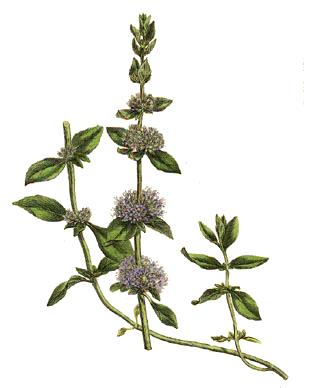
Photo: Wikimedia Commons, Public domain · source

Herb · Lamiaceae
Pennyroyal
Mentha pulegium
In other languages: Polei (Nederlands) · Menthe pouliot (Français)
Pennyroyal is a low, creeping mint native to Europe, growing naturally in damp, trampled places such as riverbanks and wet meadows. In our region it is fairly rare in the wild. The stems root at the nodes and form a dense mat of small, oval leaves. From July to September it bears lilac flower whorls that attract bees. The plant smells strongly of mint and suits a damp spot in the garden as a scented ground cover. Note that pennyroyal is poisonous and therefore not suitable for the kitchen or for tea.
Caution: Poisonous: pennyroyal contains an essential oil (pulegone) that can cause serious poisoning even in small amounts, especially the pure oil. Do not eat it, do not drink it as tea and certainly not during pregnancy. Dangerous for children and for cats and dogs: do not use the plant or the oil against fleas on pets. It can also spread strongly on moist soil: keep it in check.
Light
Sun or partial shade
preferably some sun
Moisture
Moist to wet
must not dry out
Legal basis
Sand, loam or clay
any pH
Hardiness
down to -15 °C
protect young plants
Size
0.3 m
tall, 0.5 m wide
Flowering
July–September
| Pruning months | March |
|---|---|
| Height | 0.3 m |
| Native to Belgium | Yes |
| Good for bees, butterflies and birds | Yes, for bees |
| Poisonous to people and pets | Yes, take care with children and pets |
| Flowering | July–September |
Identify
Pennyroyal: how do you recognise it?
- Habit
- Low, creeping perennial about 10–30 cm tall and up to 50 cm wide; the stems root at the nodes.
- Leaves
- Small, oval to elliptic, about 1–2 cm long, opposite, green and slightly hairy, with a strong mint scent.
- Flowers
- Lilac to pink flower whorls around the stem, from July to September.
- Scent
- Powerful, sharp mint smell, stronger than in most other mints.
- Roots
- Shallow and creeping; new roots form wherever a stem touches the ground.
Flowering: July–September · Plants: April–May and September · Pruning: March
In your garden
Why grow it?
- Dense, creeping ground cover for damp and wet places where little else grows well.
- Lilac flower whorls from July to September, a source of nectar for bees.
- Strong, fresh mint scent, especially when you brush or walk over it.
- A native plant that has become rare: a nice choice for a natural pond edge.
- Tolerates light trampling and stays low.
Pennyroyal: where does it grow best?
- Sun to partial shade; in full sun only if the soil stays moist.
- Moist to wet soil, even in summer; sand, loam or clay, acid to chalky.
- A bank, a damp corner or a wet border is ideal; dry soil is best avoided.
- Tolerates light trampling, for example between stepping stones in a damp spot.
- Space plants 30–40 cm apart; they soon close up.
- Light
- Sun and partial shade
- Soil type
- Sand, loam or clay
- Acidity
- Not fussy
- Moisture
- Wet
- Size
- 0.3 m tall, 0.5 m wide
- Hardiness
- Hardy (to -15 °C)
Goes well with
- Meadowsweet: Frothy, creamy white plumes in the same moist spot.
- Purple loosestrife: Native plant with purple flower spikes that attract bees and butterflies.
- Creeping Jenny: Yellow flowers and a creeping ground cover for wet soil.
- Snake’s head fritillary: Flowers in spring in moist, meadow-like soil.
Maintenance
Pennyroyal: when and how to plant it?
Plant in April–May and September.
- Plant in April–May or in September, when the soil is not too cold.
- Dig a hole twice as wide as the pot and mix a little compost into the soil.
- Set the plant at the same depth as in its pot and firm the soil well.
- Keep 30–40 cm apart; you can also sink it in a buried pot or tub to limit its spread.
- Water in generously straight away and keep the soil well moist for the first few weeks.
- Spread a thin layer of fine compost or leaf mould around the plants to reduce drying out.
Care
- Water
- Keep the soil always moist; water generously in dry spells. On a wet site extra water is seldom needed.
- Feeding
- Hardly needed. On poor soil, give a little compost in spring.
- Cutting back
- Cut the plants back after flowering or in spring to about 5 cm for fresh growth.
- Keeping it in check
- Slice off the edges of the mat each year and remove runners that root far outside the bed.
- Dividing
- Divide the plant every 3–4 years when the mat thins out in the middle.
Tip: Use pennyroyal only as a scented ground cover in a damp spot and never in the kitchen. Plant it where children and pets cannot nibble it.
Pennyroyal: when to prune it?
Pruning months: March.
When: In March–April, before new growth, or after flowering in September.
How:
- Cut all stems back to about 5 cm above the ground.
- Remove dead, woody and bare stems.
- Slice off the edges of the mat to keep it within bounds.
- Dispose of the clippings where children and pets cannot reach them.
Propagation
- Division
- In spring or late summer: lift a piece of the mat with roots and plant it at once in a moist spot.
- Cuttings
- In spring or summer: put a stem piece of 5–8 cm in moist potting compost or a glass of water; it roots quickly.
- Seed
- In spring: the seed is very fine. Scatter it on a moist seedbed without covering it and keep it moist.
Pennyroyal: how does it get through the winter?
Hardy to −15 °C: protect young plants.
- Hardy to about −15 °C: usually no protection needed in Belgium.
- In hard winters the top growth dies back, but the roots shoot again in spring.
- In a pot: place the pot in a sheltered corner and wrap it in hessian so the roots do not freeze.
Diseases and pests
- Mint rust: Orange-brown dots on the underside of the leaves and yellow spots above. Cut off affected stems, clear away the leaves and do not put them on the compost heap.
- Drought: The leaves dry out or the mat thins. Water more and move it to a moister spot.
- Aphids: On young tips in spring. Rinse off with water or let ladybirds clear them.
- Spreading: It roots wherever a stem touches the ground. Keep it in check by slicing off the edges.
Through the year
- March: Cut back to about 5 cm.
- April: Plant, divide and take cuttings.
- May: Plant. Keep the soil moist.
- June: Water in dry weather.
- July: Flowering begins. Bees visit the flowers.
- August: Full flower. Water in dry weather.
- September: End of flowering. Plant or divide; cut back if needed.
- October: Clear away dead stems.
Use
Edible and useful
Not edible. Pennyroyal looks like a small mint and was once used as a herb, but its oil (pulegone) is toxic to the liver and kidneys and can cause miscarriage; people have died from it. Do not drink pennyroyal tea or use it in cooking: choose spearmint or peppermint instead. It does make a pretty, fragrant ground cover for damp spots. If any is swallowed, call a poison centre (in Belgium 070 245 245) or your doctor at once.
Good for wildlife
- Bees
- Nectar and pollen for honeybees and wild bees.
You and this species
Did you know?
- The species name pulegium comes from the Latin pulex, flea: the plant has long been used to drive away fleas.
- Pennyroyal grows naturally in places that are wet in winter and dry out in summer, such as riverbanks and wet meadows.
- It was already known to the Romans.