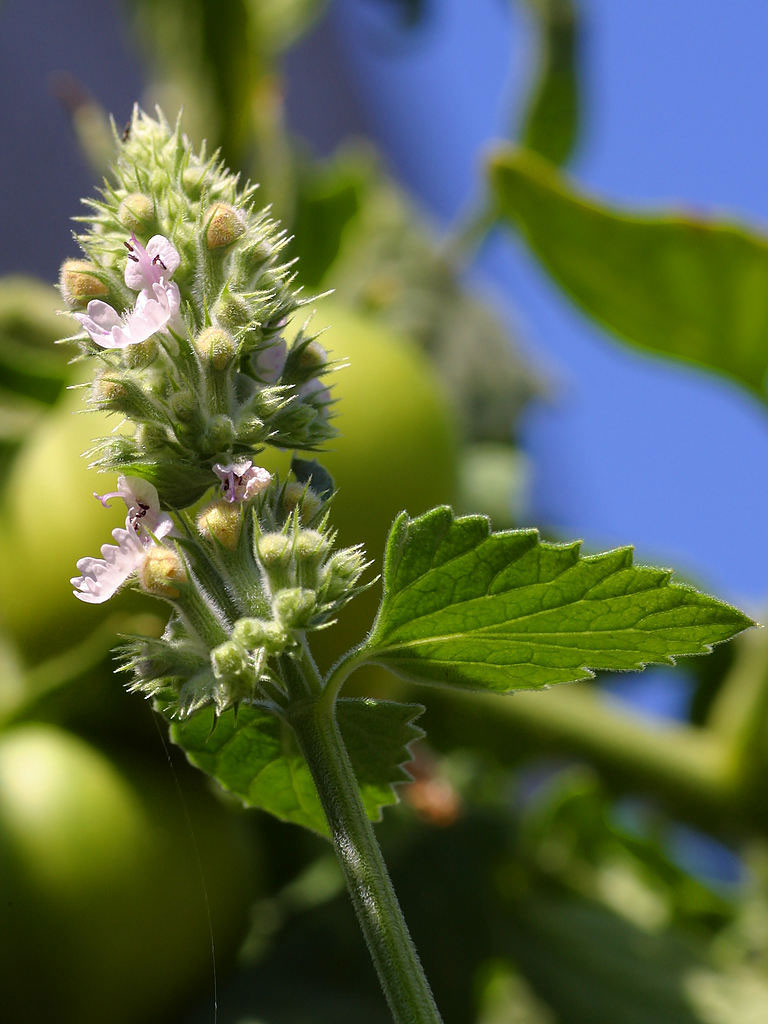
Photo: Jon Sullivan, Public domain · source

Herb · Lamiaceae
Catnip
Nepeta cataria
In other languages: Echt kattenkruid (Nederlands) · Herbe aux chats (Français)
Catnip is a perennial from Europe and western Asia that has been grown in herb gardens for centuries and has naturalised in many places. It forms an upright clump with square stems and soft, grey-green, heart-shaped leaves with toothed edges. From June to September it bears dense spikes of small white flowers spotted with purple, which are busy with bees and butterflies. The leaves smell minty and lemony and contain nepetalactone, the substance that gets so many cats excited. There is also a form with a fresh lemon scent, ‘Citriodora’.
Caution: Catnip self-seeds readily, even between paving and in borders. Remove spent spikes before the seed ripens if you do not want seedlings.
Light
Sun or partial shade
preferably some sun
Moisture
Dry to normal
no wet feet
Legal basis
Sand, loam or clay
any pH
Hardiness
Fully hardy
down to -25 °C
Size
0.8 m
tall, 0.5 m wide
Flowering
June–September
| Pruning months | March and July |
|---|---|
| Height | 0.8 m |
| Native to Belgium | No, planted |
| Good for bees, butterflies and birds | Yes, for bees and butterflies |
| Poisonous to people and pets | Not known to be poisonous |
| Flowering | June–September |
Identify
Catnip: how do you recognise it?
- Habit
- Upright, branching perennial 50–80 cm tall and about 50 cm wide, with square stems.
- Leaves
- Heart-shaped to triangular, 3–7 cm, coarsely toothed, softly hairy and grey-green.
- Flowers
- Small lipped flowers, white with purple spots, in dense spikes at the stem tips from June to September.
- Scent
- Herby and minty with a hint of lemon; much stronger when you bruise the leaves.
- Roots
- A compact, fibrous rootstock. It does not spread underground, but it does self-seed.
Flowering: June–September · Harvest and fruit: June–September · Sowing: March–May · Plants: April–May and September · Pruning: March and July
In your garden
Why grow it?
- Long flowering from June to September: a real magnet for bees and butterflies.
- Drought tolerant and undemanding: grows in almost any well-drained soil.
- Cats love it: a plant for every cat lover.
- The leaves can be used fresh or dried for herbal tea.
- After cutting back in July it flowers again until September.
Catnip: where does it grow best?
- Sun to partial shade; in full sun it flowers best and stays more compact.
- Any well-drained soil: sand, loam or clay, acid to chalky.
- Dry to moist; it dislikes wet soil in winter.
- Allow 40–50 cm between plants. Choose a spot where cats are welcome, or protect the plant.
- Light
- Sun and partial shade
- Soil type
- Sand, loam or clay
- Acidity
- Not fussy
- Moisture
- Dry or normal
- Size
- 0.8 m tall, 0.5 m wide
- Hardiness
- Hardy (to -25 °C)
Goes well with
- Lavender: Likes the same sunny, dry spot and also attracts lots of bees.
- Oregano: Another bee plant for the herb garden, with pink flowers at the same time.
- Coneflower: Large pink flowers beside the white spikes, also in summer.
- Thyme: A low, scented edge at the front of the herb garden.
- Sage: Grey leaves and the same dry, sunny position.
Maintenance
Catnip: when and how to plant it?
Plant in April–May and September.
- Sow indoors in March–April in small pots at 18–20 °C, barely covering the fine seed. Outdoors, sow where it is to grow in April–May.
- Plant out young plants in April–May or in September.
- Dig a hole slightly larger than the root ball; on heavy soil mix in some coarse sand.
- Set the plant at the same depth as it was in the pot, 40–50 cm apart, and firm the soil.
- Water well and keep the soil moist until the plant is established.
- Protect young plants from cats with a small wire-mesh cage until they are sturdy.
Care
- Watering
- Rarely needed once established, only in prolonged drought. Soil that is too wet makes the roots rot.
- Feeding
- Not needed: on rich soil it becomes floppy and falls open.
- Spent flowers
- Cut the stems back after the first flush in July: this gives a second flush and prevents self-seeding.
- Harvesting
- Pick the leaves just before or as flowering begins, on a dry morning. Dry them in bunches in an airy, shady place and store them in a closed jar.
- Cat protection
- Put a wire-mesh cage or a few twigs around young plants, or plant it among sturdier plants.
Tip: Sow or plant a few more plants than you need and protect the youngest with mesh: once they are sturdy, they can cope with a cat. Cut back in July for a second flush.
Catnip: when to prune it?
Pruning months: March and July.
When: Twice a year: in July after the first flush, and in March to remove the old stems.
How:
- In July, cut the faded stems back by about half: it regrows quickly and flowers until September.
- Remove spent spikes before they set seed if you do not want seedlings.
- Leave the dead stems standing in autumn: they protect the base in winter.
- In March, cut all old stems down to just above the new shoots at the base.
Propagation
- Seed
- Sow indoors in March–April or outdoors in April–May. At 18–20 °C the seed germinates in 1–3 weeks; barely cover it.
- Division
- In March–April or in September, split older clumps and replant them straight away.
- Cuttings
- In May–June take soft tip cuttings of 8 cm without flower buds and root them in moist cutting compost.
Catnip: how does it get through the winter?
Hardy to −25 °C.
- Hardy to about −25 °C: no protection is needed in Belgium.
- Wet soil in winter is more dangerous than frost: plant in a well-drained spot.
- Leave the old stems until March to protect the base.
Diseases and pests
- Cats: Cats lie in the plant, roll in it and bite off stems. Protect young plants with mesh; a sturdy plant usually grows back quickly.
- Powdery mildew: White powder on the leaves in dry, warm summers. Cut back affected stems and give plants space; new growth is usually healthy.
- Slugs: They eat young seedlings and shoots in spring. Only plant out sturdier plants and check in the evening.
- Root rot: The plant dies in a wet winter. Choose a well-drained spot and mix coarse sand into heavy soil.
Through the year
- March: Remove old stems. Sow indoors. Divide.
- April: Sow indoors and outdoors. Plant. Protect young plants from cats.
- May: Sow outdoors. Plant. Take cuttings.
- June: Flowering begins. Harvest leaves for tea.
- July: After the first flush, cut back by half.
- August: Second flush. Water in prolonged drought.
- September: Last flowers. Plant or divide.
- October: Leave the stems standing for winter.
Use
Edible and useful
- Leaves (June–September)
- Pick the leaves and flowering tops from June, on a dry morning, just before or at the start of flowering: that is when they are most fragrant. Catnip smells and tastes fresh, of mint and lemon, with a slightly bitter edge. Use it fresh or dried for herbal tea, and a few young leaves in a salad. And, of course, for the cat. If you cut the plant back in July, new leaves grow until September.
- Storing
- Dry it in small bunches, upside down somewhere airy and shady, and keep the leaves in a tightly closed jar: that way they keep their scent and the cat stays away. Dried, it keeps for a year, but it slowly loses its appeal to cats.
Caution: Catnip tea is a mild herbal drink, not a medicine: drink it in moderation, and not during pregnancy or breastfeeding. For tea, use only true catnip (Nepeta cataria, with small white flowers spotted with purple), not the blue ornamental catmint in the border. Cats may sniff it and roll in it, but eating a lot of leaves can make them vomit or give them diarrhoea.
Eating and using is at your own risk: see the terms of use.
Recipes
- Catnip tea (Tea · 1 cup · 10 min)
- Catnip cushion for your cat (Other · 2 cushions · 30 min)
Good for wildlife
- Bees
- Nectar and pollen for honeybees and wild bees.
- Butterflies
- Nectar for butterflies.
You and this species
Did you know?
- Not all cats react to catnip: the sensitivity is inherited, and young kittens usually do not react yet.
- The scent is only really released when the leaves are bruised, which is why cats rub, roll and bite into the plant.
- The blue catmint in many borders is a different plant (Nepeta × faassenii). True catnip has white flowers and attracts cats much more strongly.