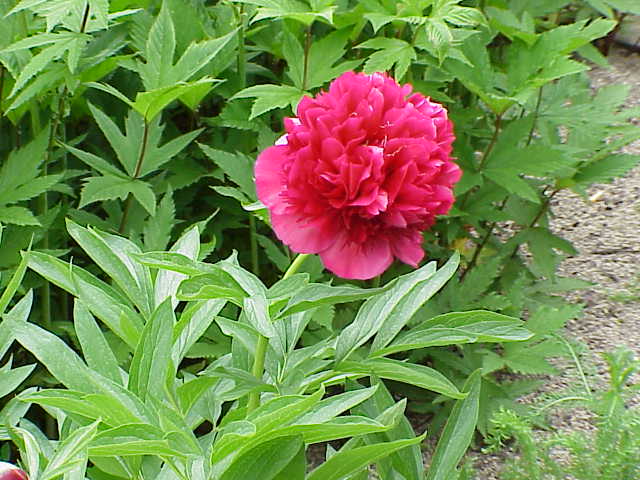
Photo: Kurt Stüber [1], CC BY-SA 3.0 · source

Perennial · Paeoniaceae
Common peony
Paeonia officinalis
In other languages: Boerenpioen (Nederlands) · Pivoine officinale (Français)
The common peony comes from southern Europe, where it grows wild on chalky slopes and in open woodland. It is a herbaceous perennial with deeply cut, dark green leaves that die back above ground every autumn. In May and June, large, globe-shaped flowers up to 12 cm across appear. In gardens you mostly see the double, crimson ‘Rubra Plena’, the classic image of the cottage garden, but there are also double pink and white forms. Gardeners love it as a cut flower and because it can stay in the same spot for decades.
Caution: All parts are poisonous, especially the roots and seeds. Keep young children and pets away from the glossy seeds.
Light
Sun or partial shade
preferably some sun
Moisture
Normal
no wet feet
Legal basis
Loam or clay
neutral to chalky
Hardiness
Fully hardy
down to -30 °C
Size
0.6 m
tall, 0.6 m wide
Flowering
May–June
| Pruning months | October |
|---|---|
| Height | 0.6 m |
| Native to Belgium | No, planted |
| Poisonous to people and pets | Yes, take care with children and pets |
| Flowering | May–June |
Identify
Common peony: how do you recognise it?
- Habit
- Rounded, herbaceous clump about 60 cm tall and wide, dying back above ground every winter.
- Leaves
- Dark green and deeply cut, on sturdy stems.
- Flower
- Bowl- or globe-shaped, 8–12 cm across; single in the wild species, usually double in gardens.
- Colour
- Crimson, pink or white, with yellow stamens in the single forms.
- Roots
- Thick, tuberous storage roots with buds (eyes) on top.
- Fruit
- In single forms, hairy seed pods that split open to show red, sterile seeds and glossy black, fertile ones.
Flowering: May–June · Plants: September–October · Pruning: October
In your garden
Why grow it?
- Large, lavish flowers in May and June, the highlight of early summer.
- An excellent cut flower for a generous bouquet.
- Very long-lived: a well-planted peony flowers for decades.
- After flowering, the dark green leaves form a fresh clump until autumn.
- Little work: once planted properly, it needs almost nothing.
Common peony: where does it grow best?
- Full sun gives the most flowers; light partial shade is fine too.
- Deep, rich loam or clay, neutral to chalky and well drained.
- Normally moist: not too dry in spring, not wet in winter.
- Give it 60–90 cm of space, away from shrubs or trees whose roots would compete.
- Light
- Sun and partial shade
- Soil type
- Loam or clay
- Acidity
- Neutral or chalky
- Moisture
- Normal
- Size
- 0.6 m tall, 0.6 m wide
- Hardiness
- Hardy (to -30 °C)
Goes well with
- Lady’s mantle: A soft, yellow edging at the front that covers the base of the peony.
- Catmint: Blue clouds beside the red flowers, and it keeps flowering after the peony has finished.
- Hardy geranium: Fills the space after flowering and blooms for a long time.
- Bearded iris: Flowers around the same time and also likes sun and chalky soil.
- Ornamental onion: Purple globes above the peony leaves in May and June.
Maintenance
Common peony: when and how to plant it?
Plant in September–October.
- Plant in September or October, while the plant is dormant.
- Dig a generous hole 40–50 cm wide and deep and mix in compost.
- Set the root so that the eyes are no more than 3 cm below the surface; on heavy clay, even a little shallower.
- Leave 60–90 cm between plants.
- Firm in gently without damaging the eyes and water well.
- Spread a thin layer of compost around the plant, but not over the eyes.
Care
- Water
- Water well in dry spells in spring, when the buds are forming.
- Feeding
- In spring, a little compost or organic fertiliser around the plant, not on the eyes. Too much nitrogen gives leaves instead of flowers.
- Support
- In April, place a ring or plant support over the young shoots: the heavy flowers flop after rain.
- Spent flowers
- After flowering, cut them off just below the flower, but leave the leaves until autumn.
- Leave alone
- Do not move it: after moving it often does not flower for a few years.
Tip: Plant in September or October with the eyes no more than 3 cm below the surface, or it will not flower. Cut flowers for the vase in bud, when the bud feels soft and shows colour.
Common peony: when to prune it?
Pruning months: October.
When: In October, when the leaves turn yellow or brown, cut the stems down to just above the ground.
How:
- Cut the stems to 2–5 cm above the ground; take care of the pink eyes at the base.
- Clear away the leaves and do not compost them if they were mouldy.
- Deadhead in June; leave the leaves, as they feed the roots for next year.
Caution: Do not cut the leaves off in summer: the plant needs them to form next year’s flower buds.
Propagation
- Division
- In September: lift the plant, rinse the soil off the roots and cut them with a sharp knife into pieces, each with 3–5 eyes and a good piece of root. Replant straight away, with the eyes no more than 3 cm deep. It flowers again after 2–3 years.
- Seed
- For single forms: sow fresh seed in autumn in a pot and stand it outdoors. Germination can take two years and the first flowers only come after several years.
Common peony: how does it get through the winter?
Hardy to −30 °C.
- Fully hardy, to about −30 °C: no protection is needed.
- It needs winter cold to flower well.
- The plant dies back above ground; the eyes overwinter just below the surface. Do not cover them with a thick mulch.
- In a pot it only succeeds in a large, deep container, sheltered against a wall.
Diseases and pests
- Grey mould: Young shoots that collapse at the base and brown buds that fail to open, especially in wet weather. Cut out affected parts and clear away all the leaves in autumn.
- No flowers: Planted too deep, too much shade, too much fertiliser or recently moved. Lift the plant in September and replant it less deeply.
- Ants on the buds: Ants are drawn to the sweet sap of the buds. They do no harm; just shake cut flowers before bringing them in.
- Flopping flowers: After rain the heavy flowers bend over. Put a support in place in good time.
Through the year
- March: Red shoots emerge. Spread compost around the plant.
- April: Put supports in place. Water in dry spells.
- May: In flower. Cut flowers in bud.
- June: Last flowers. Deadhead.
- July: Leave the leaves. Water in long dry spells.
- September: Plant and divide, with the eyes no more than 3 cm deep.
- October: Plant. Cut yellow leaves to the ground and clear them away.
Use
Edible and useful
Not edible. Peonies are mildly poisonous, especially the roots and seeds: eating them causes nausea, vomiting, stomach ache and diarrhoea, in children as well as in dogs, cats and grazing animals. In autumn the seed pods split open to show glossy red and blue-black seeds, which children like to pick up: cut them off or do not let children play with them. The root of the common peony was once used as a remedy, and its seeds as a necklace for teething babies: do not do this. The sap can irritate the skin: wear gloves when dividing and moving plants. If any is swallowed, call a poison centre (in Belgium 070 245 245) or your doctor at once.
You and this species
Did you know?
- The name Paeonia refers to Paeon, physician to the gods in Greek mythology.
- Officinalis means ‘of the apothecary’: the plant was once grown in monastery gardens as a medicinal herb.
- The double ‘Rubra Plena’ has been grown in European gardens for centuries and so became the classic cottage-garden peony.