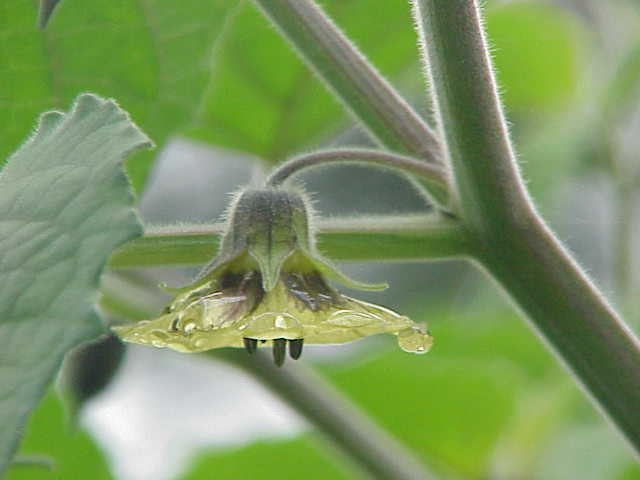
Photo: Kurt Stüber [1], CC BY-SA 3.0 · source

Fruit plant · Solanaceae
Cape gooseberry
Physalis peruviana
In other languages: Kaapse kruisbes (Nederlands) · Coqueret du Pérou (Français)
Cape gooseberry comes from the Andes in South America, where it is a perennial. Here it is not hardy and is usually grown as an annual, sown in spring and harvested in late summer and autumn. It is a broad, rather sprawling plant of about 1 m, with softly hairy, heart-shaped leaves and small yellow bell flowers with dark blotches in the centre. Each orange berry sits inside a papery lantern, which turns brown and parchment-like when the fruit is ripe. The fruits taste sweet-sour and tropical, and keep for weeks inside their husks.
Caution: Only eat ripe fruits: unripe fruits and the leaves and stems are poisonous, as in other members of the nightshade family. So take care with young children and pets.
Light
Full sun
warm and bright
Moisture
Normal
no wet feet
Legal basis
Sand, loam or clay
any pH
Hardiness
down to 2 °C
protect in harsh winters
Size
1.2 m
tall, 1 m wide
Flowering
June–September
| Pruning months | August and October |
|---|---|
| Height | 1.2 m |
| Native to Belgium | No, planted |
| Poisonous to people and pets | In part: see Caution above |
| Flowering | June–September |
Identify
Cape gooseberry: how do you recognise it?
- Habit
- Broad, branching plant 1–1.5 m tall and about as wide; sometimes taller in a greenhouse.
- Leaves
- Heart-shaped, softly hairy, greyish green, 6–15 cm.
- Flower
- Yellow, nodding bells of 1.5–2 cm with dark purple to brown blotches in the centre, from June to September.
- Fruit
- Round orange berry of 1.5–2 cm inside a lantern-shaped husk, which turns brown and papery when the fruit is ripe.
- Stems
- Soft and hairy, tending to flop under the weight of the fruit.
Flowering: June–September · Harvest and fruit: August–October · Sowing: February–April · Plants: May–June · Pruning: August and October
In your garden
Why grow it?
- Sweet-sour, tropical-tasting fruits from August until the first frost.
- Easy to sow and fast-growing: from seed to harvest in a single season.
- The lanterns are decorative and protect the fruit from birds and rain.
- Inside their husks the fruits keep for weeks in a cool place.
- Does well in a large pot on a warm patio or in the greenhouse.
Cape gooseberry: where does it grow best?
- Full sun and a warm, sheltered spot: in front of a south-facing wall, in a greenhouse or a polytunnel.
- Sandy, loamy or clay soil, acid to chalky, well drained. Not-too-rich soil gives more fruit than heavy feeding.
- Normally moist: regular watering, but never waterlogged.
- Plant 60–80 cm apart; the plants spread wide.
- In a pot of at least 20 litres on a sunny patio.
- Light
- Sun
- Soil type
- Sand, loam or clay
- Acidity
- Not fussy
- Moisture
- Normal
- Size
- 1.2 m tall, 1 m wide
- Hardiness
- Frost tender: overwinter indoors (above 2 °C)
Goes well with
- Tomato: The same warm spot and similar care, in the greenhouse or vegetable garden.
- Sweet pepper: Another heat-loving fruiting vegetable started indoors.
- Basil: A fragrant herb that also loves warmth and sun.
- Pot marigold: Colourful flowers that attract pollinators and beneficial insects.
Maintenance
Cape gooseberry: when and how to plant it?
Plant in May–June.
- Sow indoors in February–April and plant out after mid-May, once night frosts are over; a little earlier in a greenhouse.
- Harden off the young plants for a week by putting them outside during the day.
- Dig a hole slightly larger than the root ball and set the plant at the same depth as in the pot.
- Plant 60–80 cm apart and add a cane or a support ring straight away.
- Water in at once and keep the soil moist for the first few weeks.
- Add a thin mulch to keep the soil moist.
Care
- Water
- Regularly, especially in a pot and in dry spells. Do not water over the leaves.
- Feeding
- Moderate: some compost at planting and, in a pot, a potassium-rich feed every two weeks. Too much nitrogen gives lots of leaves and little fruit.
- Support
- Tie the stems to a cane or use a support ring: laden branches flop and break.
- Harvest
- Pick the fruits when the lantern is brown and papery, or gather fallen lanterns.
- Storage
- Leave the fruits in their husks and store them cool and dry: they keep for weeks that way.
Tip: Sow in good time, in February–March, as the fruits need a long summer to ripen. Only eat fruits from a brown, parchment-like lantern.
Cape gooseberry: when to prune it?
Pruning months: August and October.
When: It does not really need pruning. In late August you can pinch out the tips; if you want to overwinter the plant, cut it back in October.
How:
- The plant branches by itself: there is no need to remove side shoots as with tomatoes.
- In late August, pinch out the tips of the stems: the plant then puts its energy into the fruits already set.
- Cut off bent and broken stems.
- For overwintering: in October, cut the plant back by about half and pot it up.
Propagation
- Seed
- In February–April indoors, at 20–25 °C. Sow thinly on moist seed compost and barely cover. They germinate in one to three weeks; prick out into small pots once they have two true leaves.
- Cuttings
- Side shoots of 10 cm root easily in moist cutting compost in late summer. Overwinter the young plants light and frost-free; they fruit earlier the next year.
Cape gooseberry: how does it get through the winter?
Hardy to 2 °C: protect in harsh winters.
- Not hardy: the plant dies in even a light frost. Harvest all ripe fruits before the first night frost.
- It is usually grown as an annual and sown again each year.
- Overwintering is possible: cut back, pot up and keep it light and frost-free at 5–10 °C with little water. The next year it fruits earlier.
Diseases and pests
- Lots of leaf, little fruit: Too much feeding or sown too late. Sow in good time, go easy on nitrogen and choose the warmest spot.
- Aphids: Small green or black aphids on young shoots. Hose or wipe them off; ladybirds help.
- Whitefly: Tiny white flies under the leaves, especially in a greenhouse. Hang yellow sticky traps and ventilate well.
- Slugs and snails: Young plants nibbled after planting out. Pick them off in the evening and only plant out sturdy plants.
Through the year
- February: Sow indoors at 20–25 °C.
- March: Sow indoors. Prick out.
- April: Last indoor sowing. Pot on into larger pots.
- May: Harden off. Plant out after mid-May.
- June: Plant. First flowers. Add support.
- July: In flower. Water in dry spells.
- August: First fruits ripen. Pinch out tips. Take cuttings.
- September: Harvest when the lantern is brown.
- October: Harvest before frost. Cut back and bring in to overwinter.
- November: Overwintering plants light and frost-free, with little water.
Use
Edible and useful
- Fruit (August–October)
- The orange berries in their papery lanterns ripen from August until the first frost. Pick them when the husk is straw-coloured and dry and the berry golden orange: they often drop by themselves then. They taste sweet and sour and tropical: fresh, in fruit salad, dipped in chocolate, in jam or chutney.
- Storing
- In their husks they keep for weeks or even a few months somewhere cool and dry. Remove the husk just before use. Berries picked green do not ripen well.
Caution: Only eat fully ripe, orange berries: unripe green berries, the husk, the leaves and the stems contain toxic substances (such as solanine). Do not confuse it with the Chinese lantern (Physalis alkekengi), whose husk turns bright red and whose berry is not for eating. It is not hardy: grow it as an annual or in a pot overwintered indoors.
Eating and using is at your own risk: see the terms of use.
Recipes
- Chocolate-dipped Cape gooseberries (Other · ± 25 pieces · 20 min + 30 min setting)
- Cape gooseberry jam (Jam · ± 3 jars · 40 min)
You and this species
Did you know?
- The lantern is the calyx of the flower, which keeps growing after flowering and completely encloses the fruit.
- The name Cape gooseberry probably refers to the Cape of Good Hope in South Africa, where the plant was grown early on.
- It is related to the tomato and the potato, and to the Chinese lantern plant used in dried arrangements.