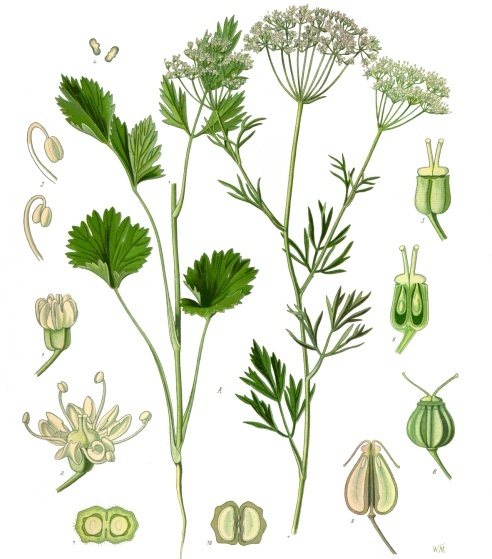
Photo: Franz Eugen Köhler, Köhler's Medizinal-Pflanzen, Public domain · source

Herb · Apiaceae
Anise
Pimpinella anisum
In other languages: Anijs (Nederlands) · Anis vert (Français)
Anise is an annual herb from the eastern Mediterranean and south-west Asia, grown for its seeds since ancient times. The plant reaches about 50 cm. The lower leaves are round and toothed, the upper ones finely cut like those of dill. In July–August it bears many small white umbels that attract bees and hoverflies. The small grey-brown seeds smell and taste of liquorice and are used in biscuits, bread, teas and liqueurs. In Belgium they only ripen in a warm, dry summer.
Light
Full sun
warm and bright
Moisture
Dry to normal
no wet feet
Legal basis
Sand or loam
any pH
Hardiness
down to 0 °C
protect in harsh winters
Size
0.5 m
tall, 0.2 m wide
Flowering
July–August
| Height | 0.5 m |
|---|---|
| Native to Belgium | No, planted |
| Good for bees, butterflies and birds | Yes, for bees |
| Poisonous to people and pets | Not known to be poisonous |
| Flowering | July–August |
Identify
Anise: how do you recognise it?
- Habit
- Slender, upright annual 40–50 cm tall and 20 cm wide, with a thin taproot and hollow, finely grooved stems.
- Leaves
- Lower leaves round to kidney-shaped and toothed, upper leaves feathery and finely cut.
- Flower
- Small white flowers in compound umbels, in July–August.
- Seed
- Small, egg-shaped and grey-brown, with fine ribs. Strong aniseed scent, especially when rubbed or crushed.
- Roots
- Thin taproot: it resents transplanting and is therefore sown where it is to grow.
Flowering: July–August · Harvest and fruit: June–September · Sowing: April–May
In your garden
Why grow it?
- The seeds give a sweet, liquorice-like flavour to bread, biscuits, teas and drinks.
- The white umbels attract bees, hoverflies and other beneficial insects.
- The fine leaves can be used in salads and soups, and as a delicate garnish.
- Easy to grow from seed, even in a large pot on a sunny patio.
- Annual and compact: it fits in a herb border, among vegetables or in a container.
Anise: where does it grow best?
- Full sun in a warm, sheltered spot: without warmth the seeds do not ripen.
- Loose, free-draining soil: sand or loam, acid to chalky. Anise dislikes wet clay.
- Dry to normal moisture: keep the soil damp while seeds germinate, after that it is fairly drought tolerant.
- Allow 20 cm between plants and 30 cm between rows; in a pot, at least 25 cm deep.
- Light
- Sun
- Soil type
- Sand or loam
- Acidity
- Not fussy
- Moisture
- Dry or normal
- Size
- 0.5 m tall, 0.2 m wide
- Hardiness
- Frost tender: overwinter indoors (above 0 °C)
Goes well with
- Coriander: The same sunny spot and the same need for loose, free-draining soil.
- Dill: A related umbellifer with fine foliage; it also attracts beneficial insects.
- Pot marigold: A colourful, easy annual that attracts hoverflies and bees.
- Sage: Likes the same warm, free-draining soil and adds a contrast in foliage.
Maintenance
Anise: when and how to plant it?
- Sow in April–May directly outdoors, when the soil is warm enough and no hard frost is expected.
- Rake the soil to a fine tilth and remove weeds; add a little compost if you like, but not too much.
- Sow thinly in rows 30 cm apart at about 1 cm deep, cover with a thin layer of soil and firm lightly.
- Keep the soil lightly moist until the seedlings emerge (after 2–3 weeks).
- Thin the seedlings to 20 cm apart as soon as they are 5 cm tall.
Care
- Water
- Keep lightly moist during germination and in the first weeks. After that, water only in long dry spells.
- Feeding
- Usually not needed. Soil that is too rich gives a lot of leaf and few seeds.
- Weeding
- Keep young plants weed-free: they grow slowly at first and are quickly overgrown.
- Support
- In a windy spot, a few twigs or a string will keep the stems upright once the seeds become heavy.
- Harvesting
- Pick leaves in summer. For the seeds: harvest when the umbels turn grey-brown (August–September), cut the stems and hang them upside down in a paper bag to dry.
Tip: Sow in April–May where it is to grow, in a warm spot, as it dislikes transplanting. Harvest the umbels when they are grey-brown and leave them to dry on paper.
Anise: when to prune it?
When: Anise is not pruned: it is an annual.
How:
- Pick young leaf tips for the kitchen, but not too many if you want seed.
- Cut off the seed umbels when they are grey-brown and the seeds start to loosen.
- After harvest, pull up the stems and put them on the compost heap.
Propagation
- Sowing
- In April–May, directly in the final position, at 1 cm deep. Fresh seed germinates best: old seed quickly loses its viability.
- Self-seeding
- Leave a few umbels to drop their seed: young plants often appear the following spring.
Anise: how does it get through the winter?
Hardy to 0 °C: protect in harsh winters.
- Anise is an annual: after setting seed the plant dies and there is nothing to protect.
- Young plants cannot take hard frost (around 0 °C), so do not sow too early.
- Store the dried seeds cool, dry and dark in a sealed jar and preferably use them within a year or two, also for sowing.
Diseases and pests
- Seed does not ripen: In a cool, wet summer the seeds do not ripen. Choose the warmest spot you have, or use the leaves instead.
- Slugs: Young seedlings are quickly eaten. Collect the slugs and protect the sowing until the plants are stronger.
- Powdery mildew: White powder on leaves and stems in dry weather and in dense stands. Allow enough space and water at the base.
- Aphids: On young shoots and umbels. Rinse off with water or let the ladybirds do their work.
Through the year
- March: Prepare the seedbed in a sunny spot.
- April: Sow in place as soon as the soil warms up.
- May: Sow and thin to 20 cm. Weed.
- June: Weed. Water in dry spells.
- July: White umbels in flower. Bees and hoverflies visit the flowers.
- August: Seeds form. Watch the colour of the umbels.
- September: Harvest the umbels as soon as they are grey-brown. Dry them and thresh the seed.
Use
Edible and useful
- Leaves (June–July)
- Pick the young, finely divided leaves in June and July, before and at the start of flowering. They taste mild and sweet, of aniseed: snip them over a salad, carrots, fish or fruit, like dill or chervil. Do not take too much from one plant, or it will set less seed.
- Seeds (August–September)
- The seeds are the real spice. In a warm summer the umbels turn greyish brown in August and September: cut them off, hang them upside down in a paper bag to finish drying and rub out the seeds. In a cool, wet summer they do not always ripen. Aniseed gives a sweet, liquorice-like flavour to bread, biscuits, hot milk, tea, red cabbage and fish. Crush it just before use.
- Storing
- Leave the seeds to finish drying for a week in an open dish, then blow or sieve out the chaff. In a closed jar, dark and dry, they keep their flavour for one to two years. The leaves are best fresh and keep for a few days in a bag in the fridge.
Caution: Anise belongs to the carrot family, like the very poisonous hemlock and fool’s parsley, whose leaves and umbels look very similar. Only use anise you sowed yourself from bought seed, or buy the seed, and never pick wild members of the carrot family. Hemlock has purple blotches on the stem and smells of mice. People allergic to celery, carrot or fennel may also react to anise. In normal kitchen amounts aniseed is safe; do not swallow the essential oil.
Eating and using is at your own risk: see the terms of use.
Recipes
- Aniseed milk (Other · 2 mugs · 15 min)
- Aniseed biscuits (Dish · ± 40 biscuits · 30 min + 1 hr chilling)
Good for wildlife
- Bees
- Nectar and pollen for honeybees and wild bees.
You and this species
Did you know?
- Anise is not related to star anise: that is a tree from a completely different family, although the same aromatic compound gives both their typical taste.
- In the Netherlands, sugar-coated aniseed, known as muisjes, is traditionally eaten on rusks to celebrate a birth.
- Anise has been grown for thousands of years in the eastern Mediterranean, and its seeds are a common flavouring for bread and drinks in many countries.