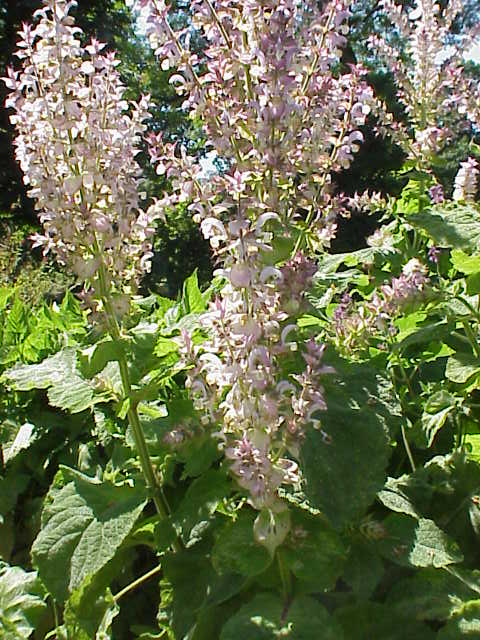
Photo: Wikimedia Commons, CC BY-SA 3.0 · source

Herb · Lamiaceae
Clary sage
Salvia sclarea
In other languages: Scharlei (Nederlands) · Sauge sclarée (Français)
Clary sage is a biennial sage from southern Europe, the Mediterranean and Central Asia. In its first year it forms a broad rosette of large, wrinkled, grey-green, hairy leaves. In the second year, from June to August, branched flower spikes up to 1 m tall appear, with lilac or pinkish-white bracts and pale blue to lilac lipped flowers. The whole plant has a strong, musky scent: some people love it, others think it smells of sweat. Gardeners like it because it copes well with drought, draws bees and bumblebees in large numbers and self-seeds gently in a sunny spot. It is often sold as var. turkestanica, with large pink-and-white spikes.
Light
Full sun
warm and bright
Moisture
Dry to normal
no wet feet
Legal basis
Sand, loam or clay
neutral to chalky
Hardiness
Fully hardy
down to -20 °C
Size
1 m
tall, 0.5 m wide
Flowering
June–August
| Pruning months | August–September |
|---|---|
| Height | 1 m |
| Native to Belgium | No, planted |
| Good for bees, butterflies and birds | Yes, for bees and butterflies |
| Poisonous to people and pets | Not known to be poisonous |
| Flowering | June–August |
Identify
Clary sage: how do you recognise it?
- Habit
- Biennial: a low rosette 30–40 cm across in the first year, branched flowering stems up to 1 m tall and 50 cm wide in the second. The plant dies after setting seed.
- Leaves
- Large, oval to heart-shaped, up to about 20 cm long, wrinkled and densely hairy; grey-green and slightly sticky.
- Flowers
- Lipped flowers in whorls along long, branched spikes, from June to August; pale lilac to white, with showy pinkish-lilac bracts.
- Scent
- The whole plant smells strongly, aromatic and musky, especially when touched and in warm weather.
- Stems
- Square, sturdy and hairy, as in all members of the mint family; sticky towards the top.
- Seed
- Small brown nutlets in the calyx, ripe from late August. They germinate readily in open, sunny soil.
Flowering: June–August · Harvest and fruit: May–September · Sowing: March–May · Plants: May and September · Pruning: August–September
In your garden
Why grow it?
- A tall, spectacular flowering plant for a dry, sunny border or gravel garden, from June to August.
- Bees, bumblebees and butterflies constantly visit the lipped flowers.
- Tolerates drought and poor soil once well rooted: watering is rarely needed.
- The coloured bracts stay attractive for weeks, even after the small flowers have faded.
- Self-seeds gently, so you have flowering plants every year without sowing again.
- Even in its first year, the large, felty leaf rosette is an ornament in the border.
Clary sage: where does it grow best?
- Full sun: the warmer and sunnier the spot, the sturdier the plant and the richer the flowering.
- Well-drained soil: sand, loam or clay, neutral to chalky. Improve heavy clay with coarse sand or gravel.
- Dry to moderately moist; wet soil in winter makes the rosette rot.
- Allow 40–50 cm between plants. They look best in groups of three to five.
- Light
- Sun
- Soil type
- Sand, loam or clay
- Acidity
- Neutral or chalky
- Moisture
- Dry or normal
- Size
- 1 m tall, 0.5 m wide
- Hardiness
- Hardy (to -20 °C)
Goes well with
- Lavender: The same dry, sunny spot and the same visitors.
- Globe thistle: Steel-blue globes beside the pinkish-lilac spikes.
- Feather grass: Airy plumes that sway with the tall flowering stems.
- Catmint: A low blue foreground that hides the base of the clary sage.
- Purpletop vervain: Airy purple flowers at the same height, which also self-seed freely.
Maintenance
Clary sage: when and how to plant it?
Plant in May and September.
- Sow indoors in March–April in moist seed compost at 18–20 °C and cover the seeds only very thinly. They germinate in one to two weeks.
- Prick the seedlings out into small pots once they have two true leaves and harden them off gradually.
- You can also sow outdoors where they are to flower in April–May, thinly in rows, then thin the seedlings to 40–50 cm.
- Plant out in May or September, at the same depth as in the pot, 40–50 cm apart. September plantings flower the following summer.
- Water in well and keep the soil lightly moist for the first few weeks until the plant has rooted.
- Mulch with gravel rather than compost: it keeps the base of the rosette dry in winter.
Care
- Watering
- Rarely needed once established; only during long dry spells in the first year.
- Feeding
- Not needed. On rich soil the stems go soft and the plant flops.
- Support
- In a windy spot, put in a few canes or a plant support for the tall flowering stems.
- Deadheading
- Leave a few spikes to self-seed and cut the rest after flowering if you do not want too many seedlings.
- Harvesting
- The small flowers and young leaves are edible: scatter the flowers over a salad and use the leaves sparingly, as their flavour is strong.
- Clearing up
- The plant dies after setting seed: pull it out in autumn and leave the young rosettes in place.
Tip: Each plant flowers only once: leave a few seedlings or sow a few more every year, so you have flowering plants every summer.
Clary sage: when to prune it?
Pruning months: August–September.
When: After flowering, in August–September. No real pruning is needed: it is mainly a matter of cutting off spent spikes.
How:
- Cut spent flowering stems back to just above the leaf rosette if you do not want seed.
- If you want seedlings, leave two or three spikes until the seed is ripe and brown.
- After early cutting back, a plant sometimes forms a new rosette and flowers for another year, but do not count on it.
- Remove dead plants, roots and all, in autumn.
Caution: The leaves are sticky and the scent lingers on your hands for a long time: wear gloves if you would rather avoid that.
Propagation
- Seed
- Indoors in March–April or outdoors in April–May. Sowing fresh seed outdoors in August–September also works; those plants flower after the following winter.
- Self-seeding
- Let a few spikes ripen. In spring, seedlings appear around the parent plant; move them while still small, with a good root ball.
Clary sage: how does it get through the winter?
Hardy to −20 °C.
- Hardy to about −20 °C: the rosette survives a normal Belgian winter without protection.
- Wet soil is a greater danger than frost: choose a well-drained spot, if possible slightly raised.
- Do not cover the rosette with wet leaves or straw, as it will rot underneath.
- In a pot: stand it against a wall or under an overhang so the compost does not get too wet.
Diseases and pests
- Slugs: Eat holes in young rosettes and seedlings. Pick them off in the evening and spread gravel around young plants.
- Winter rot: The rosette turns brown and soft. The cause is wet soil; in future sow or plant in a drier, better-drained spot.
- Flopping stems: On rich soil or in too much shade the stems go soft. Do not feed, plant in sun and support if needed.
- Aphids: On young flowering stems in spring. Ladybirds usually deal with them; otherwise hose them off with water.
- Too many seedlings: Weed out surplus seedlings in spring, or cut off most spikes before the seed ripens.
Through the year
- March: Sow indoors. Clear dead leaves from overwintered rosettes.
- April: Sow indoors or outdoors. Prick out seedlings.
- May: Sow outdoors. Plant out young plants. Watch for slugs.
- June: Second-year plants flower. Add support if needed.
- July: Full flower. Water young plants during long dry spells.
- August: End of flowering. Cut off spent spikes or leave a few to self-seed.
- September: Plant out this year’s rosettes. Sow fresh seed outdoors.
- October: Clear dead plants. Leave the seedlings in place.
- December: Rest. Keep the rosettes free of wet leaves.
Use
Edible and useful
- Flowers (June–August)
- Pick the lilac, pink or white flowers from June to August, in the second year, when the plant is in flower. They taste sweet and aromatic, milder than the leaves: scatter them over a salad or a dessert. Pick them on a dry day and use them straight away.
- Leaves (May–September)
- Pick the large, wrinkled rosette leaves from May to September, in the first and second year; the young ones are the most tender. They smell strong and musky and taste more powerful and more bitter than common sage: use them sparingly. They have long been dipped in batter and fried, and in the past they were used to give wine a muscat flavour.
- Storing
- Clary sage is best used fresh. The flowers keep for a day in a closed box in the fridge, the leaves for a few days in a bag.
Caution: Clary sage is edible, but use it as a herb, in small amounts. Not during pregnancy or breastfeeding. Never swallow clary sage essential oil. It is a biennial: in the first year, do not take too many leaves from the rosette, or the plant will weaken.
Eating and using is at your own risk: see the terms of use.
Recipes
- Clary sage fritters (Dish · 4 people as a snack · 30 min)
Good for wildlife
- Bees
- Nectar and pollen for honeybees and wild bees.
- Butterflies
- Nectar for butterflies.
You and this species
Did you know?
- In German it is called Muskatellersalbei: it was once used to give wine a muscat-like flavour.
- The flowering tops are distilled for an essential oil that is widely used in perfumery.
- The colourful part of the spike is mainly the bracts, not the small flowers: that is why it stays attractive for so long.