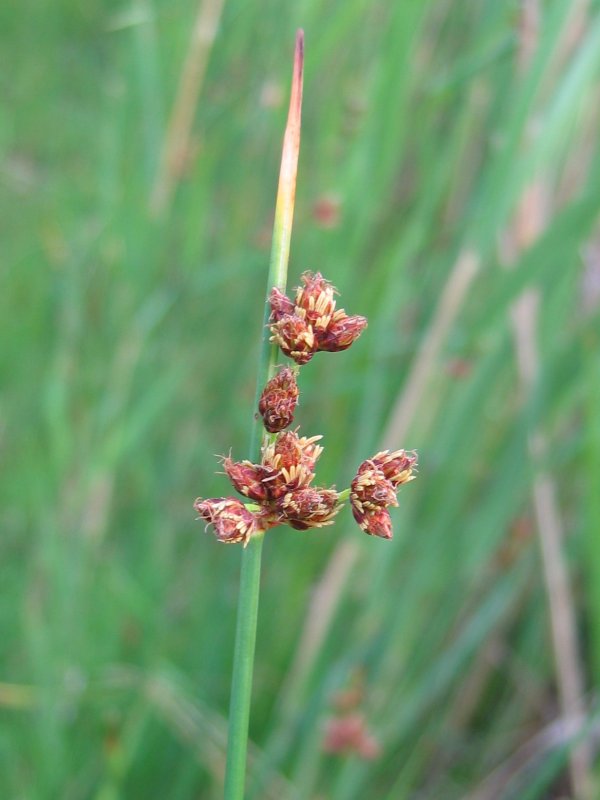
Photo: Kristian Peters -- Fabelfroh 06:50, 11 July 2006 (UTC), CC BY-SA 3.0 · source

Water or marginal plant · Cyperaceae
Grey club-rush
Schoenoplectus tabernaemontani
In other languages: Ruwe bies (Nederlands) · Scirpe de Tabernaemontanus (Français)
Grey club-rush is a native marginal plant that grows wild mainly along ditches and pools and in brackish areas near the coast. It looks like a smaller common club-rush, with round, blue-green stems up to 1.2 m tall topped by a small tuft of brown spikelets. It grows in shallow water 5 to 30 cm deep and stays more compact than its big cousin, so it also fits a medium-sized pond. In gardens the best known form is the zebra rush, ‘Zebrinus’, with cream-yellow bands across the stems. This variegated form grows more slowly and needs a little extra attention.
Caution: Grey club-rush spreads by rhizomes, though less strongly than common club-rush. In a small pond keep it in a basket, and never put plants or pieces of rhizome into ditches, streams or ponds in the wild.
Light
Full sun
warm and bright
Moisture
Moist to wet
must not dry out
Legal basis
Loam, clay or peat
neutral to chalky
Hardiness
Fully hardy
down to -30 °C
Size
1.2 m
tall, 0.5 m wide
| Pruning months | March and June–August |
|---|---|
| Height | 1.2 m |
| Native to Belgium | Yes |
| Poisonous to people and pets | Not known to be poisonous |
Identify
Grey club-rush: how do you recognise it?
- Habit
- Upright stand of round stems up to 1.2 m tall and about 50 cm wide, slowly spreading by rhizomes.
- Stems
- Round, smooth and blue-green, thinner than in common club-rush. In ‘Zebrinus’ with cream-yellow cross bands.
- Leaves
- Hardly visible: the leaves are reduced to sheaths at the base of the stems.
- Spikelets
- Small brown spikelets in a tuft just below the tip of the stem, in summer; not showy.
- Roots
- Creeping rhizome, less vigorous than in common club-rush.
- Pond zone
- Shallow water: from 5 to 30 cm below the water surface.
Plants: April–June · Pruning: March and June–August
In your garden
Why grow it?
- Clean, blue-green stems: a calm vertical line at the pond edge.
- The zebra rush with its yellow-banded stems is eye-catching from spring to autumn.
- More compact and less rampant than common club-rush: suitable for a medium-sized pond.
- Dragonflies and damselflies use the stems to climb out of the water and emerge.
- Takes up nutrients from the water and so helps to hold back algae.
- Native, fully hardy and even tolerates brackish water.
Grey club-rush: where does it grow best?
- Full sun: there the stems stay sturdy and the zebra rush keeps its best banding.
- A bottom of loam, clay or peat, neutral to alkaline.
- Water depth 5–30 cm, in still or slow-moving water.
- Allow about 50 cm per plant; in a smaller pond grow it in a basket.
- Light
- Sun
- Soil type
- Loam, clay or peat
- Acidity
- Neutral or chalky
- Moisture
- Wet
- Size
- 1.2 m tall, 0.5 m wide
- Hardiness
- Hardy (to -30 °C)
Goes well with
- Arrowhead: Arrow-shaped leaves and white flowers at the same water depth.
- Flowering rush: Pink flower heads among the straight stems, in summer.
- Yellow flag: Broad sword-shaped leaves and yellow flowers in May–June, next to the round stems.
- Water forget-me-not: Blue flowers at the base, in the shallow margin.
Maintenance
Grey club-rush: when and how to plant it?
Plant in April–June.
- Plant from April to June, while the new stems are growing.
- Use an aquatic basket of about 10 litres filled with heavy garden soil or clay, without potting compost or fertiliser.
- Lay the rhizome 3–5 cm deep and top with 2–3 cm of gravel.
- Lower the basket to 5–30 cm below the water surface; the zebra rush preferably at 5–15 cm.
- Keep about 50 cm from other plants.
Care
- Water
- Not needed in the pond. In dry summers top up the pond with rainwater.
- Feeding
- Not needed: fertiliser in a pond mainly feeds algae.
- Variegated form
- On the zebra rush, cut out all-green stems at the base: they grow more strongly and would otherwise crowd out the banded ones.
- Keeping in check
- Cut off rhizomes that grow over the edge of the basket.
- Dividing
- Every 3 years, when the basket is full, divide in April–May.
Tip: Plant the zebra rush shallow, at 5–15 cm, in full sun, and cut green stems out at the base straight away: that keeps the banding at its best.
Grey club-rush: when to prune it?
Pruning months: March and June–August.
When: In March cut away the old stems before the new ones appear. From June to August remove the green stems on the zebra rush.
How:
- In March cut all old, brown stems off just above the water surface.
- On the variegated form, cut green stems off as low as possible as soon as you see them.
- Remove broken stems that hang in the water whenever you see them.
Caution: Do not leave the spring cut until the new stems are already tall: you will easily damage them.
Propagation
- Division
- In April–May take the plant out of its basket and cut the rhizome with a knife or spade into pieces with a few stems each. For the zebra rush, use only pieces with banded stems.
Grey club-rush: how does it get through the winter?
Hardy to −30 °C.
- Fully hardy, to about −30 °C: even the zebra rush needs no protection in a Belgian pond.
- Leave the brown stems standing until March: they give shelter to insects.
- In a tub or mini pond: put it in a sheltered spot so the water does not freeze to the bottom.
Diseases and pests
- Green stems: The zebra rush makes all-green stems that take over. Cut them out at the base as early as possible.
- Spreading too much: New stems outside the basket. Cut off the rhizomes and divide every few years.
- Broken stems: Wind or ice break the stems. Remove what hangs in the water and cut everything back in March.
- Brown tufts: The brown tufts at the top of the stems in summer are the spikelets: not a disease.
Through the year
- March: Cut old stems off above the water surface.
- April: Plant or divide. The new stems appear.
- May: Plant. Set the basket at the right depth.
- June: Cut out green stems on the zebra rush.
- July: Cut out green stems on the zebra rush.
- August: Cut out green stems. Top up the pond in dry spells.
- October: Take broken stems out of the water.
- December: Leave the stems standing as winter shelter.
You and this species
Did you know?
- The species name honours Jacobus Theodorus Tabernaemontanus, a 16th-century German physician and botanist who wrote a well-known herbal.
- It tolerates more salt than many other marginal plants and also grows wild in brackish areas near the coast.
- The cross bands of the zebra rush are parts of the stem without chlorophyll.