Side by side
Atlas cedar or deodar? How to tell them apart
Cedrus atlantica · Cedrus deodara
How to tell them apart – Atlas cedar: shorter, stiff needles and obliquely rising branches and leader; deodar: longer, softer needles, and gracefully drooping branch tips and leader.
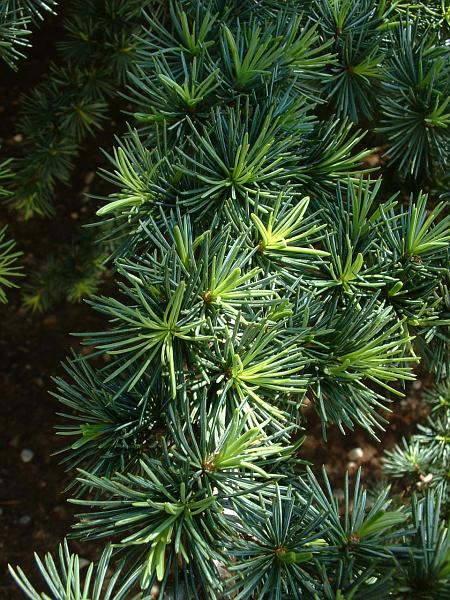


How do you recognise them?
- Atlas cedar
- Cedar with obliquely rising branches and an upright leader; in parks often with blue-grey needles.
- Compared with deodar: shorter, stiff needles and obliquely rising branches and leader.
- Deodar
- Cedar with long, soft needles, gracefully drooping branch tips and a nodding leader.
- Compared with Atlas cedar: longer, softer needles, and gracefully drooping branch tips and leader.
| Atlas cedar | Deodar | |
|---|---|---|
| Needles | Needles 1.5–2.5 cm, stiff and sharp, in tufts on short shoots and single on young shoots; green to silvery blue-grey (‘Glauca’). Evergreen. | Needles 2.5–5 cm, the longest of the cedars, fairly soft, green to grey-green; in tufts on short shoots and single on young shoots. Evergreen. |
| Flowering | – | – |
| Cones and seeds | Upright, barrel-shaped cones 5–8 cm long with a slightly sunken tip; they break up on the tree after 2–3 years. | Upright, barrel-shaped cones 7–12 cm long with a rounded tip, blue-green and bloomy when young. |
| Bark | Dark grey, smooth for a long time, later cracking into small plates. | Dark grey to brownish-black, cracked into small plates. |
| Shape and height | Conifer, 25–35 m | Conifer, 20–35 m |
| Site | Full sun, any garden soil, dry | Full sun, any garden soil, normal |
| Native to Belgium | No, planted | No, planted |
| Good for bees, butterflies and birds | – | – |
| Poisonous to people and pets | Not known to be poisonous | Not known to be poisonous |
| Pruning months | August–September | August–September |
What does it mean for your garden?
- Atlas cedar (25–35 m) and deodar (20–35 m) both grow into large trees: too big for an ordinary garden, but fine in a large garden, a park or a meadow.
Read on
- Plant profile: Atlas cedar
- Plant profile: Deodar
- Atlas cedar: when and how to prune
- Deodar: when and how to prune
- Identification key
Also looks like
Identify by feature
This comparison is compiled from the Bladwijzer species pages.