Photo: Wikimedia Commons, CC BY-SA 3.0 · source

Conifer · Pine family (Pinaceae)
Atlas cedar
Cedrus atlantica
Atlas cedar is a stately evergreen conifer from the Atlas Mountains of Morocco and Algeria. It grows 25–35 m tall, with obliquely rising branches, an upright leader and a crown about 12 m across. In parks you mainly see the blue-grey form ‘Glauca’. It tolerates drought and chalk better than most conifers. It is far too big for an ordinary garden: it belongs as a specimen tree on a large lawn, in a park or on a big estate, well away from the house.
Light
Full sun
warm and bright
Moisture
Dry
tolerates drought
Legal basis
Any garden soil
any pH
Hardiness
Throughout Belgium
no protection needed
Size
25–35 m
tall
| Pruning months | August–September |
|---|---|
| Height | 25–35 m |
| Native to Belgium | No, planted |
| Poisonous to people and pets | Not known to be poisonous |
Identify
Atlas cedar: how do you recognise it?
- Habit
- Tree of 25–35 m with obliquely rising branches and an upright leader; conical when young, later with a broad crown of about 12 m.
- Needles
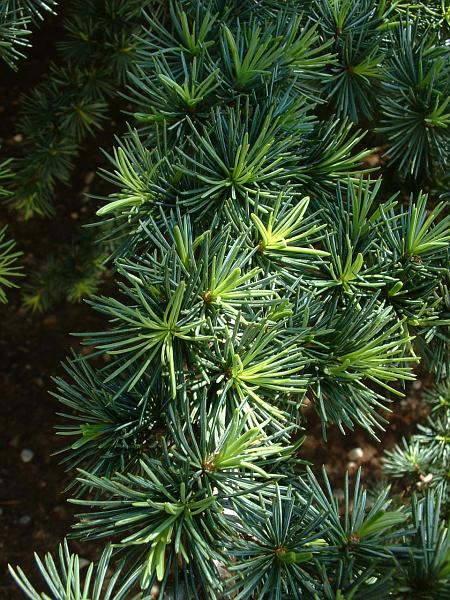
- 1.5–2.5 cm, stiff and sharp, in tufts on short shoots and single on young shoots; green to silvery blue-grey (‘Glauca’). Evergreen.
- Bark
- Dark grey, smooth for a long time, later cracking into small plates.
- Cones
- Upright, barrel-shaped cones 5–8 cm long with a slightly sunken tip; they break up on the tree after 2–3 years.
- Difference from cedar of Lebanon
- Cedar of Lebanon has long, horizontal branches in flat tiers, a flattened crown and larger cones.
- Difference from deodar
- Deodar has longer, softer needles, and gracefully drooping branch tips and leader.
Pruning: August–September
Identify by feature: Prickly needles · Needles in bundles
Looks like it, but isn’t
- Cedar of Lebanon Cedrus libani: long, horizontal branches in flat tiers, a flattened crown and larger cones. Difference from cedar of Lebanon
- Deodar Cedrus deodara: longer, softer needles, and gracefully drooping branch tips and leader. Difference from deodar
- Cedar Cedrus: the page for the whole genus, with what all cedars have in common.
In your garden
Why grow it?
- A majestic specimen tree, green or silvery blue-grey all year round.
- Tolerates drought, heat and chalk well: a tree that can cope with dry summers.
- A cedar looks best unpruned: little work.
- A tree for generations: cedars can live for hundreds of years.
Atlas cedar: where does it grow best?
- Full sun; in shade it becomes sparse and lopsided.
- Any well-drained soil, including chalky and dry soil; no wet feet.
- An open spot with space all around: the low, wide branches are the finest part of the tree.
- Allow for 25–35 m tall and a crown of about 12 m: give it at least 10 m of space and plant it well away from the house and the boundary.
- Light
- Full sun
- Legal basis
- Any garden soil
- Moisture
- Dry
- Size
- 30 m tall, 12 m wide
- Hardiness
- Throughout Belgium, no protection needed
Goes well with
- Silver birch: White trunks and light foliage beside the blue-grey cedar.
- Persian ironwood: A smaller park tree with fiery autumn colour, lovely in the background.
- English lavender: For the sunny, dry edge outside the crown.
- Crocus: Flowers in spring in the grass at the edge of the crown.
Good and bad companions
Goes well with
- Tolerate the shade under this tree: oregon grape, rhododendron, oleaster, japanese skimmia, garden privet, camellia, laurustinus, box-leaved honeysuckle
Maintenance
Atlas cedar: when and how to plant it?
- Plant in April or in September–October, when the ground is neither frozen nor bone-dry.
- Choose a young, pot-grown tree: a cedar does not like its roots being disturbed.
- Tease out the roots if they circle the pot, and plant at the same depth as before.
- Put a stake on the windward side and remove it after 2–3 years.
- Water after planting and in dry spells during the first year.
Care
- Watering
- In dry spells for the first two years; after that it copes well with dry summers.
- Feeding
- Not needed.
- Lower branches
- Leave them down to the ground: that is the finest feature of a free-standing cedar.
- Snow
- Shake wet snow off the branches of young trees.
Tip: Not enough room for a 30 m tree? Then choose the weeping form ‘Glauca Pendula’: it stays much smaller and can be trained along an arch or a wall.
Atlas cedar: when to prune it?
Pruning months: August–September.
When: Dead, diseased and broken branches can be removed at any time of year. Any formative pruning in late summer.
How:
- A cedar looks best unpruned.
- Keep a single leader on a young tree: if it has two, remove one in late summer.
- Cutting side branches back to just outside the trunk spoils the tree for good: if a branch has to go, saw it off completely at the trunk.
Caution: Don’t cut into bare wood: a cedar will not regrow from there.
Propagation
- Sowing
- Collect seeds from a cone that is breaking up on the tree, and sow them in a pot in spring. Seedlings of the blue ‘Glauca’ are not all blue.
- Grafting
- Blue and weeping forms, such as ‘Glauca’ and ‘Glauca Pendula’, are grafted; that is a job for the nursery.
Atlas cedar: how does it get through the winter?
Hardy throughout Belgium: no protection needed.
- Hardy in Belgium and the Netherlands.
- Wet snow on the branches can break them: shake young trees free.
Diseases and pests
- Snow damage: Broken branches after heavy, wet snow. Saw the break off cleanly at the trunk or at a healthy side branch.
- Aphids: Sticky honeydew and black sooty mould under the tree, sometimes with needle drop in spring. The tree usually recovers by itself.
- Honey fungus: Honey-coloured toadstools at the base and dying branches: root rot. Have an arborist check the tree’s stability.
- Wet soil: Yellow needles and poor growth in soil that stays wet for long. Choose a well-drained spot.
Through the year
- January: Shake wet snow off the branches; remove broken branches.
- April: Plant pot-grown trees.
- June: Water young trees in dry spells.
- July: Water young trees during long dry spells.
- August: Any formative pruning; remove dead branches.
- September: Formative pruning is still possible; the male cones release their pollen.
- October: Plant pot-grown trees.
Use
What can you use it for?
- Garden and landscape
- Stately park tree, especially in the blue form ‘Glauca’; tolerates drought and chalk well.
- Wood
- Fragrant, durable wood used in Morocco for doors, ceilings and carving.
Caution: Grows much taller and wider than it looks in the pot: give it at least 10 m of space.
You and this species
Did you know?
- Native to the Atlas Mountains of Morocco and Algeria. The blue form ‘Glauca’ is one of the most widely planted park conifers.
- In Morocco its fragrant, durable wood is used for doors, ceilings and carving.
- Barbary macaques live in the cedar forests of Morocco’s Middle Atlas.