Side by side
Atlas cedar or cedar of Lebanon? How to tell them apart
Cedrus atlantica · Cedrus libani
You can tell an Atlas cedar by its obliquely rising branches, upright leading shoot, shorter needles and smaller cones; a cedar of Lebanon has long, horizontal branches in flat tiers, a flattened crown, slightly longer needles and larger cones.
Look at the shape of an old tree: the cedar of Lebanon has long, horizontal branches in flat tiers, like tables stacked above one another, and a broad, flat-topped crown; the Atlas cedar has branches that angle upwards and an upright leading shoot. Both have stiff, pointed needles in tufts on short shoots and upright, barrel-shaped cones. Young trees are harder: both are then conical.
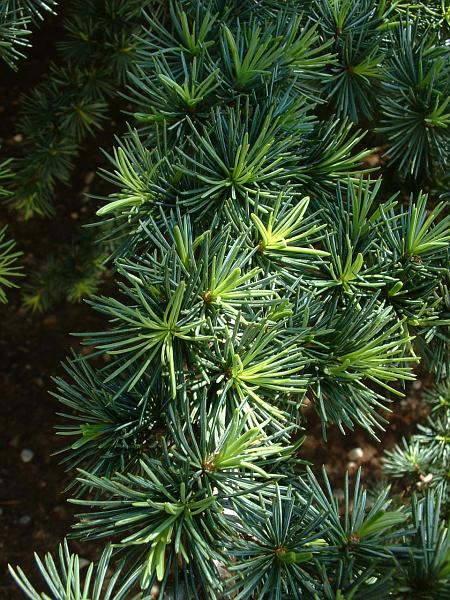
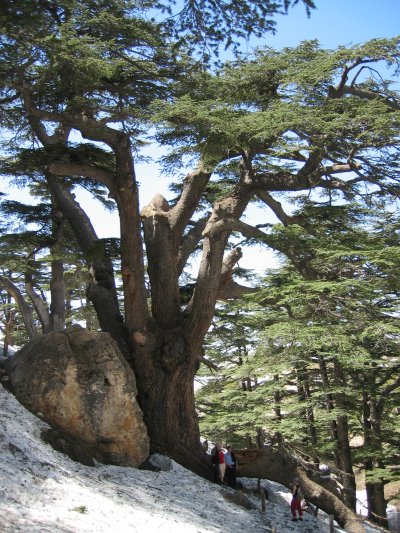


| Atlas cedar | Cedar of Lebanon | |
|---|---|---|
| Needles | Needles 1.5–2.5 cm, stiff and sharp, in tufts on short shoots and single on young shoots; green to silvery blue-grey (‘Glauca’). Evergreen. | Needles 2–3 cm, stiff and sharp, dark green to grey-green; in tufts on short shoots and single on young shoots. Evergreen. |
| Flowering | – | – |
| Cones and seeds | Upright, barrel-shaped cones 5–8 cm long with a slightly sunken tip; they break up on the tree after 2–3 years. | Upright, barrel-shaped cones 8–12 cm long with a flattened tip, which break up on the tree. |
| Bark | Dark grey, smooth for a long time, later cracking into small plates. | Dark grey, cracked into small, scaly plates. |
| Shape and height | Conifer, 25–35 m | Conifer, 20–35 m |
| Site | Full sun, any garden soil, dry | Full sun, any garden soil, dry |
| Native to Belgium | No, planted | No, planted |
| Good for bees, butterflies and birds | – | – |
| Poisonous to people and pets | Not known to be poisonous | Not known to be poisonous |
| Pruning months | August–September | August–September |
The best feature in each season
- Spring
- On young shoots the needles are single, on short shoots in tufts. On the Atlas cedar they are 1.5–2.5 cm, often silvery blue-grey in the ‘Glauca’ form; on the cedar of Lebanon 2–3 cm and dark to greyish green.
- Summer
- The cones stand upright on the branches: barrel-shaped, 5–8 cm, with a slightly sunken top on the Atlas cedar; 8–12 cm with a flat top on the cedar of Lebanon.
- Autumn
- The ripe cones break up on the tree: the scales flutter down and only the central spike remains. The size and tip of the cones remain the best feature.
- Winter
- Both are evergreen. From a distance you recognise the cedar of Lebanon by its horizontal tiers and flat crown, the Atlas cedar by its rising branches, often with a blue-grey tint.
Where do they grow?
The Atlas cedar comes from the Atlas Mountains in Morocco and Algeria, the cedar of Lebanon from the mountains of Lebanon, Syria and Turkey. Here they stand as specimen trees in parks, castle gardens and large estates.
Which one for your garden?
- Both are far too big for an ordinary garden: the Atlas cedar reaches 25–35 m with a crown of around 12 m, the cedar of Lebanon 20–35 m with a crown of around 18 m. They belong as a specimen tree on a large lawn or in a park, well away from the house.
- The Atlas cedar copes better with drought and chalk than most conifers. The cedar of Lebanon only develops its typical tiers after many years: whoever plants one does so for the generations to come.
Did you know? The cedar of Lebanon appears on the flag of Lebanon, and its timber was already used in ancient times for temples and ships.
Read on
- Plant profile: Atlas cedar
- Plant profile: Cedar of Lebanon
- Atlas cedar: when and how to prune
- Cedar of Lebanon: when and how to prune
- Identification key