Side by side
Common jasmine or star jasmine? How to tell them apart
Jasminum officinale · Trachelospermum jasminoides
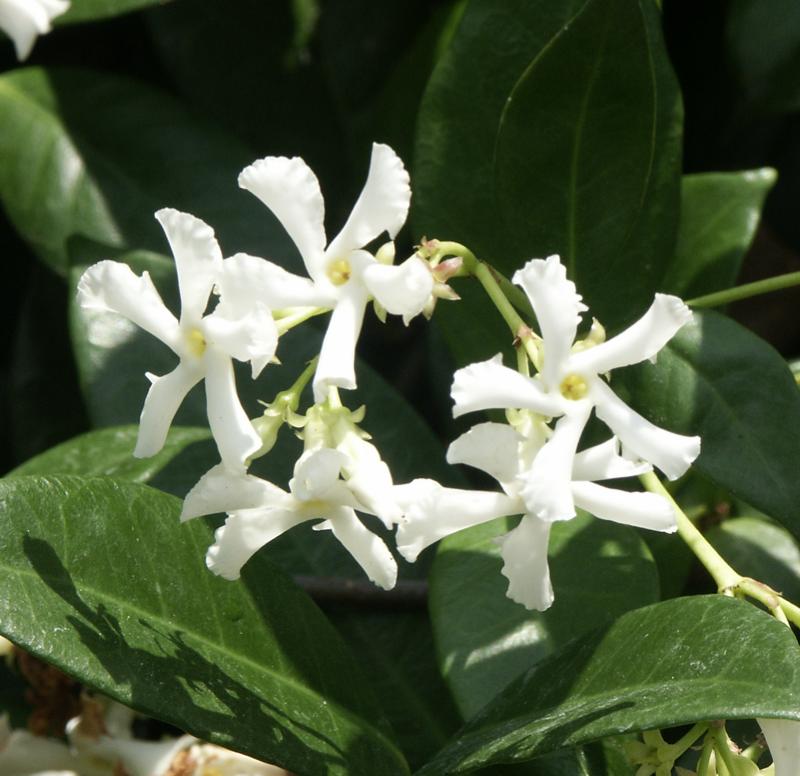
How to tell them apart – common jasmine: pinnate leaves without milky sap, mostly shed in winter; star jasmine: evergreen, with simple, glossy, leathery leaves and milky sap.



How do you recognise them?
- Common jasmine
- Twining climber with pinnate leaves and white, star-shaped, intensely fragrant flowers in summer.
- Compared with star jasmine: pinnate leaves without milky sap, mostly shed in winter.
- Star jasmine
- Evergreen twining climber with glossy, leathery leaves and white, propeller-shaped, sweetly scented flowers.
- Compared with common jasmine: evergreen, with simple, glossy, leathery leaves and milky sap.
| Common jasmine | Star jasmine | |
|---|---|---|
| Leaves | Opposite, pinnate with 5–9 pointed leaflets of 1–6 cm; partly evergreen in mild winters. | Opposite, elliptic, 4–8 cm, untoothed and glossy dark green; often turning reddish-brown in winter. |
| Flowering | White flowers (2 cm) with a long tube and 4–5 lobes, in loose clusters, June–September; strongly scented, especially in the evening (June–August). | White, star-shaped flowers (2–3 cm) with 5 twisted lobes, in clusters, June–August; strongly scented (June–August). |
| Fruit | Small black berries; rare here. | Long, narrow pods in pairs; rare here. |
| Bark | Green, angular, twining twigs that become woody at the base. | Twining brown stems that ooze white milky sap when damaged. |
| Shape and height | Climber, twines to 4–6 m | Climber, twines to 3–6 m |
| Site | Full sun, any garden soil, normal | Sun or partial shade, any garden soil, normal |
| Native to Belgium | No, planted | No, planted |
| Good for bees, butterflies and birds | – | – |
| Poisonous to people and pets | Not known to be poisonous | Not known to be poisonous |
| Pruning months | March and September | April and August–September |
What does it mean for your garden?
- Choose what suits your soil, your light and the space you have: see the growing conditions in the table.
Read on
- Plant profile: Common jasmine
- Plant profile: Star jasmine
- Common jasmine: when and how to prune
- Star jasmine: when and how to prune
- Identification key
Also looks like
Identify by feature
This comparison is compiled from the Bladwijzer species pages.