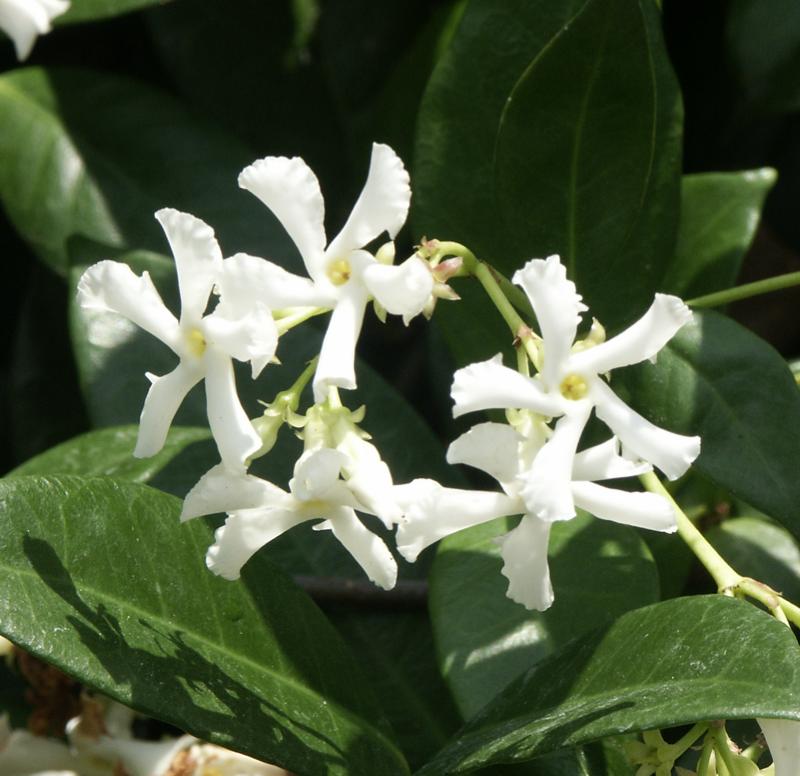
Photo: Scott Zona from USA, CC BY 2.0 · source

Climber · Dogbane family (Apocynaceae)
Star jasmine
Trachelospermum jasminoides · also: Confederate jasmine, Trachelospermum
Star jasmine is an evergreen twining climber from China and Japan, with glossy, leathery leaves that often turn reddish-brown in winter. From June to August it is covered in white, propeller-shaped flowers with a sweet, powerful scent. Despite its name it is not a jasmine, but a relative of periwinkle and oleander. It grows slowly in its first few years, but reaches 3–6 m against a sheltered wall or fence; it also does well in a large pot. It is not fully hardy.
Caution: Not fully hardy: it can be cut back by frost in severe winters. Protect plants in pots.
Light
Sun or partial shade
preferably some sun
Moisture
Normal
no wet feet
Legal basis
Any garden soil
any pH
Hardiness
Throughout Belgium
no protection needed
Size
twines to 3–6 m
tall
Flowering
June–August
| Pruning months | April and August–September |
|---|---|
| Height | twines to 3–6 m |
| Native to Belgium | No, planted |
| Poisonous to people and pets | Not known to be poisonous |
| Flowering | June–August |
Identify
Star jasmine: how do you recognise it?
- Habit
- Evergreen twining climber of 3–6 m that grows slowly in its first few years; without support it creeps over the ground.
- Leaf
- Opposite, elliptic, 4–8 cm, untoothed and glossy dark green; often turning reddish-brown in winter.
- Stems
- Twining brown stems that ooze white milky sap when damaged.
- Flower
- White, star-shaped flowers (2–3 cm) with 5 twisted lobes, in clusters, June–August; strongly scented.
- Fruit
- Long, narrow pods in pairs; rare here.
- Difference from common jasmine
- Common jasmine has pinnate leaves without milky sap, mostly shed in winter.
- Difference from ivy
- Ivy has lobed leaves, aerial roots and green flowers in autumn.
Flowering: June–August · Pruning: April and August–September
Identify by feature: Twining climbers
Looks like it, but isn’t
- Common jasmine Jasminum officinale: pinnate leaves without milky sap, mostly shed in winter. Difference from common jasmine
- Common ivy Hedera helix: lobed leaves, aerial roots and green flowers in autumn. Difference from common ivy
In your garden
Why grow it?
- Evergreen: a glossy green wall, even in winter.
- Strongly scented flowers in June–August.
- Grows in sun and partial shade, also in a large pot on a patio.
- Needs little pruning.
- In winter the leaves often turn an attractive reddish-brown.
Star jasmine: where does it grow best?
- Sun to partial shade, sheltered from cold winds: against a south- or west-facing wall, or on a sheltered patio.
- Well-drained, humus-rich soil that does not stay wet in winter.
- It twines but has no aerial roots: fix wires or mesh, or use a trellis or fence, and tie in the young shoots for the first few years. It does not damage walls or gutters.
- It grows well in a pot of at least 40–50 cm, but there the root ball is vulnerable to frost in winter.
- Light
- Sun or partial shade
- Legal basis
- Any garden soil
- Moisture
- Normal
- Size
- 5 m tall, 2 m wide
- Hardiness
- Throughout Belgium, no protection needed
Goes well with
- Bay laurel: Another evergreen that likes shelter: together in large pots by the front door or on the patio.
- English lavender: Flowers at the same time at the sunny foot of the wall; together, scent and bees in summer.
- Common jasmine: Flowers into September and loses its leaves in winter: together, a fragrant wall, with star jasmine as the green backbone.
Good and bad companions
Goes well with
- Can climb into old, large trees: english oak, scots pine, sycamore, large-leaved lime
Maintenance
Star jasmine: when and how to plant it?
- Plant in spring (April–May), so that it is well rooted before winter.
- Plant 30–40 cm from the wall and fan the shoots out over the wires or mesh.
- Mix compost into the planting hole and make sure water can drain away well.
- In a pot: use good potting compost with some coarse sand, in a pot with a drainage hole.
Care
- Watering
- In dry spells during the first year; in a pot, regularly all summer, without leaving the root ball waterlogged.
- Feeding
- Some compost in spring; in a pot, an occasional liquid feed from May to July.
- Tying in
- Guide new shoots along the support and tie them in loosely.
- Winter protection
- In hard frost, cover the base with leaves, wrap a pot in hessian or fleece and move it against the wall.
Tip: Not sure whether it will survive the winter in your garden? Grow it in a large pot first: then you can move it to shelter in a severe winter.
Star jasmine: when to prune it?
Pruning months: April and August–September.
When: Lightly after flowering (August–September) or in April.
How:
- Little needed: cut back overlong and frost-damaged stems and train the new ones along the support.
- To keep it compact, shorten protruding shoots to a side shoot after flowering.
- In April, remove dead and frost-damaged branches as soon as you can see where it is reshooting.
Caution: Don’t prune hard in late summer: young shoots that grow after that are vulnerable to frost.
Propagation
- Cuttings
- In summer, take 10–15 cm cuttings from semi-ripe shoots; they root in a small pot under plastic, but slowly.
- Layering
- In spring, lay a long shoot in a pot of soil and cover a node; after a year you can cut it free.
Star jasmine: how does it get through the winter?
Hardy throughout Belgium: no protection needed.
- Not fully hardy: planted out in a sheltered spot, it usually survives frost down to about −10 °C; in harder or prolonged frost it is cut back.
- The leaves often turn reddish-brown in winter and usually green up again in spring: this is not a disease.
- In a pot the root ball freezes faster: move it against a wall under cover, wrap the pot, or in hard frost bring it into a cold, light room.
Diseases and pests
- Frost damage: Brown, dried-out leaves and branches after a severe winter. Wait until April–May and cut out the dead wood; it often reshoots lower down.
- Scale insects and mealybugs: Brown scales or white fluffy tufts on stems and leaves, especially on plants in pots in a sheltered spot. Wipe them off or cut out the worst shoots.
- Yellow leaves: Often caused by waterlogged roots or a pot that is too small. Make sure it drains well and repot a plant that is too cramped.
Through the year
- April: Light pruning: cut out frost-damaged branches; remove winter protection; planting.
- May: Guide new shoots to the support; planting.
- June: Flowering begins: a sweet scent across the patio.
- July: Full flower; water in dry spells, especially in pots; take cuttings.
- August: Last flowers; light pruning after flowering.
- September: Last light pruning.
- November: Cover the base; move pots to shelter and wrap them.
- December: Extra protection in hard frost; reddish-brown winter leaves.
Use
What can you use it for?
- Garden and landscape
- Evergreen, wonderfully fragrant climber for a sheltered wall, a fence or a large pot.
- For wildlife
- Bees and butterflies visit the flowers.
Caution: Not fully hardy: it can be cut back by frost in severe winters. Protect plants in pots.
You and this species
Did you know?
- It comes from China and Japan and, despite its name, it is not a jasmine: it belongs to the periwinkle family, like oleander.
- The flowers look like little propellers: the five lobes are all twisted in the same direction.