Side by side
Guelder rose or red-berried elder? How to tell them apart
Viburnum opulus · Sambucus racemosa
How to tell them apart – guelder rose: simple, lobed leaves and berries in flat heads; red-berried elder: elder with egg-shaped clusters of yellowish-white flowers in April and scarlet berries as early as July, the pith of the twigs is brown.
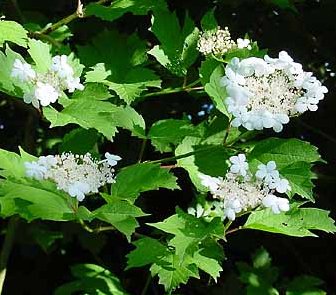
Photo: Original uploader was Wouter Hagens at en.wikipedia, CC BY-SA 3.0 · source
Guelder rose Viburnum opulus


How do you recognise them?
- Guelder rose
- Shrub with three-lobed, maple-like leaves, flat white flower heads and glossy red berries.
- Compared with red-berried elder: simple, lobed leaves and berries in flat heads.
- Red-berried elder
- Elder with egg-shaped clusters of yellowish-white flowers in April and scarlet berries as early as July; the pith of the twigs is brown.
| Guelder rose | Red-berried elder | |
|---|---|---|
| Leaves | Opposite, 3–5-lobed, coarsely toothed, 5–10 cm; small glands on the leaf stalk. Red autumn colour. | Opposite, pinnate with usually 5 pointed, sharply toothed leaflets; unpleasant-smelling when crushed. |
| Flowering | Flat heads of small fertile flowers, ringed by large white outer flowers (May–June) (May–June). | Egg-shaped, upright clusters of yellowish-white flowers in April–May, together with the leaves (April–May). |
| Fruit | Glossy red, translucent berries in clusters; poisonous raw. | Dense, egg-shaped clusters of glossy scarlet berries in June–July; poisonous raw, especially the seeds. |
| Bark | Greyish-brown and smooth. | Greyish-brown with conspicuous warts (lenticels); the pith of the twigs is light brown. |
| Shape and height | Shrub, 2–4 m | Shrub, 2–4 m |
| Site | Sun or partial shade, any garden soil, moist to wet | Sun or partial shade, acid soil, normal |
| Native to Belgium | Yes | Yes |
| Good for bees, butterflies and birds | Yes, for bees and birds | – |
| Poisonous to people and pets | Not known to be poisonous | Yes, take care with children and pets |
| Pruning months | June–July | November–March |
What does it mean for your garden?
- Red-berried elder is poisonous to people and pets: take care with children and animals.
- Both are native and good for wildlife: choose what suits your soil, your light and the space you have.
Read on
- Plant profile: Guelder rose
- Plant profile: Red-berried elder
- Guelder rose: when and how to prune
- Red-berried elder: when and how to prune
- Identification key
Also looks like
- Elder or red-berried elder
- Laurustinus or guelder rose
- Ninebark or guelder rose
- Guelder rose or Japanese snowball
- Guelder rose or field maple
- Guelder rose or wayfaring-tree
Identify by feature
This comparison is compiled from the Bladwijzer species pages.