Side by side
Elder or red-berried elder? How to tell them apart
Sambucus nigra · Sambucus racemosa
You can tell an elder by its large, flat heads of creamy flowers in May–June, its purplish-black berries and the white pith in its twigs; a red-berried elder has egg-shaped clusters of yellowish-white flowers as early as April–May, scarlet berries in June–July and brown pith.
Cut a twig: white pith on the elder, light brown pith on the red-berried elder. In flower or fruit it is even easier: flat heads and black berries, or egg-shaped clusters and bright red berries.
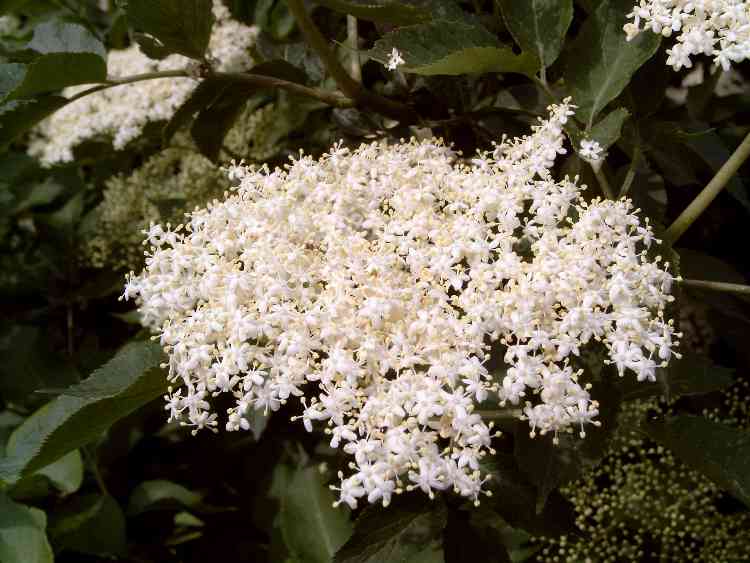


| Elder | Red-berried elder | |
|---|---|---|
| Leaves | Opposite, pinnate with 5–7 toothed, pointed leaflets. When crushed the leaf smells unpleasant. | Opposite, pinnate with usually 5 pointed, sharply toothed leaflets; unpleasant-smelling when crushed. |
| Flowering | Large flat umbels of creamy, fragrant little flowers in May–June (May–June). | Egg-shaped, upright clusters of yellowish-white flowers in April–May, together with the leaves (April–May). |
| Fruit | Hanging umbels of purple-black berries (Aug–Sept). Mildly poisonous raw, delicious cooked in syrup or jam. | Dense, egg-shaped clusters of glossy scarlet berries in June–July; poisonous raw, especially the seeds. |
| Bark | Grey-brown and corky, fissured; young twigs with conspicuous warts (lenticels) and soft white pith. | Greyish-brown with conspicuous warts (lenticels); the pith of the twigs is light brown. |
| Shape and height | Shrub, 3–10 m, shrub or small tree | Shrub, 2–4 m |
| Site | Sun to shade, any garden soil, normal | Sun or partial shade, acid soil, normal |
| Native to Belgium | Yes | Yes |
| Good for bees, butterflies and birds | Yes, for birds | – |
| Poisonous to people and pets | Not known to be poisonous | Yes, take care with children and pets |
| Pruning months | November–March | November–March |
The best feature in each season
- Spring
- The red-berried elder flowers first, in April–May, together with the leaves, with upright, egg-shaped clusters; the elder follows in May–June with large, flat, strongly scented flower heads.
- Summer
- In June–July the red-berried elder is laden with dense clusters of scarlet berries; the elder still has green berries then, which only turn purplish black in August–September.
- Autumn
- The elder is full of purplish-black berries in hanging heads, a feast for dozens of bird species. By then the red-berried elder has usually been stripped already.
- Winter
- Both have twigs with conspicuous lenticels and buds in opposite pairs. Cut a twig: the pith is white on the elder and light brown on the red-berried elder. The red-berried elder also stays smaller, 2–4 m.
Where do they grow?
Both are native. The elder grows almost everywhere: along woodland edges, in hedges, on waste ground and in gardens, even in shade. The red-berried elder likes acid soil and partial shade and is, especially in the Ardennes, a typical shrub of clearings and woodland edges.
Which one for your garden?
- If you want to harvest, choose the elder: its flowers make cordial or tea, its berries jam, but only eat them cooked. Birds love the berries of both.
- The raw berries of the red-berried elder are poisonous, especially the seeds: do not pick them to eat and keep small children away. Raw berries, leaves and stems of the elder are mildly poisonous too.
Did you know? The red-berried elder feeds birds in high summer, when few other shrubs already carry ripe berries.
Read on
- Plant profile: Elder
- Plant profile: Red-berried elder
- Elder: when and how to prune
- Red-berried elder: when and how to prune
- Identification key