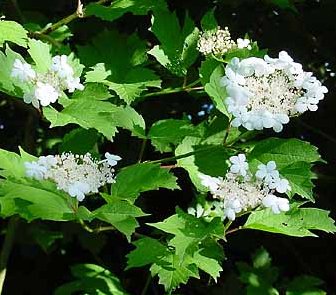
Photo: Original uploader was Wouter Hagens at en.wikipedia, CC BY-SA 3.0 · source

Shrub · Moschatel family (Adoxaceae)
Guelder rose
Viburnum opulus
Guelder rose is a native shrub of 2–4 m for damp places. In May–June it bears flat white flower heads, with a ring of large white outer flowers around the small fertile ones. In autumn it hangs with clusters of glossy red, translucent berries and its maple-like leaves turn red. The berries often last well into winter, as food for birds. Raw, they are mildly poisonous.
Caution: The raw berries are mildly poisonous: eating a lot of them causes stomach ache, vomiting and diarrhoea. Keep young children and pets away from them. In Eastern Europe the berries are cooked into jam and syrup; never eat them raw.
Light
Sun or partial shade
preferably some sun
Moisture
Moist to wet
must not dry out
Legal basis
Any garden soil
any pH
Hardiness
Throughout Belgium
no protection needed
Size
2–4 m
tall
Flowering
May–June
| Pruning months | June–July |
|---|---|
| Height | 2–4 m |
| Native to Belgium | Yes |
| Good for bees, butterflies and birds | Yes, for bees and birds |
| Poisonous to people and pets | In part: see Caution above |
| Flowering | May–June |
Identify
Guelder rose: how do you recognise it?
- Habit
- Broad, loose shrub of 2–4 m with upright branches.
- Leaf
- Opposite, 3–5-lobed, coarsely toothed, 5–10 cm; small glands on the leaf stalk. Red autumn colour.
- Bark
- Greyish-brown and smooth.
- Flower
- Flat heads of small fertile flowers, ringed by large white outer flowers (May–June).
- Fruit
- Glossy red, translucent berries in clusters; poisonous raw.
- Difference from field maple
- Field maple is a small tree with milky sap and winged fruits.
Flowering: May–June · Pruning: June–July
Identify by feature: Palmate leaves · Red autumn colour · Red berries
Looks like it, but isn’t
- Field maple Acer campestre: a small tree with milky sap and winged fruits. Difference from field maple
In your garden
Why grow it?
- White flower heads in May–June, red berries and red leaves in autumn.
- Native: flowers for insects, berries for birds in winter.
- One of the few shrubs that like wet soil.
- Fits into a mixed hedge, a hedgerow or the edge of a pond.
Guelder rose: where does it grow best?
- Sun or partial shade; in sun it flowers best and bears the most berries.
- Moist to wet soil, acid or chalky: ideal by a pond, a ditch or in a damp spot in the garden.
- On dry, sandy soil it does less well; mulch the soil there and water in dry summers.
- Allow 3 m width.
- Light
- Sun or partial shade
- Legal basis
- Any garden soil
- Moisture
- Moist to wet
- Size
- 4 m tall, 3 m wide
- Hardiness
- Throughout Belgium, no protection needed
Goes well with
- Alder: Together by a pond or ditch: two native species that like wet feet.
- Common dogwood: Red twigs in winter next to the red berries, in the same damp, mixed hedge.
- Elder: Flowers at the same time with creamy flower heads; together a bird-rich edge.
- Grey willow: A native willow for the same wet spot, with catkins for early bees.
Good and bad companions
Goes well with
- Together a mixed native hedge, good for birds and insects: hawthorn, blackthorn, hazel, dog rose, common dogwood, wild privet, field maple, hornbeam
- Suits the woodland edge or the light shade of: ginkgo, box elder, ash, honey locust, field maple, silver maple
Maintenance
Guelder rose: when and how to plant it?
- Plant from November to March, bare-root or root-balled.
- In a mixed hedge: one plant every 1–1.5 m, together with other native shrubs.
- Plant at the same depth as before, firm the soil and water generously.
- After planting, shorten the branches by a third for a bushier shrub.
Care
- Watering
- In the first year and in dry summers; it likes moist soil.
- Feeding
- Not needed; a layer of leaves or compost in autumn is enough.
- Mulch
- A layer of leaves or wood chips keeps the soil moist.
- Berries
- Leave them for the birds; they often last into winter.
Tip: If you mainly want flowers, choose the snowball bush (‘Roseum’): round white flower heads, but no berries. For birds and insects the wild form is better.
Guelder rose: when to prune it?
Pruning months: June–July.
When: After flowering (June–July).
How:
- Thin out old branches at the base; don’t cut everything back, or there will be no berries.
- Every few years, remove one or two of the oldest branches so that young shoots can come through.
- Cut overlong or crooked branches back to a side branch rather than simply shortening them.
Caution: June–July falls in the nesting season: check for nesting birds in the shrub before you prune.
Propagation
- Softwood cuttings
- In June, take 10–15 cm cuttings of young, still soft shoots and root them under glass or plastic; they root readily.
- Layering
- Bend a low branch to the ground and cover it with soil; after a year it will have roots.
- Sowing
- Sow the seeds from ripe berries outdoors in autumn; they often take a year and a half to germinate.
Guelder rose: how does it get through the winter?
Hardy throughout Belgium: no protection needed.
- Fully hardy.
- The red berries often last well into winter; birds only eat them once other food has run out.
Diseases and pests
- Viburnum beetle: In April–May, small yellow larvae eat the leaves down to lace; later in summer the adult beetles do the same. In autumn they lay eggs in the shoot tips: cut those tips off in winter and put them in the general waste.
- Black bean aphid: Colonies of black aphids on the shoot tips in spring, making the leaves curl. They overwinter as eggs on the shrub. Let ladybirds and tits do the work, or hose them off with water.
- Drought: On dry soil the leaves droop and the berries stay small. Water and mulch the soil.
Through the year
- January: Find shoot tips with viburnum beetle eggs and cut them off.
- April: Watch for viburnum beetle larvae and aphids.
- May: Flowering: white flower heads full of insects.
- June: Prune after flowering; check for nests first.
- July: Last pruning month; the berries start to colour.
- September: Red berries and red autumn colour.
- November: Plant bare-root shrubs.
- December: Berries for the birds in winter.
Use
What can you use it for?
- Garden and landscape
- Native shrub for a damp spot or a mixed hedge.
- For wildlife
- Flowers for insects, berries for birds in winter.
Caution: The raw berries are mildly poisonous.
Good for wildlife
- Birds
- Berries, seeds or insects as food, or a place to nest.
- Hoverflies
- Open flowers for hoverflies; many of their larvae eat aphids.
- Bees
- Nectar and pollen for honeybees and wild bees.
- Ladybirds
- Aphids on the plant are food for ladybirds and their larvae.
You and this species
Did you know?
- The snowball bush of gardens is a form with only sterile flowers, in rounded heads.
- The large white outer flowers are sterile: they only serve to draw insects to the small fertile flowers in the centre.
- In Ukraine, guelder rose (kalyna) is a national symbol, found in songs and embroidery.
- The Dutch name ‘Gelderse roos’ refers to the province of Gelderland, where the cultivated snowball form is said to come from. The English ‘guelder rose’ points there too.
- In Ukraine the guelder rose, known as kalyna, is a national symbol that features in folk songs, embroidery and poetry.