Side by side
Dutch elm or wych elm? How to tell them apart
Ulmus × hollandica · Ulmus glabra
How to tell them apart – Dutch elm: a cross with field elm, smaller, less rough leaf on a distinct stalk; wych elm: larger, very rough leaf that covers the very short stalk.
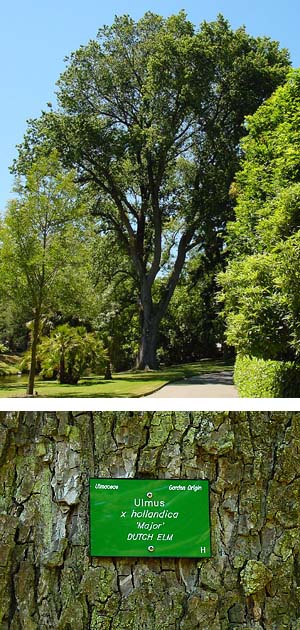
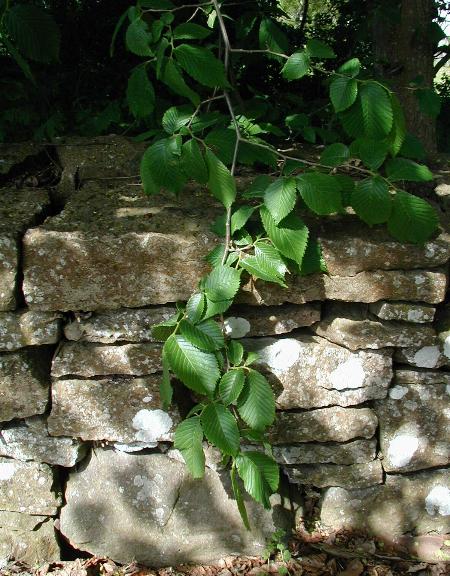


How do you recognise them?
- Dutch elm
- A cross between wych elm and field elm: medium-sized, somewhat rough leaf with a lopsided base and a short stalk; once the avenue tree par excellence.
- Compared with wych elm: a cross with field elm: smaller, less rough leaf on a distinct stalk.
- Wych elm
- Elm with a very large, rough leaf whose lopsided base covers the short leaf stalk; often three points at the tip.
- Compared with Dutch elm: larger, very rough leaf that covers the very short stalk.
| Dutch elm | Wych elm | |
|---|---|---|
| Leaves | Alternate, 7–12 cm, oval with a pointed tip and lopsided base, double-toothed; upper side smooth to somewhat rough, often glossy. Leaf stalk 5–10 mm. | Alternate, 8–16 cm, broadly obovate with a long pointed tip, often with two extra side points; double-toothed. Upper side as rough as sandpaper. The larger half of the leaf covers the very short stalk (2–5 mm) with an ear lobe. |
| Flowering | Clusters of small reddish-purple flowers in February–March, before the leaves (March). | Clusters of small reddish-purple flowers in February–March, before the leaves (March). |
| Fruit | Round winged fruits 1.5–2 cm long; the seed lies between the middle and the notch. | Large (1.5–2.5 cm), round winged fruits with the seed in the middle; ripe in May–June. |
| Bark | Grey-brown, furrowed lengthways; twigs without or with few corky ridges. | Smooth and grey for a long time, only later furrowed into broad, shallow ridges; young twigs thick and hairy, without corky ridges. |
| Shape and height | Broadleaf tree, 20–35 m | Broadleaf tree, 20–30 m |
| Site | Full sun, any garden soil, normal | Sun or partial shade, any garden soil, normal |
| Native to Belgium | Yes | Yes |
| Good for bees, butterflies and birds | – | – |
| Poisonous to people and pets | Not known to be poisonous | Not known to be poisonous |
| Pruning months | November–February | November–February |
What does it mean for your garden?
- Both are native and good for wildlife: choose what suits your soil, your light and the space you have.
- Dutch elm (20–35 m) and wych elm (20–30 m) both grow into large trees: too big for an ordinary garden, but fine in a large garden, a park or a meadow.
Read on
- Plant profile: Dutch elm
- Plant profile: Wych elm
- Dutch elm: when and how to prune
- Wych elm: when and how to prune
- Identification key
Also looks like
Identify by feature
This comparison is compiled from the Bladwijzer species pages.