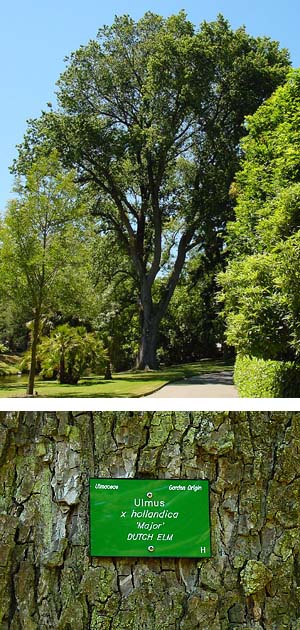
Photo: Wouter Hagens at Dutch Wikipedia, CC BY-SA 3.0 · source

Broadleaf tree · Elm family (Ulmaceae)
Dutch elm
Ulmus × hollandica · also: Hybrid elm
The Dutch elm is a cross between wych elm and field elm, with a medium-sized, somewhat rough leaf with a lopsided base and a short stalk. It was once the avenue, dyke and canal tree par excellence in the Netherlands and Belgium, among others as the cultivar ‘Belgica’. Dutch elm disease killed most of those trees. Left to grow freely it reaches 20–35 m with a crown of about 15 m: too big for an ordinary garden. If you want an elm in that style today, plant a cultivar that is resistant to Dutch elm disease.
Caution: Very susceptible to Dutch elm disease: only plant resistant cultivars, only prune in winter and clear away diseased and dead elm wood quickly.
Light
Full sun
warm and bright
Moisture
Normal
no wet feet
Legal basis
Any garden soil
any pH
Hardiness
Throughout Belgium
no protection needed
Size
20–35 m
tall
Flowering
March
| Pruning months | November–February |
|---|---|
| Height | 20–35 m |
| Native to Belgium | Yes |
| Poisonous to people and pets | Not known to be poisonous |
| Flowering | March |
Identify
Dutch elm: how do you recognise it?
- Habit
- Tree of 20–35 m with a broad crown of about 15 m; as an avenue tree often with a high, raised crown.
- Leaves
- Alternate, 7–12 cm, oval with a pointed tip and lopsided base, double-toothed; upper side smooth to somewhat rough, often glossy. Leaf stalk 5–10 mm.
- Bark
- Grey-brown, furrowed lengthways; twigs without or with few corky ridges.
- Flowers
- Clusters of small reddish-purple flowers in February–March, before the leaves.
- Fruit
- Round winged fruits 1.5–2 cm long; the seed lies between the middle and the notch.
- Difference from wych elm
- Wych elm has a larger, very rough leaf that covers the very short stalk.
- Difference from field elm
- Field elm has a smaller, smooth leaf on a longer stalk, and often corky ridges.
Flowering: March · Pruning: November–February
Identify by feature: Lopsided leaf base
Looks like it, but isn’t
- Wych elm Ulmus glabra: larger, very rough leaf that covers the very short stalk. Difference from wych elm
- Field elm Ulmus minor: smaller, smooth leaf on a longer stalk, and often corky ridges. Difference from field elm
In your garden
Why grow it?
- A classic avenue and dyke tree with a broad, stately crown.
- Copes well with wind and an exposed site.
- Food plant of the white-letter hairstreak.
- Resistant cultivars give the classic avenue elm a new chance.
Dutch elm: where does it grow best?
- Full sun.
- Almost any soil, ideally fertile clay or loam; chalk is no problem.
- Copes well with wind: a classic tree for dykes, canals and open landscapes.
- Allow for 20–35 m in height and a crown of about 15 m: only for a large garden, a park or an avenue.
- Light
- Full sun
- Legal basis
- Any garden soil
- Moisture
- Normal
- Size
- 30 m tall, 15 m wide
- Hardiness
- Throughout Belgium, no protection needed
Goes well with
- English oak: Together with oak and ash, the elm once grew in every hedgerow and along every dyke.
- Hawthorn: The classic hedge beneath and between avenue and dyke trees.
- Elder: A fast-growing native shrub for the edge, with flowers and berries for people and birds.
Good and bad companions
Goes well with
- Tolerate the shade under this tree: oregon grape, rhododendron, oleaster, japanese skimmia, garden privet, camellia, laurustinus, box-leaved honeysuckle
Maintenance
Dutch elm: when and how to plant it?
- Plant from November to March, when the ground is not frozen.
- Don’t plant an ordinary Dutch elm, but a cultivar that is resistant to Dutch elm disease; ask a reliable nursery. A seedling or sucker is never resistant.
- Tie a young tree to a stake and keep the base free of grass for the first few years.
- Water after planting and during dry spells in the first summers.
Care
- Watering
- In dry spells during the first few years; rarely needed after that.
- Feeding
- Not needed in ordinary garden soil.
- Checking
- In June–July, look out for branches that suddenly wilt and turn yellow or brown: the first sign of Dutch elm disease.
- Elm wood
- Don’t leave pruned branches or felled wood with bark lying around the garden: the elm bark beetle breeds in it.
Tip: An avenue or dyke lined with elms? Plant a mix of resistant cultivars and other tree species: that way a new disease will never take out the whole row at once.
Dutch elm: when to prune it?
Pruning months: November–February.
When: Only in winter (November–February).
How:
- In spring and summer, fresh pruning wounds attract the elm bark beetle: so never prune during the growing season.
- Give a young tree a single central leader and raise the crown of an avenue tree gradually.
- Remove diseased branches, burn or shred them, and disinfect your tools.
Caution: Don’t stack elm firewood with the bark still on: the elm bark beetle breeds in the bark of dead elm wood.
Propagation
- Cuttings and grafting
- Cultivars are propagated vegetatively by the nursery, from cuttings or by grafting: only then do they stay true to the parent tree and keep any resistance.
Dutch elm: how does it get through the winter?
Hardy throughout Belgium: no protection needed.
- Fully hardy, also on the coast.
- Winter is the only good season for pruning; the first reddish-purple flowers appear in late February.
Diseases and pests
- Dutch elm disease: Leaves on one branch or across the whole crown wilt in June–July, turn yellow to brown and often stay hanging; under the bark you see brown streaks in the wood. There is no cure: have the tree felled and clear away the wood with bark quickly.
- Elm bark beetle: A small bark beetle that breeds in diseased and dead elms and carries the fungal spores to healthy trees. Clear away dead elm wood.
- Leaf galls: Rolled leaves or galls on the leaf, caused by aphids. Harmless.
Through the year
- January: Prune, only now in winter; remove the prunings from the site.
- February: Last month for pruning; the first flowers appear.
- March: Flowers before the leaves; still planting season.
- June: Look out for wilting branches (Dutch elm disease); do not prune.
- July: Check again for Dutch elm disease; water young trees in dry spells.
- October: Yellow autumn colour.
- November: Planting season; pruning is possible again.
- December: Prune in winter; clear away dead elm wood.
Use
What can you use it for?
- Garden and landscape
- Once the avenue, dyke and canal tree par excellence; today, plant a resistant cultivar instead.
- Wood
- Tough wood for furniture, chests and waterworks.
Caution: Very susceptible to Dutch elm disease.
You and this species
Did you know?
- Despite its name, it is no Dutch invention: the cross arises all over Europe wherever wych elm and field elm grow together.
- The cultivar ‘Belgica’, the Belgian elm, was once planted on a massive scale along avenues, dykes and canals in the Netherlands and Belgium.
- Its tough wood was used for furniture, chests and waterworks.